
Table of Contents
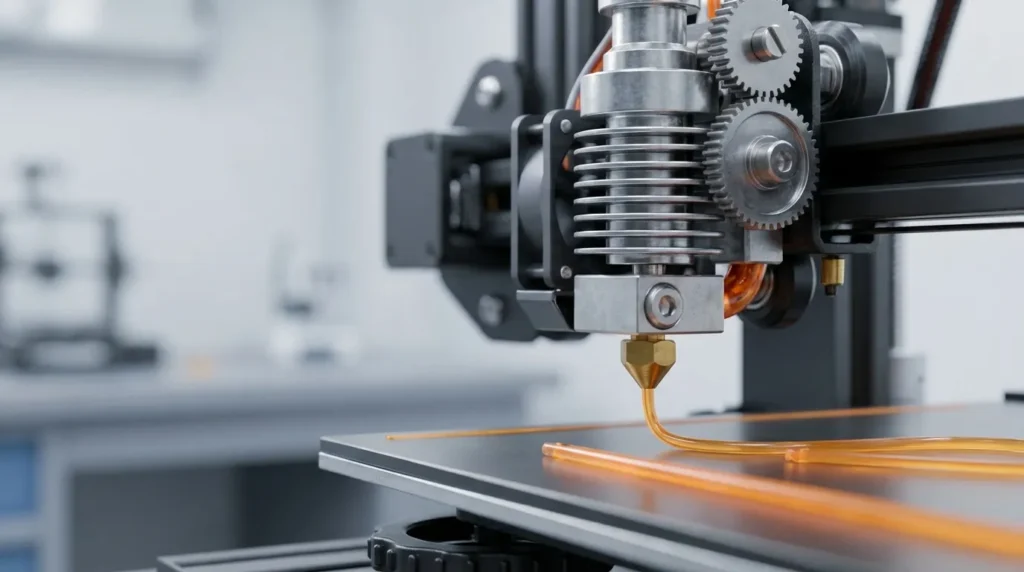
Understanding the Role of 3D Printer Nozzles: Types and Upgrades
In high-speed FDM printing, small parts can have big effects, and the nozzle is a clear example. It controls how plastic melts and flows before it lands on the part, shaping almost everything that comes after, even though many people don’t think much about it. Still, a lot of engineers and advanced users treat the nozzle like a simple consumable. I think that’s a mistake. That mindset often limits speed and accuracy, and over time it can quietly hurt repeatability. For industrial users in Australia, this usually matters even more. Long supply chains and high labour costs add pressure beyond the printer itself. Tight deadlines leave little room for failed prints, and when a job goes wrong, the cost often shows up fast, sometimes the same day. Therefore, understanding how 3D printer nozzles influence these outcomes is critical for consistent performance.
At the center of the extrusion system, 3D printer nozzles affect surface finish, layer bonding, dimensional accuracy, and overall print time at the same time, which is a lot to put on such a small part. They also decide which materials you can run safely, especially abrasive filaments or high‑temperature polymers that push hardware harder. So when people talk about nozzle upgrades, they’re often really talking about process upgrades. The right nozzle can allow higher flow rates, cleaner detail, and often a longer service life with fewer swaps.
This article explains how 3D printer nozzles work and covers the main types used in industrial FDM. It also points out signs that an upgrade makes sense, things you’ve probably already noticed. We look at flow limits, materials, geometry, and real production use cases, all grounded in day‑to‑day printing.
Why 3D Printer Nozzles Matter More Than You Think
Speed gets most of the attention, but it’s rarely the real limit anymore. Modern CoreXY and gantry machines can usually move fast and hit their marks without much trouble, which is great. The more common slowdown is quieter: how much melted plastic the nozzle can push each second. That limit, often called volumetric flow rate, usually decides how fast a print can actually run. When it’s low, the printer has to slow way down. Push it too far, and you start seeing rough surfaces and weaker layer bonds, which often leads to early failures many people have run into before.
This is also why nozzles are getting more attention lately. The global market for 3D printer nozzles is growing at over 12 percent per year, along with rising industrial FDM use. In real life, many companies aren’t printing eye‑catching demos. They’re making jigs and fixtures that print for hours or even days. In that kind of work, reliability usually matters more than top speed, almost every time.
| Metric | Value | Timeframe |
|---|---|---|
| Global nozzle market size | USD 1.02 billion | 2023 |
| Projected nozzle market size | USD 2.96 billion | 2032 |
| Industrial FDM market growth | ~15% CAGR | 2026, 2035 |
From a technical view, nozzle design shapes how heat moves into the filament and how pressure and flow behave at the tip. These details may sound small, but they often aren’t. Even a small change in shape or material can double usable flow. That’s why, in my view, swapping a nozzle can unlock more real‑world speed than upgrading motors or belts. It’s a small change, and you usually feel the difference right away.
Common Types of 3D Printer Nozzles Used in Industry
3D printer nozzles aren’t all the same, and that becomes clear pretty quickly. Each type balances price, heat handling, and wear in its own way, and those trade‑offs often explain where problems begin. Some nozzles work very well for one job, while others accept small compromises. Knowing these trade‑offs can help avoid setups that cause issues later. In real use, it often comes down to cost versus how long the nozzle will last. There’s usually an option available, even when it’s not obvious at first.
Brass nozzles are still very common, and that’s easy to understand. They move heat well and usually give smooth, steady extrusion. With PLA or PETG, they tend to run without trouble, which is why many users keep using them. Issues appear with abrasive filaments. Glass‑filled or carbon‑fibre materials can wear brass out in just a few days.
Hardened steel nozzles solve that wear problem. They last much longer with abrasive filaments and keep their shape over time. The downside is poorer heat transfer, which can limit flow unless temperatures are increased. Slower prints handle this fine, but faster jobs can reach those limits.
| Nozzle Type | Strength | Limitation |
|---|---|---|
| Brass | Great heat transfer | Wears quickly |
| Hardened steel | High wear resistance | Lower flow |
| Ruby-tipped | Extreme durability | High cost |
Ruby‑tipped and coated nozzles take durability even further. They hold a steady diameter for thousands of hours, which helps keep print accuracy predictable. That’s why many production settings now treat them as standard equipment instead of optional upgrades.
Nozzle Diameter and Geometry with Flow Rate Explained
Diameter gets a lot of attention, but it rarely tells the whole story. A wider opening does increase flow, that’s true, but it often softens fine detail, which you’ll usually notice first on small features. Internal geometry matters too, in my view, and it often gets ignored. Modern high‑flow 3D printer nozzles change how filament melts as it moves through the nozzle, and that change tends to affect real‑world performance more than many people expect.
Under ideal conditions, standard 0.4 mm nozzles usually reach usable flow rates of about 20 to 30 cubic millimetres per second. Push past that and pressure climbs fast, which often leads to uneven extrusion. High‑flow designs handle this in another way, using split melt channels or longer heat paths. Both add surface area, so the filament heats more evenly as it travels, which usually leads to steadier results.
| Configuration | Typical Flow Rate | Use Case |
|---|---|---|
| Standard 0.4 mm | ~30 mm³/s | General printing |
| Hardened steel | 15, 20 mm³/s | Abrasive filaments |
| High-flow nozzle | 24, 40 mm³/s | High-speed production |
That’s why engineers often pick high‑flow nozzle upgrades instead of just increasing diameter. Surface detail stays mostly intact, print speed improves, and back pressure on the extruder drops, helping keep extrusion more stable during long prints, especially on complex parts.
When 3D Printer Nozzle Upgrades Make Sense in Real Production
Speed records get lots of attention, but nozzle upgrades usually pay off by solving everyday production issues. Tooling and fixtures are a good example. These parts are often large and printed thick to stay stiff, and there’s usually no easy way around that. With a standard nozzle, prints like this can drag on overnight. A high‑flow nozzle can shave hours off a single run, which matters when these parts are blocking the rest of the work.
The same thing happens with abrasive engineering plastics. Carbon‑fibre nylon is a popular pick for stiff tooling, and for good reason. It’s tough, but running it through unhardened or uncoated nozzles slowly wears the opening. That wear can cause loose fits and wasted parts. I think a one‑time upgrade often saves weeks of rework later.
What about doing motion upgrades first? Many teams push faster settings and keep the same nozzle. That mismatch often leads to under‑extrusion and weak layer bonding. The nozzle has to keep up with what the machine is asked to do, especially at higher speeds.
Advanced Considerations for Industrial FDM Systems
The most noticeable problems usually appear on the print surface first. In advanced setups, nozzle choice is closely tied to thermal management and firmware designed around the extrusion system. Printers running Klipper often use higher acceleration and speed, which can create sharper pressure changes inside the nozzle, something that’s hard to miss. These changes are real, and steady flow becomes very important at those speeds. When flow isn’t consistent, defects show up almost right away.
IDEX and dual extrusion systems add another layer to think about. Using the same nozzle type on both toolheads usually helps reduce calibration drift. In production work, even small diameter differences can show up as seams between materials, especially along shared edges.
Large-format printers benefit as well. Longer print times make reliable, steady-flow nozzles helpful for unattended overnight runs, like a multi-hour enclosure panel finishing cleanly by morning.
How to Choose the Right Nozzle Upgrade for Your Application
A good place to start is usually the job itself, not the hardware. Ask what’s actually limiting your current prints: speed, wear, surface finish, or repeatability. These questions sound simple, but they often point you in the right direction. If speed is the main issue, high‑flow nozzle upgrades are often the first option to examine. When wear starts to show, hardened or coated 3D printer nozzles usually make more sense. This keeps changes based on real needs, not guesswork or swapping parts just to try something new.
You’ll also find that measuring results helps clear things up. Track print time and part accuracy before and after making a change. Many teams are surprised by how much improvement can come from a single nozzle swap, and it usually becomes clear pretty quickly.
Over time, it’s helpful to treat nozzles as process components instead of throwaway items. Keeping spares on hand, standardising nozzle types across machines when possible, and logging usage hours as part of normal work is often easier than expected, and the benefits add up over time.
Putting 3D Printer Nozzle Knowledge Into Practice
3D printer nozzles do more than push melted plastic through a tiny opening. They quietly affect how smoothly a job runs, how dependable a machine feels day to day, and what finished parts look like, including layer lines and surface finish. These details seem minor, but they add up quickly, especially on busy machines. For industrial users, the right nozzle can allow higher speeds without losing accuracy by keeping flow steady at higher output. Over long production runs, it also helps stop dimensions from slowly drifting, which can cause real problems.
Once nozzle types, materials, and geometry are clear, upgrade decisions usually get easier. You stop chasing every new feature (often a relief) and focus on flow behavior, wear resistance, and consistency, which matter most on long prints. For high-speed systems or abrasive filaments, a nozzle upgrade is often the quickest improvement. Start small, test one change at a time, then standardize what works, like using one proven nozzle across the whole fleet.
