
Table of Contents
Understanding 3D Printing Nozzles: Types, Uses, and Upgrades
When aiming for top-quality prints from an FDM 3D printer, the 3D printing nozzles are often easy to overlook. It’s tiny enough to forget about, yet it can make a big difference in how a job turns out. For industrial engineers, manufacturing specialists, technical trainers, and seasoned hobbyists, this small part isn’t just metal, it’s where speed, accuracy, material options, and consistent results all meet.
Pick the wrong one and you might waste hours and filament on failed prints. Pick the right one and your process can feel smoother, faster, and less stressful. We’ll look at different nozzle types, what they’re good at, and how a smart upgrade can improve everyday projects. Whether you’re prototyping, making tooling, or producing detailed pieces in Australia, knowing your 3D printing nozzles’ strengths can give your work a clear advantage.
Why 3D Printing Nozzles Matter in High-Precision FDM Printing
Before any filament reaches your print bed, it passes through the nozzle, that small part doing a surprisingly big job. It controls how quickly material is pushed out, affects how sharp the fine details look, and handles tough materials like abrasive composites (carbon fiber blends being a common example). In many industrial setups, picking the right nozzle can mean faster production, fewer unexpected pauses, and prints that stay consistent. Choose the wrong one, and you might end up with warped shapes, rough surfaces, or even whole batches that have to be scrapped. A smart choice is usually one that spreads heat evenly, avoids clogs over time, and keeps layers sticking together from start to finish.
The Palette 300 isn’t about incremental improvement, it’s about removing the long-standing barriers of multi-color, multi-material 3D printing.
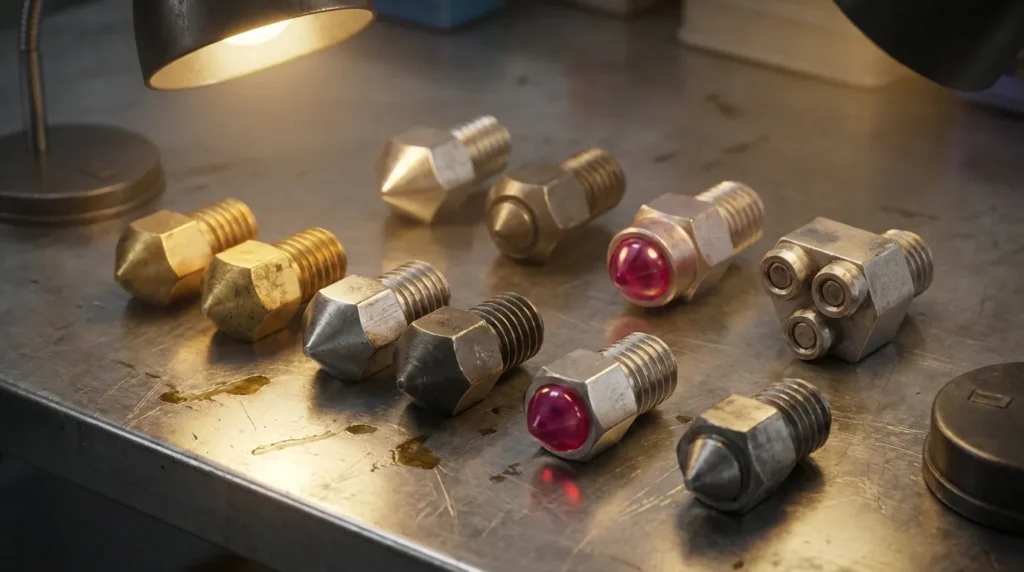
Take hardened steel nozzles, they can handle carbon fiber-filled filaments without wearing down after just a few prints. Brass nozzles are great at conducting heat, giving PLA parts a smooth, shiny finish when the temperature is set just right. Stainless steel’s clean and rust-proof qualities make it a favorite for medical or food-safe prints. Tungsten carbide is valued in aerospace for keeping accuracy and reliability even after hundreds of hours of heavy use. The tip’s shape makes a difference too: conical tips often keep filament flowing smoothly, while flat tips can bond layers more tightly, helpful for challenging materials. It’s surprising how this one small part can decide whether a print turns out exactly as planned.
| Nozzle Type | Material | Best For |
|---|---|---|
| Brass | Brass alloy | PLA, ABS, PETG |
| Hardened Steel | Tool steel | Carbon fiber, glass-filled composites |
| Stainless Steel | Stainless steel | Food-safe, medical |
| Tungsten Carbide | Tungsten carbide | Extreme durability |
| Ruby-Tipped | Brass + synthetic ruby | Ultra-abrasive filaments |
| Multi-Nozzle Arrays | Mixed materials | Multi-material and multi-color builds |
Choosing the Right 3D Printing Nozzles for Your Application
Picking a nozzle with the right diameter is just one piece of the puzzle, how well its design works for the job can make a big difference to the final print. It’s worth looking at things like the material it’s made from, the shape inside, and the surface finish, then matching those to your filament and project needs. How well it conducts heat, how resistant it is to wear, how smooth the bore is, and even the angle of the taper all affect how easily the filament flows. A smooth, polished bore often means the filament moves through with less drag, so the extruder doesn’t have to push as hard, and you’re less likely to get tiny snags that can spoil composite prints.
For projects that need fine detail, smaller nozzles, around 0.2 or 0.4 mm, are a common choice. Brass and stainless steel versions do well here, producing sharp edges on miniature architectural models, delicate dental forms, or small figurines. For bigger builds or high-volume jobs, larger nozzles such as 0.6 mm or even 1.0 mm in hardened steel or tungsten carbide push through more filament faster. These tougher materials handle abrasive filaments without wearing down quickly, making them good for strong jigs, sturdy casings, or large mechanical parts.
In Australian manufacturing, keeping production quick and reliable is a priority. Hardened steel and ruby-tipped nozzles are common because they keep their shape longer, meaning fewer replacements. Ruby tips especially hold up well against tough filaments like glow-in-the-dark PLA or blends with metal powder.
The 3D Printing Industry’s 2025 Executive Survey points to future nozzles that could switch between materials easily, clean themselves, and adjust heat on the fly, using built-in thermal sensors that respond instantly to changes in workshop temperature. For more detailed insights, see Maximizing Your 3D Printing Potential: A Comprehensive Guide to 3D Printing Nozzles.
Multi-Nozzle Systems and Advanced 3D Printing Nozzles Capabilities
Multi-nozzle setups, like the AtomForm Palette 300, are shaking up how 3D printing gets done. The old routine of stopping a print just to swap filament (something most users found annoying) is fading away. These machines can switch between colors or materials almost instantly, right in the middle of a job. That’s a big help for builds where each section needs its own qualities, like a tough, load-bearing shell joined perfectly with soft, flexible gaskets, all printed in one go.
For industrial prototyping, the benefits are easy to see: less wasted material, faster turnaround, and often a multi-color, finely detailed model without any mid-print interruptions. A standout trick is the ability to print conductive paths inside the object, so electronics can be built right into it instead of added later.
Of course, it’s not completely effortless. Accuracy is key, nozzle offsets must be adjusted to tiny fractions of a millimeter, or you risk misaligned layers and weaker joins. Calibration can take patience, and upkeep is more demanding than with single-nozzle printers. Still, for production work, the time savings often make up for the extra effort. Some teams say they finish multi-material jobs up to 40% faster compared to using just one nozzle.
Wondering about pairing these with IDEX systems? Our Guide to Dual Extrusion explains how, and with smart slicing software, swaps and purges happen automatically, no hands-on work needed.
Balancing Speed and Precision with 3D Printing Nozzles
Speed and precision often pull in opposite directions, and in 3D printing you notice that trade-off pretty quickly. A bigger nozzle pushes out material faster, but those small grooves and sharp corners tend to lose their crispness, frustrating if you care about clean edges. A smaller nozzle can produce beautiful, detailed results, though printing can feel slow. The reason is simple: wider beads stick layers together more strongly but round off edges, while thinner beads capture sharp lines, though if settings aren’t right, the layers might not hold as well.
In many industrial setups, nozzle size changes depending on the stage of the project. Early prototypes or large, chunky parts often use big nozzles to get ideas made quickly. Later, smaller nozzles handle fine gear teeth or precise curves for aerospace parts or medical devices. Early runs focus on testing function; later runs aim for accuracy so parts fit and perform correctly.
| Nozzle Diameter | Best Use | Trade-Off |
|---|---|---|
| 0.2 mm | Ultra-fine detail | Slow speed |
| 0.4 mm | Balanced detail and speed | Moderate speed |
| 0.6 mm | Fast production | Lower detail |
| 1.0 mm | Large-scale parts | Minimal detail |
Planning those swaps ahead makes balancing speed and detail easier. Some advanced printers can even switch nozzles mid-print, speeding through bulk sections while still getting sharp detail in the same job.
Upgrading Your 3D Printing Nozzles for Industrial Reliability
Swapping out a nozzle might seem like a small change, but it can noticeably boost a production line’s speed and consistency. When abrasive filaments are in the mix, hardened steel, tungsten carbide, ruby-tipped, or coated nozzles are often worth the spend, since they’re built to handle heavy wear while keeping prints clean and precise. In one long test run, tungsten carbide nozzles kept their bore size nearly unchanged after more than 500 hours of continuous carbon fiber printing, clear proof they can take the strain.
For jobs in food or medical production, stainless steel is often the top choice. It meets strict safety rules, fights off rust easily, and can be sterilized again and again without losing accuracy. Brass still earns a spot, especially for softer, non-abrasive plastics where keeping costs low and prints neat matters more than extreme toughness.
Alongside material choice, think about multi-nozzle setups, built-in cleaning features, or purge stations to keep work flowing. Ultrasonic baths, often skipped, can quickly remove buildup and get extrusion running smoothly again. For more advanced methods, see Mastering Multi-Material 3D Printing with IDEX and Klipper and Dual Extrusion 3D Printer Techniques for Multi-Material Printing, both hands-on guides for moving past basic prototypes.
Your Path Forward in 3D Printing Nozzles Optimization
Knowing the strengths and limits of different 3D printing nozzles, and figuring out when an upgrade makes sense, can be the moment when your FDM 3D printer starts performing much better. For Australian industrial engineers and manufacturing specialists, these improvements can mean quicker production runs, cleaner details on complex parts, and far fewer stops caused by clogs mid-print. That added reliability also makes it easier to try new materials or advanced printing techniques without feeling like each test might ruin your output quality.
It’s worth watching closely how your current nozzle handles the materials you use most. A good way to check is by looking at wear resistance, heat tolerance, and whether filament flow stays steady under different conditions. Think about whether it still meets the compliance standards your industry needs, whether that’s ISO rules or food-grade approval. After that, look at upgrades that fit your work: hardened steel for heavy, high-volume tasks, stainless steel for places where rust is a risk, or multiple nozzles when you need both speed and flexibility.
The right nozzle setup can make your printer far more dependable. In industries like aerospace, automotive, medical, or consumer goods, that extra precision often means smoother projects and fewer production problems.
