
Table of Contents
The Rise of Hybrid Manufacturing: Integrating 3D Printing and CNC
Manufacturing is changing fast, and you can feel the pressure on the shop floor. Engineers often want things done quickly, while managers and teams usually focus on accuracy, less waste, and fewer delays. That push and pull is why hybrid manufacturing is getting real interest. It’s not just another trendy term. It brings 3D printing and CNC machining into one connected workflow that works in real shops, not just on paper. There’s no longer a forced choice between additive or subtractive methods. Instead, 3D printing handles complex shapes, while CNC machining handles tight tolerances, which matches how real jobs are usually done. That flexibility matters most when timelines are tight and work can’t slow down.
Hybrid manufacturing also isn’t new or experimental. It’s already used for prototyping, tooling, and often for production parts. For Australian manufacturers, this hits close to home. High labour costs, strained supply chains, and short deadlines add pressure quickly. Using FDM printing with CNC finishing can reduce that pressure, with less rework, better control, and faster decisions managers tend to want.
This article explains what hybrid manufacturing actually means and how 3D printing and CNC systems work together day to day. No fluff. It also looks at why adoption is growing, using real performance data, practical workflows, common mistakes, and future trends, all based on how shops really operate.
What Hybrid Manufacturing Really Means in Practice
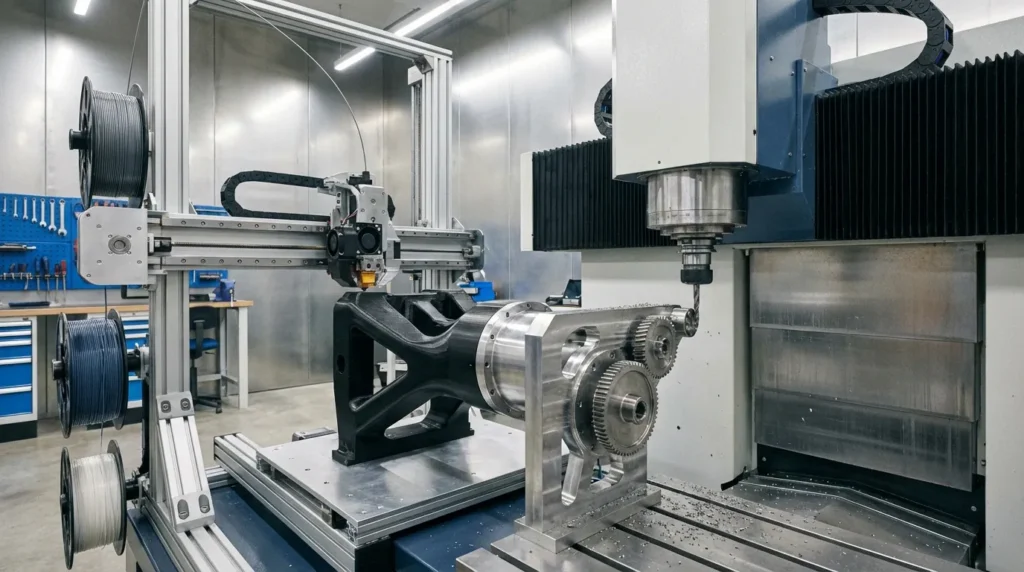
Hybrid manufacturing mixes additive and subtractive processes into one practical workflow. In simple terms, parts are printed first and then machined, and it is usually as straightforward as it sounds. 3D printing quickly creates the main shape and can handle complex geometry without much trouble. CNC machining then comes in to finish only the areas that really need tight tolerances, such as mating faces or critical holes. It is a simple idea, but often an effective one, and, in my view, a sensible way to approach modern part making.
Why This Approach Works Well
This approach works well because each method focuses on what it does best. FDM 3D printing is usually fast, flexible, and well suited to producing complex forms with little waste, which most workshops appreciate. CNC machining focuses on accuracy, surface finish, and repeatability from one part to the next. Different tools suit different jobs. When they are combined with care, shops avoid forcing one process to cover the other’s weak points, which often cuts down on delays and frustration. That balance usually leads to more dependable results and better overall part quality.
Growth and Cost Control in Hybrid Manufacturing
To control costs and shorten lead times, many manufacturers are moving toward hybrid workflows. Market data shows steady growth, often linked to higher demand for customization and quicker product cycles. There is also a push to make parts closer to where they are needed, which makes local manufacturing more attractive.
| Metric | Value | Timeframe |
|---|---|---|
| Hybrid manufacturing market size | USD 3.1 billion | 2025 |
| Projected market size | USD 25.5 billion | 2035 |
| Estimated CAGR | 23.5% | 2025, 2035 |
In day-to-day use, hybrid manufacturing does not always mean a single all-in-one machine. Many Australian workshops run high-precision FDM printers alongside CNC mills, which is more common than people might expect. The main factor is planning: printing near-net shapes first, then machining only the features that matter most. This keeps equipment costs lower while still delivering most of the advantages.
This approach works well for jigs, fixtures, enclosures, molds, and repair parts. It also fits industrial FDM systems built for speed and accuracy, where dimensional stability and repeatable results across multiple builds matter. In these situations, consistency really does make a difference.
How 3D Printing and CNC Work Together Step by Step
A solid hybrid workflow usually starts at the design stage. Engineers plan parts with both 3D printing and CNC machining in mind from day one, which helps avoid frustration later. Large volumes and complex internal shapes are usually printed first. Flat faces, tight tolerances, and accurate holes are left for CNC, often on areas tools can reach easily. This approach works well in real projects. Planning this way reduces rework and helps make sure cutting tools can reach the features that matter, instead of running into awkward collisions. Fewer surprises halfway through is something most teams welcome.
Typical Hybrid Manufacturing Workflow
So what does this look like in practice? A helpful way to think about the process is as layered instead of strictly step-by-step. In many cases, it follows a pattern like this:
- Design the part with extra material in areas that will be machined
- Print the overall shape using FDM, often favoring speed over surface finish
- Secure the printed part in a fixture, usually a simple custom jig
- CNC machine the key features
- Inspect the part and handle light finishing, such as sanding or cleanup
Key Advantages of Hybrid Manufacturing
The biggest advantage is time savings. In real projects, tooling that once took weeks has shipped in just days. Some manufacturers see lead times drop by more than 80%, especially for custom fixtures or small batch runs where fast turnaround matters early on.
| Process | Traditional Workflow | Hybrid Workflow |
|---|---|---|
| Material waste | High | Low |
| Lead time | 6, 10 weeks | 2, 3 days |
| Design freedom | Limited | High |
| Final tolerance | High | High |
With FDM printing, stability and calibration usually matter more than raw speed. Machines with rigid frames, linear rails, and firmware like Klipper tend to produce more consistent parts. This consistency matters once CNC machining begins, because uneven layers or slight warping can quietly affect accuracy later.
On the CNC side, work often includes face milling, drilling, tapping, or pocket finishing as needed. Since most of the material is already in place, cutting time stays short, tool wear stays low, and setups are often limited to a single fixture. Many shops can fit this into existing CNC schedules without disrupting regular metal work.
Where Hybrid Manufacturing Delivers the Biggest Wins
Hybrid manufacturing proves its value in everyday industrial work, not just on paper. Across Australia, companies use it for aerospace tooling, mining fixtures, and many repair jobs in the energy sector, especially at sites with heavy maintenance demands. What stands out is how fast teams can work: printing rough shapes quickly, then machining the precise features that matter. When timelines get tight, this mix often gives teams an advantage that’s hard to overlook. In industries where delays quickly turn into lost revenue, that advantage often leads to clear, measurable results.
Material Efficiency and Waste Reduction
Waste reduction is another area where hybrid workflows often do well. Parts are printed close to their final shape, so much less material needs to be machined away later. This matters when using expensive engineering polymers or composite‑filled filaments common in industrial FDM systems. Less scrap usually means better control, and in many cases, lower material costs that are easy to see in the numbers.
| Benefit | Hybrid Manufacturing Impact |
|---|---|
| Material waste reduction | Up to 97% |
| Tooling lead time | Reduced to under 72 hours |
| Precision after CNC | Micron-level tolerances |
Repair and Reinforcement Applications
Repair and reinforcement are also common uses. Instead of throwing away worn parts, teams add material to damaged sections and machine everything back to the correct size. This approach is widely used for molds, dies, and custom brackets that take time or money to replace. Tools stay in use longer, and spare part inventories are usually easier to manage.
Problems can still come up. Poor thermal control during printing often causes warping and CNC alignment issues later on. Skipping calibration is another frequent issue when time is short. Fixturing is also easy to underestimate. Printed parts still need strong support during machining, no exceptions. Planning fixtures early often decides whether a hybrid job runs smoothly, or not.
Choosing the Right Equipment for Hybrid Workflows
Not every 3D printer fits a hybrid manufacturing setup, and that becomes clear pretty fast. Consumer-grade machines often produce uneven results from one part to the next. That’s usually fine for hobby projects but rarely works here. This kind of inconsistency tends to appear early, sometimes after only a few runs. Industrial FDM printers are designed to avoid this. They use sturdier frames, more reliable motion systems, and tighter control at high temperatures. These details often make a real difference once printed parts move into machining, especially during CNC finishing. There really aren’t many shortcuts in this space.
Key Features to Look For
One key factor is how the printer performs before machining even begins. The features that usually matter most include:
- Rigid metal frames
- Linear rails or other precision motion hardware
- Dual extrusion or IDEX options
- Enclosed build chambers
- Advanced firmware that allows deeper tuning and adjustment
IDEX systems, in particular, tend to make hybrid workflows easier. They often simplify soluble supports and multi-material prints, which cuts down on cleanup later. Cleaner parts coming off the printer usually mean less prep before CNC work, and surfaces are easier to reach without fighting stubborn supports.
CNC Considerations and Local Support
On the CNC side, smaller mills are often enough. Hybrid setups usually focus more on accuracy than heavy material removal, so many shops update machines they already have.
For Australian users, local support often matters more than specs on paper. Downtime adds up quickly. Easy access to nearby parts, upgrades, and reliable firmware support helps keep hybrid systems running smoothly during busy weeks. For more details on hybrid manufacturing standards and equipment options, visit Australian Manufacturing Forum.
Future Trends Shaping Hybrid Manufacturing
What stands out first isn’t flashy tech, but how much smoother hybrid manufacturing is becoming. Process consolidation drives a lot of this shift. More systems now manage printing and machining in a single setup, which usually makes daily work simpler. With fewer handoffs and less movement between machines, handling errors drop and alignment stays more consistent. This matters most for high‑precision or complex multi‑axis parts, where even small mistakes can cause real issues.
Software and Education Developments
Software is also doing more behind the scenes. Toolpaths are no longer locked in from start to finish. Many systems react to sensor feedback and adjust print settings or machining passes while the job runs. In practice, this leads to better accuracy and less scrap because problems appear sooner. It’s not flashy, but the gains add up over time.
Education is shifting along with the technology. Universities and technical schools now teach additive and subtractive methods together, giving graduates a clearer view of how hybrid systems work. Companies spend less time retraining, with fewer surprises.
Sustainability and Efficiency
Sustainability continues to guide decisions. Using less material often lowers costs and waste at the same time. In Australia, this supports local production and helps meet stricter environmental rules without extra effort.
High‑speed FDM brings it all together: parts print faster, machining starts sooner, and throughput improves in ways shops can clearly measure. For further insights into sustainable hybrid manufacturing practices, see CSIRO Manufacturing Research.
Putting Hybrid Manufacturing to Work
Hybrid manufacturing isn’t about replacing CNC or 3D printing. It usually works best when each method is used where it makes the most sense. Complex shapes that are hard to machine, especially internal features, are often better suited for printing. Surfaces that need tight tolerances and a clean finish can then be machined (simple, but effective). This mix helps teams get more from the equipment and skills they already have, while keeping workflows practical instead of overcomplicated.
Getting Started with Hybrid Manufacturing
What often makes the biggest difference early on? Starting with simple, low‑risk parts. Jigs or fixtures are a common first step because they’re forgiving, useful right away, and mistakes aren’t as costly. Calibration and repeatability tend to matter more than expected, since small errors can stack up quickly. Material quality matters too, especially when moisture control gets ignored. Planning machining steps early also helps, so last‑minute redesigns don’t slow things down.
For experienced teams, tooling, repairs, and short‑run production often bring quick wins. That’s where high‑precision FDM printers paired with CNC machines really show their value in real industrial work. Hybrid manufacturing is already changing how parts are made for Australian engineers and manufacturers, with speed, accuracy, and control you can see on real jobs.
