
Table of Contents
The Future of Multi-Material 3D Printing: Techniques and Applications
Multi‑material 3D printing isn’t a niche idea anymore. It’s becoming a core part of modern manufacturing, and that change happened pretty quickly (it kind of snuck up on us). For engineers and educators across Australia, this often brings both excitement and a few new challenges. As machines get faster and materials get better, FDM 3D printers can handle much more in everyday work. That usually raises expectations across teams. With more capability comes more pressure and more to learn, and you’ve probably felt that shift already.
Things weren’t always like this. Not long ago, most FDM systems printed just one material, which worked fine for basic prototypes. Simple days, if you ask me. Now the needs have changed. Manufacturers often want parts that mix strength and flexibility without compromise. They also expect soluble supports or built‑in seals that work for real production, not just test runs. Multi‑material 3D printing often meets these needs while helping keep costs in check, which matters during budget reviews.
This article looks at where multi‑material FDM printing is heading, with no fluff (which I find refreshing). It covers market growth, real Australian use cases, common pitfalls, and future trends. If speed and reliability shape your daily work, this guide should feel relevant and genuinely useful.
Why Multi-Material FDM Printing Is Growing So Fast
Multi-material printing is gaining traction because companies want parts that actually work in daily production, not just something to display in a demo. This change is practical. Recent industry data shows the global 3D printing market hit USD 16.16 billion in 2025 and is expected to more than double by 2030. FDM still makes up the largest slice, at over a third of the total market, which usually shows where teams feel most comfortable putting their money.
| Metric | Value | Year |
|---|---|---|
| Global 3D printing market size | USD 16.16 billion | 2025 |
| Projected market size | USD 35.79 billion | 2030 |
| FDM share of market | 36.7% | 2026 |
| Multi-material printer segment | USD 716.58 million | 2026 |
These numbers point to a clear reason. Many manufacturers are choosing these systems because multi-material printing cuts down assembly by merging parts into one build. A single print can often replace several machined or moulded parts, saving time and lowering the chance of mistakes. Fewer steps usually mean fewer production issues.
Material development matters too. Engineers can now mix rigid and flexible filaments or pair high-temperature plastics with soluble supports, which often works better in real-world use. This is especially helpful for tooling, jigs, fixtures, and end-use parts that go straight into products.
We’re finally moving past the ‘wow factor’ and into true, scalable adoption, largely because platforms like HP’s Multi Jet Fusion are proving that 3D printing is a volume manufacturing solution, delivering isotropic, end-use parts with the throughput businesses actually need to scale.
The quote talks about powder-based systems, but the same trend is easy to see in FDM. Novelty matters less now; most teams care more about steady output and printers that stay running day after day.
Core Techniques Powering Multi-Material FDM Systems
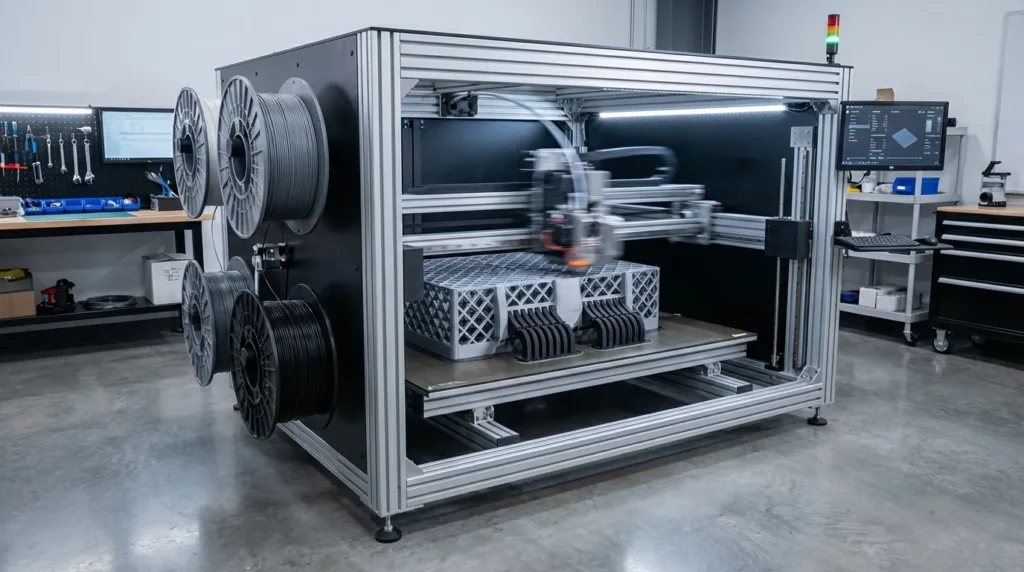
Modern FDM 3D printers use a handful of proven methods to print with more than one material, and each one has clear upsides and downsides. Dual extrusion is the most common option and has been around long enough that most of its quirks are familiar. You’ll often see this in IDEX setups, where each extruder moves on its own path. Keeping materials physically separate usually leads to cleaner tool changes, which users tend to notice right away. It also allows mirror printing and duplication modes, and in everyday use it often produces more consistent results without constant tweaking, making regular print jobs easier to manage.
Tool‑changing systems work in a different way. Instead of sharing a carriage, the printer swaps full toolheads during a print. Each toolhead is assigned to a single material, which often improves reliability and cuts down on purge waste. The whole process feels more controlled and predictable, especially on longer prints. That’s why industrial users often choose this setup for production runs that can last many hours.
Motion hardware also matters over time, since wear slowly adds up. CoreXY layouts with linear rails help keep speed and accuracy consistent across the build area, while rigid aluminium frames reduce flex during fast moves. When Klipper firmware is used, features like pressure advance, input shaping, and tuned temperature control tend to work together more smoothly.
Material handling is another detail that’s easy to miss until something goes wrong. Dry boxes, filament sensors, and regular calibration help catch small problems early. In Australian workshops dealing with heat and humidity, these steps often make the difference between a clean finish and a wasted afternoon.
Real-World Applications in Industrial and Educational Settings
On busy shop floors, it’s usually the small, everyday wins that matter most. Multi-material FDM printing shows its value in hands-on work, especially for manufacturing tooling. Engineers can print jigs with stiff frames and softer contact areas in a single job. This often helps protect finished parts and makes tools nicer to handle. These gains may seem small, but they add up during day-to-day production.
Functional prototyping is another place where the benefits are easy to spot. Instead of waiting for moulds, designers can test snap fits or overmoulded grips early on. This usually cuts down on back-and-forth and shortens design cycles. Teams can avoid expensive late changes, which are often harder and more frustrating to fix. Less waiting also tends to mean fewer surprises later.
In education and R&D, multi-material systems help teach design-for-manufacture skills in a practical way. Students can see how material choices affect strength and wear, and handling real parts often sticks better than theory alone.
In the Americas, established manufacturing hubs in North America and strategic investment incentives have accelerated the assimilation of multi-material 3D printing into both prototyping and end-use production workflows.
Australia follows a similar pattern. Distributed manufacturing is common across mining, agriculture, and defence. Because local, flexible production matters, multi-material FDM often helps reduce dependence on long supply chains. Distance usually shapes how choices are made.
Some common issues still come up. Poor calibration between materials can weaken bonds, and the wrong support interface can damage surface finish. With careful setup and testing, these problems are usually easy to avoid.
Advanced Materials and Thermal Control Challenges
Problems often appear as print speed goes up. Faster speeds push more material through the nozzle and create extra heat inside the part. Without good control, this usually weakens how layers stick together. Newer firmware helps by adjusting extrusion as it prints, rather than using fixed settings that need constant attention.
As materials get better, printers have to keep up. High‑performance filaments like carbon fibre nylon and PEKK need steady temperatures and well‑managed cooling, with very little room for mistakes. This becomes harder in mixed setups, where these materials run alongside lower‑temperature plastics in the same machine.
That’s where enclosures help. They keep chamber temperatures steady and often cut down warping during long or overnight prints. Many industrial FDM systems now include active heating and filtered airflow, and skipping shortcuts here usually pays off.
Engineers benefit from planning material pairings early. Some plastics simply don’t bond well, so small test prints can save time and money. Professional machines handle heat and long runs well. Hobby printers can get close, but they need careful tuning and patience. Worth it, in my view.
Implementing Multi-Material Printing in Your Workflow
A useful place to start is being clear about the goal. Are you setting up for prototyping, or for end‑use parts? These usually call for different approaches, and being honest about what you actually need can save time later, along with a few unnecessary headaches. Saying this early helps, especially when more than one person is involved.
Next comes hardware, and there’s rarely a single answer that fits everyone. IDEX systems often work well for soluble supports and dual‑colour prints. Tool‑changers tend to suit longer runs with regular material swaps, especially when jobs change from day to day. In real use, motion quality and frame stiffness often matter more than the top speed listed on a spec sheet.
Software is just as important. A slicer should manage material changes smoothly, without strange pauses or errors. Firmware like Klipper adds monitoring and control, which usually leads to less downtime and steadier results.
Training is often overlooked. When operators know how to handle drying and calibration, many problems never show up. A few simple habits can make a big difference.
For Australian businesses, local support also matters. Easy access to spare parts and practical advice lowers risk. This is where specialist providers can be especially helpful, assisting with setup, fixing issues, and ongoing support while real jobs are running.
Putting the Future to Work Today
What’s most interesting is how normal multi-material 3D printing now feels. Faster FDM printers, smarter controls, and better materials have quietly changed how parts are designed and made, and people are noticing. What once felt experimental now feels reliable and repeatable. It’s part of everyday work, with results teams can plan for and trust.
For engineers and educators, the opportunity is easy to see. Multi-material printing often cuts development time and reduces assembly steps. This can make room for designs that used to feel too complex or too costly to pursue. With fewer trade-offs, teams usually get more freedom while still meeting performance needs.
So where do you begin? Many teams start by reviewing current workflows and finding places where multiple materials can replace manual steps. Small changes add up. Another smart move is investing early in calibration and training, and choosing systems built for accuracy, with speed as a nice extra.
Across Australia, adoption is growing, and teams that move early often gain an edge. Multi-material FDM is no longer just a feature. It’s becoming a practical requirement, with tools that are ready to use today.
