
Table of Contents
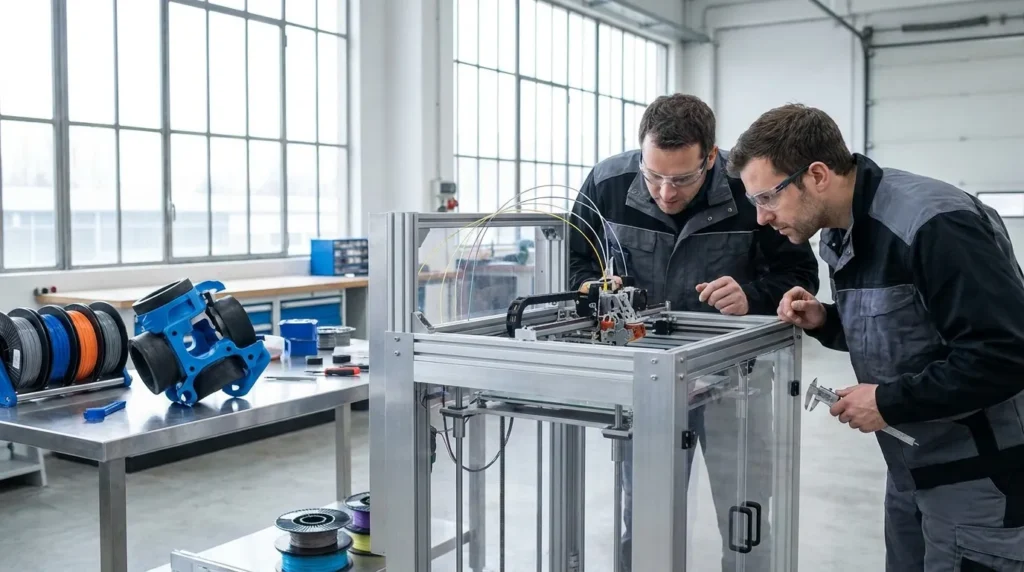
Navigating Multi-Material 3D Printing: Techniques and Best Practices
Multi-material 3D printing used to feel like a nice extra. Now it’s turning into a real production tool. For engineers and manufacturing teams, the benefit goes far beyond colour. Function is the main reason it matters. It lets teams combine rigid and flexible sections, use soluble supports for hard-to-reach geometry, cut assembly work in a single build, and make parts that do more straight off the printer, which is where the real value is.
That becomes even more important in Australia. Labour costs are high, and downtime can get expensive very fast. A well-set-up multi-material workflow can cut lead times for prototypes, jigs, fixtures, and low-volume end-use parts. It can also help repeatability, which matters a lot on the factory floor, especially compared with hand-built assemblies.
Still, multi-material printing is far from simple. Material pairing, moisture control, purge strategy, nozzle offsets, and printer architecture all affect the final result. This guide covers practical 3D printing techniques for multi-material FDM, explains where each method fits best, and shares useful proven methods for speed, accuracy, and reliability. If you’re weighing up single-nozzle switching, dual extrusion, and IDEX systems, this article will help you make a smarter choice.
Why multi-material printing matters now
The market signals are clear. Additive manufacturing is growing fast, and FDM still makes up a big share of that growth. That points to where machine makers, material suppliers, and software teams are putting their effort. For industrial users, it shows up in better hardware, more stable slicers, and, over time, a wider range of materials (which is easy to spot on the shop floor).
| Metric | Figure | Year |
|---|---|---|
| 3D Printing Materials and Equipment Market | USD 2.98 billion | 2025 |
| Global 3D Printing Market | USD 40.60 billion | 2025 |
| FDM 3D Printer Market | USD 3.07 billion | 2026 |
| Australia 3D printing market size | USD 672.3 million | 2025 |
| Australia market CAGR | 17.05% | 2026-2034 |
Those figures help explain why multi-material printing is moving from a niche use into regular production. Industry reporting also points to faster switching, less purge waste, easier material handling, and simpler setup in newer systems. The user experience is getting better in a way that feels clear.
It also helps to separate multi-colour from multi-material work. Multi-colour is about appearance. Multi-material is about function. That can mean pairing support and build polymers, adding soft-touch surfaces, or making one part that would otherwise need fasteners or glue.
From an end-user perspective, the total lead-time can be further reduced by using multi-material printing. Especially when it comes to assemblies, which typically require joining operations such as welding, bolting, gluing, etc.
For manufacturing teams, that is the real business case: fewer steps, less handling, and faster turnaround.
Choosing the right printer architecture
Multi-material systems work very differently from each other, and the differences are pretty big. The hardware you choose affects print speed, waste, material separation, and maintenance, which covers most of the practical side. So this is one 3D printing method worth getting right from the start.
Single-nozzle filament switching
This is the cheapest option, which is a nice bonus. One hot end handles multiple materials by switching filament, and it works well for color changes and simple support prints.
The trade-off is pretty clear: it makes more purge waste, takes longer during material swaps, and raises the chance of cross-contamination.
Dual nozzle and IDEX
Dual extrusion gives each material its own nozzle, while IDEX goes a step further by putting each nozzle on its own separate carriage, which is pretty handy. That setup is especially useful for engineering materials, soluble supports, cleaner separation between filled and unfilled filaments, and less purging through one nozzle.
For many professional FDM users, IDEX hits a practical sweet spot. It handles complex supports, lowers contamination risk, and fits high-precision production support tasks well, which can save hassle.
Toolchangers and advanced systems
Toolchangers make sense when a job needs lots of materials, less idle mass on the printhead, and tighter process control, which can make a real difference. They also tend to fit industrial environments better than consumer-style material switching systems.
For mostly visual prototypes, switching systems can be enough. But for clean soluble supports, carbon-fibre blends, or reliable production tooling, dual extrusion or IDEX is often a better fit, and toolchanging can be too, depending on what’s being made.
Material compatibility is the real engineering challenge
A multi-material part only works if its materials work well together. Many failed jobs start there, and they can go wrong fast. People often look at the printer first, but the bigger issue is whether both materials can handle the same thermal and mechanical process range. That is the real test.
Start with these checks:
Temperature overlap
Both materials need the same nozzle, bed, and chamber settings. If one needs much more heat to print, the lower-temp material can break down or deform, which is exactly the problem to avoid.
Adhesion between materials
Some materials bond well, while others barely stick. Rigid and flexible pairs can work too, which is useful, but they need tested matches and adjusted interface settings.
Moisture behaviour
This matters most for soluble supports like PVA and BVOH. Damp filament can cause stringing, blobs, poor layer bonding, and weak support interfaces, which gets frustrating fast. In professional workflows, dry boxes, sealed storage, and active filament drying are part of the process.
Thermal expansion mismatch
If one polymer shrinks more than the other, the part can warp, split, or curl where the materials meet, which can be a real headache. It’s a real issue.
A newer research direction called blended FDM is trying to help by creating smoother transitions between materials instead of sharp boundaries, rather than abrupt material changes.
b-FDM-enabled material gradient programming can facilitate seamless multi material 3D printing and promote robust bonding between different materials with mechanically invisible material interfaces.
It’s still a growing area, but the idea already matters. Better interfaces can lead to stronger parts and more useful industrial applications, which you can see in real-world use.
Best practices for high-speed, high-precision multi-material FDM
High-speed systems can make a real difference in throughput, especially for teams that count on overnight jobs. Recent industry commentary even points to FDM speeds nearing 500 mm/s on advanced platforms. But at those speeds, bad settings get expensive fast. A mistake at high speed is still a mistake, just finished sooner.
Reliable multi-material printing depends on a careful setup process, and shortcuts usually show up in the final part.
| Best Practice | Why It Matters | Shop-Floor Impact |
|---|---|---|
| Dry filament before printing | Prevents bubbles, stringing, and weak layers | Higher first-pass success |
| Tune purge volumes by material pair | Reduces contamination and waste | Cleaner interfaces, lower cost |
| Verify nozzle or tool offsets | Keeps dual-material layers aligned | Better dimensional accuracy |
| Create slicer profiles per material pair | Different pairs need different flow and cooling | More repeatable jobs |
| Use nozzle wipe routines | Reduces ooze and colour carryover | Cleaner surfaces |
The table makes the main point clear: reliability comes from process control, not guesswork. Skilled operators adjust pressure advance and check retraction for each material. They also test flow for each nozzle on its own. On IDEX machines, parked nozzle ooze needs close attention. On switching systems, purge towers have to be big enough to fully clean the melt zone, without creating so much waste that material cost becomes a problem.
In schools, labs, and production teams, standard operating procedures help too, even the basic ones. Label material pairs. Lock slicer presets. If a print works, record that profile so the same result is easier to repeat later.
Real-world use cases and common mistakes to avoid
The best multi-material printing jobs are practical, not just polished demos. Think of jigs with soft contact pads, fixtures with ESD-safe sections, ducting with soluble internal supports, or one-piece prototypes that mix hard and flexible features. These are the kinds of jobs teams actually need, and they save labour by cutting out extra assembly and finishing steps.
In the Australian market, providers like Raven 3D Tech match that demand well. Their high-speed, high-precision FDM systems and IDEX capability work well for overnight tooling, repeatable prototyping, and production support parts, especially when timelines are tight. That makes them a good local fit.
Even so, many teams still run into the same mistakes:
Using cosmetic workflows for functional jobs
A setup that works for multi-color PLA can fail fast, and with engineering polymers or soluble supports, it usually just won’t hold up.
Ignoring maintenance
On long runs, nozzle wear, offset drift, dirty wipe stations, and poor thermal control all hurt print quality (it adds up). Small issues can have a big effect (and you’ll notice).
Underestimating total cost
The printer price is only one part of the picture. Purge waste, support material, downtime, and failed prints can end up costing more over time than the difference in machine price (it adds up fast).
For stable output, maintenance and calibration need to be part of production, not just occasional cleanup (that’s the real change).
Where the technology is heading
Multi-material printing is moving beyond extra colours and toward smarter, more useful material combinations. Industry trends show growing demand for rigid and flexible parts in the same build, filled materials paired with dedicated supports, cleaner separation between engineering polymers, and a broader shift toward additive production that can grow (which is where things get practical).
We’re finally moving past the ‘wow factor’ and into true, scalable adoption, largely because platforms like HP’s Multi Jet Fusion are proving that 3D printing is a volume manufacturing solution, delivering isotropic, end-use parts with the throughput businesses actually need to scale.
That quote is about a different additive process, but the main point still fits FDM. Buyers now care more about throughput, repeatability, and real end-use value than novelty, and that change is pretty obvious.
For FDM, this points to better automation, stronger slicer logic, more reliable material handling, and better thermal control for continuous printing. Over time, it also suggests advanced areas like functionally graded materials may move from research into practical use and start showing up in real production settings.
Putting multi-material printing to work
Better multi-material printing starts with the workflow, not the marketing label. Start by locking in the real goal: soluble support removal, fewer assemblies, a soft-touch feature, or a stronger production fixture. From there, choose the printer design and materials that fit that job, because that match matters more than whatever label is attached to the machine.
After that, focus on a process you can keep consistent. Dry the filament, tune profiles for each material pair, check nozzle offsets regularly, and keep purge waste under control. A strict maintenance schedule helps too. These steps are simple, but they are also what make advanced 3D printing methods repeatable in real use and help avoid problems later.
For Australian engineers, manufacturers, educators, and advanced hobbyists, the upside can be big. Faster iteration, less manual assembly, cleaner complex geometry, and end parts that are genuinely more useful are all realistic gains. Multi-material FDM is no longer just there for demos. Paired with the right machine and consistent discipline, it becomes a practical tool for prototyping, tooling, and production support.
Now is a good time to look at the current setup and ask a clear question: where could one well-tuned multi-material workflow remove a bottleneck in the process?
