
Table of Contents
Navigating 3D Printing Supplies: What You Need for Industrial Applications
Industrial 3D printing in Australia is growing fast, with manufacturers, engineers, educators, and research labs moving past basic prototyping into full-scale production using high-speed FDM printers. The challenge isn’t just getting a bigger machine, scaling often relies on having a smart 3D printing supply plan that keeps production flowing and avoids interruptions mid-project. That usually means making sure your materials are accurate, consistent, and still affordable.
This guide covers the essentials for industrial 3D printing, like high-performance filaments, durable wear-resistant nozzles, and other parts you’ll use often. We’ll look at how to pick, store, and maintain them so your work meets strict industrial standards, whether for aerospace tooling, automotive jigs, functional prototypes, or custom fixtures. In reality, having the right 3D printing supply resources can be the difference between a smooth run and a frustrating delay.
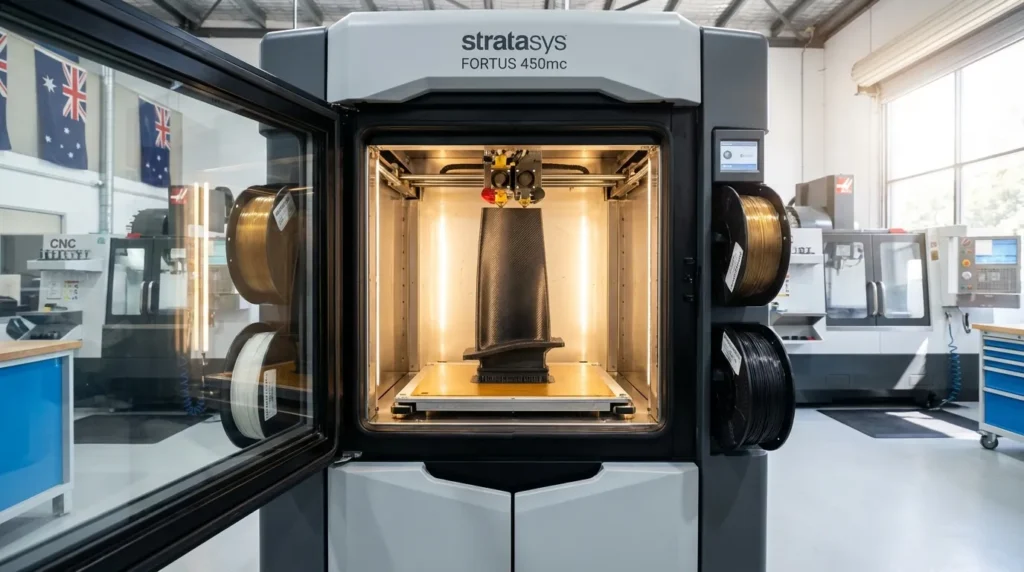
We’re seeing industrial 3D printing move from prototyping into full-scale production, driven by advances in materials and automation.
Understanding Industrial 3D Printing Supply Needs
Industrial 3D printing isn’t just a bigger version of a hobby setup, it comes with its own set of hurdles that often surprise newcomers. Some high-performance materials, like PEEK and ULTEM, need very steady high temperatures and careful handling all the way through; miss one step and the whole job could be wasted. Carbon fiber composites are great for strength, but they wear down nozzles much faster than regular filaments. And with large-scale prints, skipping regular checks can lead to expensive problems. Imagine coming back after the weekend to find a massive, half-finished part stuck solid to the print bed.
In Australia, industrial 3D printing hit USD 10.45 billion in 2024, with forecasts showing 16.6% CAGR through 2031. This growth is being driven by industries like mining, defense, aerospace, and advanced manufacturing, where production-ready parts are increasingly made on-site, whether that’s deep underground in a mine or inside an aircraft hangar.
| Supply Category | Industrial Need | Recommended Specs |
|---|---|---|
| Filaments | High-performance thermoplastics | PEEK, PEKK, ULTEM, carbon-fiber reinforced PLA/PETG |
| Print Beds | Large-format, high-temp capability | Heated beds up to 120°C, removable build plates |
| Nozzles | Wear-resistant for abrasive materials | Hardened steel or tungsten carbide |
| Maintenance Kits | Prevent downtime | Spare extruders, belts, bearings |
| Software | Precision slicing & process control | Industrial-grade slicers with AI optimization |
| Post-processing tools | Production-grade finish | CNC finishing, vapor smoothing |
A helpful way to plan supplies is to match tools and materials closely to the job. For aerospace prototypes, strong polymers and high-flow extruders are often essential. Tooling work benefits from heated chambers and tough nozzles built to last. Planning ahead matters: keeping different filament types and spare parts, especially with possible shipping delays, can save weeks of lost production. That’s why many Australian companies use ERP systems to track inventory, trigger reorders, and schedule upkeep, making sure projects stay on time and meet quality goals. For more on environmental control, see 3D Printer Thermal Management for Industrial 3D Printing.
Choosing the Right Filaments for Industrial Use
In industrial‑grade FDM printing, the filament is really the heart of the process, and in tough work environments, picking the right one can mean the difference between a perfect part and an expensive reprint. Strong materials like PEEK, PEKK, ULTEM, and certain composite blends are built to handle heavy stress, extreme heat, and chemical exposure without breaking, ideal for things like aerospace brackets or medical tools that need sterilizing. Carbon‑fiber reinforced PETG or PLA adds extra stiffness while keeping the weight low, which is handy when every gram matters in a design.
The expansion of industrial 3D printing means manufacturers can leverage high-performance materials such as titanium, high-strength polymers, and composites to produce parts that rival or exceed traditional manufacturing.
These high‑end filaments aren’t just something you load and start printing with. They often need much higher extrusion temperatures, sometimes over 350°C, and a heated build chamber to stop warping halfway through a job, which can be a real headache to fix. Storage is just as key. Moisture gets in quickly with materials like nylon or PEEK, and even one damp spool can wreck a part and ruin your day.
For those in Australia, buying from local suppliers usually means faster delivery and fewer surprises with stock. Some big global brands even work with Australian manufacturers to keep quality high and restocks quick. Before placing a large order, it’s smart to run a small test batch, see how the filament works with your printer and meets your strength needs. An automotive shop, for example, might check tensile strength and heat resistance of carbon‑fiber PETG before making jigs. Choosing the right filament with good QC can save money, keep production moving, and meet industry standards. This is a crucial part of your overall 3D printing supply strategy.
Essential Hardware and Component Upgrades
In heavy-use industrial printing, it’s not just the filament that needs to be tough, the printer’s main parts have to keep up with the pace and stress too. Nozzles made from hardened steel or tungsten carbide last much longer with abrasive materials like carbon fiber blends, which can wear down softer brass ones fast. High-flow hotends push out a lot more molten plastic in less time, making those oversized projects finish quicker instead of dragging on forever. Heated beds with removable build plates are another unsung helper. Parts come off with little effort, so the next print can start almost right away instead of after a long scrape and clean.
The motion system can make a bigger difference than most expect. A CoreXY setup, like RatRig’s V-Core, can run at high speed while keeping vibration low. Pair that with Klipper firmware, and some machines can hit over 400 mm/s while still keeping sharp detail.
Tools and spare parts may not seem exciting, but a stocked maintenance kit can mean the difference between a quick fix and losing an entire day’s output. Belts, bearings, extruders, having them on hand cuts downtime and avoids missed deadlines. For maintenance best practices, see Maintaining Industrial 3D Printers: Best Practices for Longevity and Performance.
Upgrades should match your actual needs. Printing abrasive composites often? Liquid-cooled hotends can last much longer. Working on large aerospace parts? Dual-drive extruders feed heavy filaments more smoothly. In Australian industrial shops, swapping standard rods for precision linear rails is common, reducing wobble and improving accuracy on tall builds. The right hardware and 3D printing supply choices keep prints sharp, downtime rare, and expenses lower.
Thermal Management and Environmental Control
When working with tough, industrial-grade materials, keeping the printing environment steady can be the difference between a headache and a perfect finish. A heated enclosure holds temperatures steady so layers stick properly, and you avoid those annoying mid-print warps. It also keeps extrusion smooth, especially when you’re making large parts built to handle everyday wear and tear. Many only realise how useful it is after a failed run without one.
In parts of Australia, workshop temperatures can swing from chilly to hot within hours, and those changes can throw off accuracy. For tricky filaments like ABS, ASA, ULTEM, or PC blends, active temperature control isn’t just nice to have, it’s often what keeps prints within spec. The result is fewer failed projects and less wasted filament.
Moisture can cause trouble too. Nylon and PVA soak up water quickly, so airtight storage or a dehumidifier is smart. Coastal makers deal with salty air that can slowly corrode parts. A good filter helps, and checking with a thermal camera can show heat leaks you’d otherwise miss. Treating environmental control like regular upkeep, tracking temps, sealing filament bins, keeps prints sharp and consistent all year.
Software, Automation, and Scaling Production
Picking the right slicing software can be the difference between a smooth, reliable process and one full of headaches. Modern industrial slicers have gone way beyond the old “set it and forget it” approach. Many now use AI to fine‑tune settings, let you adjust layer heights mid‑print, show live updates, and even spot possible issues before they ruin a job. That means fewer wasted parts and more consistent results.
Automation is moving quickly too. Some setups have robotic arms that remove finished pieces from the build plate so the next print can start right away. AI tools can catch problems mid‑print and either pause or change settings before a big failure eats up hours and materials. For anyone working under pressure, that can really save the day.
In Australia, many manufacturers are adopting these tools to handle bigger orders without needing more space. Combining faster printers with reliable suppliers and smart inventory systems makes growth less overwhelming. Connect that software to an MES, and you can track each component from raw material to final check, essential for industries like defense or medical. Add automated filament swaps, and multi‑material jobs keep going without stopping. Put it all together, and scaling feels not just doable, but genuinely motivating. Having a robust 3D printing supply plan integrated with automation ensures this scaling is sustainable.
Your Path Forward in Industrial 3D Printing
Industrial 3D printing in Australia has moved well past the “just for prototypes” phase. These days, it’s about making tough, high-quality parts fast, components you can rely on to perform over and over without hoping for luck each time. While having a powerful printer helps, the real difference comes from having a smart plan to keep your supply chain steady, even when deadlines are tight and orders pile up.
A good starting point is to lock in materials that truly give your products what they need, maybe heat resistance for engine parts, extra strength for heavy loads, or flexible plastics for complex shapes. Your printer should be able to handle those materials at consistent industrial speeds without hiccups. Don’t forget the print environment; keeping temperature and humidity under control can be the tipping point between “okay” and “exact.” Using reliable software and automation can make sure ramping up production doesn’t quietly lower your quality. For a deeper look into upkeep, see Industrial 3D Printing Maintenance Guide for Maximum Reliability.
This industry changes fast, and having your 3D printing supply chain sorted can give you a strong advantage. With the right mix of equipment, materials, and workflow, you can turn out parts that match, or even beat, traditional manufacturing, all from your own Australian workshop.
So, choose supplies that fit your long-term plans, refine your process, and be ready for the next jump forward. Think of your 3D printing supply plan as the backbone of your operation, every spool of filament, every precise nozzle, every software upgrade adding strength and flexibility. Keep that backbone strong, and you’ll tackle bigger jobs, sudden market changes, and tight deadlines with ease.
