
Table of Contents
Multi-Material Printing: Techniques and Best Practices for Industrial Applications
Multi-material printing is no longer just a nice extra. It’s becoming a core capability in industrial additive manufacturing, and it’s moving faster than many teams expected. Engineers and manufacturers are already feeling the pressure. Parts often need to be made faster, assembly steps cut down, performance improved, and quality kept consistent from run to run, which is harder than it sounds. That mix of demands isn’t easy to manage. From my perspective, this is where multi-material 3D printing often shows its real value.
So what does that look like in practice? It means printing more than one material into a single part during the same build. This could be rigid and flexible plastics working together, or a strong structural material combined with a dissolvable support. For industrial teams, the main benefit is usually smarter part design and production cycles that move faster overall.
This article gets straight to the point. It breaks down the main multi-material FDM techniques and how they appear in real industrial settings. It also covers best practices for high-speed, high-precision environments, where small mistakes add up fast. If you’re working with prototyping and tooling, especially small-batch production in Australia, this guide is built for you.
What Multi-Material 3D Printing Really Means in Industry
In industrial settings, multi-material 3D printing usually means running two or more materials in a single print job. On FDM systems, this is most often done using dual extruders or IDEX setups, the type commonly found on production floors. The idea itself is simple, but once parts are designed around it, the results are often bigger than people expect.
What makes this useful is rarely colour. Function tends to matter more here, at least in my view. Designers can combine rigid and flexible materials in one build, creating strong components with built-in soft seals and fewer assembly steps. This changes how parts are tested and approved. Support materials are another quiet benefit: when they dissolve away, surfaces come out cleaner and fine details are easier to keep, usually with far less post-processing, something engineers generally welcome.
This shift is happening quickly because the numbers are starting to make sense. Cost per part is often the deciding factor. Current market estimates place the global multi-material 3D printing market around USD 4.8 to 5.0 billion in 2025, with steady double-digit growth. About 15 percent of new industrial printers now include multi-material capability as standard, which is a clear jump.
| Metric | Value | Year |
|---|---|---|
| Global multi-material 3D printing market | USD 4.8, 5.0 billion | 2025 |
| Projected market size | USD 12 billion | 2028 |
| Market CAGR | 13.9, 20% | 2025, 2028 |
| Share of new industrial printers | ≈15% | 2025 |
For Australian manufacturers, this trend fits real-world needs. Mining and tooling applications benefit from tougher, more abrasion-resistant parts, while medical and aerospace components often rely on multiple materials to perform reliably over time.
Core 3D Printing Techniques for Multi-Material FDM
There are a few tried-and-true ways to get multi-material results from FDM printers (it’s common). Understanding how these methods usually work can help when picking a platform and avoiding costly mistakes, which makes this worth learning.
Dual Extrusion Systems
The most noticeable downside of dual extrusion is oozing. When one nozzle sits idle, it can drip onto the print, and that’s usually what annoys people first. Dialing in temperatures and using wipe routines often helps in many cases, but it does take some tuning to get right.
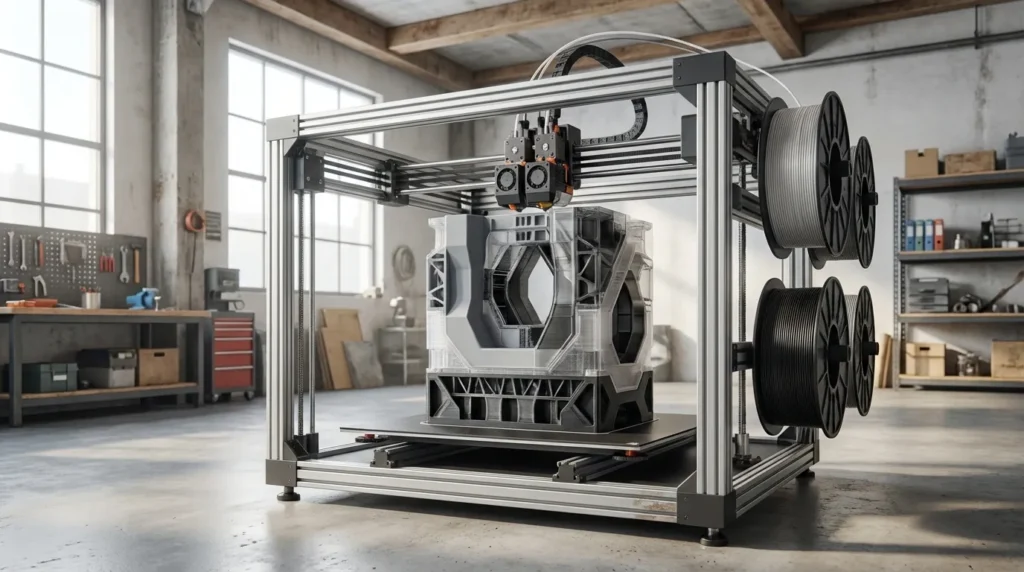
Dual extrusion printers use two nozzles on the same carriage, with one handling the main material and the other running a secondary one. This setup is pretty common and often stays budget‑friendly, which is a plus. I think it’s a solid choice for soluble supports and simple material pairings, especially when you’re just getting started.
IDEX Dual Extrusion
For industrial users, IDEX is a solid option because it can increase throughput by duplicating parts or using mirroring to finish more work faster. IDEX means Independent Dual Extruder, and each nozzle has its own motion system. This often leads to better control during printing and less material mixing. Complex jobs are usually easier as well, especially when printing rigid and flexible materials side by side with clear separation.
Tool-Changing Systems
Tool changers use separate print heads that swap on their own, and the motion looks smooth. Each tool stays separate. They cost more and can handle high‑temperature materials and complex mixes. Setup and cost are tougher, with extra steps you’ll notice. For production‑grade parts, tool changing is usually reliable.
Material Pairing Strategies That Actually Work
This is often where projects start to slip. Picking materials sounds simple, but not every filament works well together, even if the label says it should. Thermal expansion and adhesion matter more than many people think, and cooling rates can quietly ruin a print when they’re ignored. These details seem minor, but they usually decide how things turn out. Brand names don’t help much here; how a material behaves almost always matters more.
One pairing that’s common and fairly dependable is PLA or PETG with PVA or BVOH supports. Since these dissolve in water, they protect surface quality and reduce cleanup time. Industrial parts go further than that. Nylon with carbon fibre reinforcement is used when strength is the main goal. TPU is picked for flexible areas, while high‑temperature materials are used when parts need to handle heat or chemicals. These requirements add up fast.
A practical way to approach this is by function. What does each section need to do, carry weight, bend, seal, resist wear? Materials should match those needs, not lead the decision. It’s simple logic, but easy to skip.
Designing mechanical interlocks is another smart habit. Even when materials stick well, physical locking adds a safety margin, especially where stiff and flexible plastics meet.
Most problems come from ignoring shrinkage differences or mixing materials with incompatible temperature ranges. Warping, weak layers, mid‑print failures, or brittle parts usually follow, and yes, they’re frustrating to fix.
Industrial Applications Across Australian Manufacturing
Across Australian manufacturing, multi-material 3D printing is already fixing everyday problems on factory floors, often in quiet ways. Jigs and fixtures are a common example. They’re still simple tools, just made better, and the gains add up over time. Using a rigid body with soft contact points helps protect finished parts and makes tools easier to handle. On busy production lines, small details like this matter when operators are moving fast.
In mining and resources, printed tooling often mixes wear-resistant materials with lightweight structures. Being tough without extra weight matters during long shifts. Lighter tools reduce fatigue, while harder surfaces last longer in harsh conditions.
Aerospace teams use multi-material printing for ducting and bracketed assembly aids, where cutting weight is especially important. Built-in flexible features remove extra fasteners and make installation simpler.
Medical and research sectors benefit too. Patient-specific tools need strength in some areas and comfort where they touch the body. Multi-material FDM allows fast iteration and avoids traditional mould costs, which is a very practical advantage.
Process Control and Calibration Best Practices
What usually makes or breaks high‑speed multi‑material printing is tight process control. Each material needs its own profile. Temperature, flow rate, and cooling often need separate tuning for each part, more than people expect. That’s how reliable results happen, even if it feels tedious.
Modern firmware makes this possible, but independent extrusion calibration still cuts waste and improves layer bonding. Closed enclosures and chamber heating matter with nylons and other high‑temperature filaments, especially on long jobs.
Support strategy needs care. Soluble supports give cleaner surfaces but add handling and cleanup time. Breakaway supports save time but often leave small marks. That’s the tradeoff most teams accept.
Filament storage is another detail people miss. Moisture can quietly ruin quality, especially when switching materials mid‑print. Dry storage with regular checks prevents many failures. In production, standardising profiles across machines often works better.
Trends Shaping the Future of Multi-Material Printing
One clear trend is how fast multi-material printing is moving into everyday production. High-speed extrusion is cutting cycle times while still hitting the accuracy most shops need. Automated calibration now feels standard in many setups, and real-time monitoring is becoming common too, often sooner than expected.
Hybrid manufacturing is another strong change. When tight micron-level tolerances are required, printed parts are finished with CNC machining. This works well because multi-material printing allows teams to make near-net-shape parts with functional areas already built in before machining starts.
Materials matter as well. Carbon fibre nylons and flexible TPUs are no longer experimental and are now widely used in real jobs.
For Australian businesses, this often leads to less dependence on overseas supply chains and faster responses when lead times shrink or demand suddenly rises.
Putting Multi-Material Printing Into Practice
The biggest gains usually show up when multi-material printing is tied to a clear goal, not just curiosity. When assembly steps slow things down, lead times stretch, or a part still misses the mark, the issue is often easy to spot once you look at it closely. A helpful approach is to pick one bottleneck and design a part that truly benefits from multiple materials, adding stiffness where it’s needed and flexibility where it counts. That kind of focus matters more than mixing materials just because you can.
Hardware choices should follow that goal. Dual extrusion works well for many everyday jobs, while IDEX systems add more options when prints get tricky and alignment really matters. Tool changers tend to suit demanding production and longer runs. Calibration and material testing do take time, and that effort often pays off later.
Thinking long term also helps. Used well, this approach can lead to faster workflows and tougher parts, for example, a single print that replaces a multi-part assembly by combining rigid and flexible areas.
