
Table of Contents
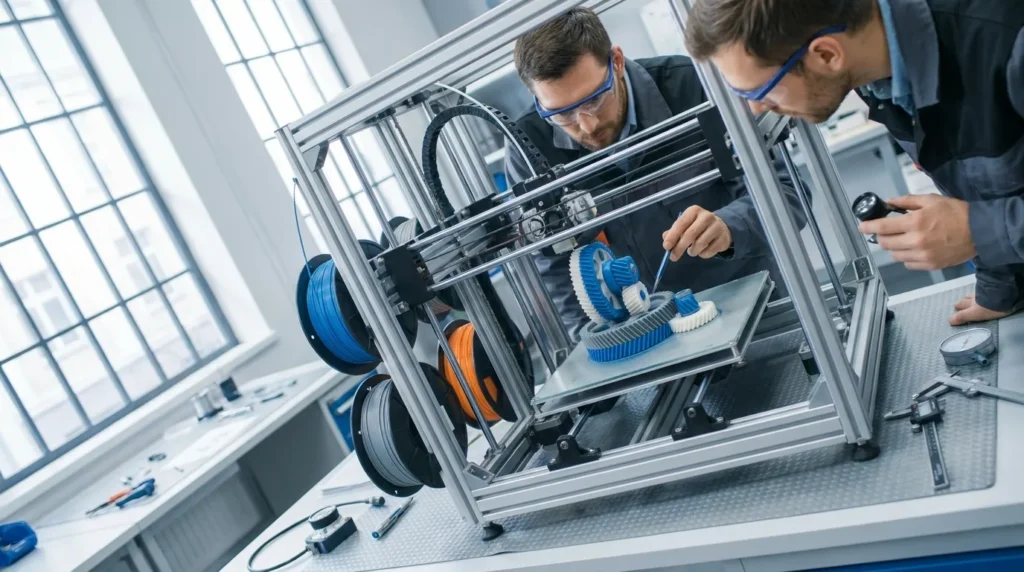
Multi-Material 3D Printing: Techniques for Enhanced Prototyping
Multi material 3d printing is no longer limited to labs or display parts. It’s becoming a practical option for faster prototyping, better fit checks, and more realistic testing on the factory floor. For industrial engineers, manufacturing teams, educators, and serious makers in Australia, the shift is pretty clear: one print can now replace several parts and materials (which saves time), and in some cases it can cut assembly steps too.
A lot of prototyping delays come from rework, manual bonding, weak support strategies, or parts that don’t act enough like the final product. The right 3d printing approach can help with many of those issues. With a suitable setup, teams can combine rigid and flexible materials, use soluble supports for complex geometry, and move from concept models to functional tooling with less waste (and less cleanup too). That also means less downtime.
This guide explains how multi-material workflows work in FDM systems and where they bring the most value. It covers what to watch during setup, calibration, and material handling. It also looks at high-speed precision printing, IDEX systems, and how teams can build stronger design-for-additive skills for real production needs, making production work easier to handle with fewer compromises.
Why Multi-Material Printing Is Growing Fast
Additive manufacturing is growing quickly, and that helps explain why more people are paying attention to multi-material methods. Recent market research says the global 3D printing market reached USD 15.39 billion in 2024, with strong growth expected through 2030. Separate research also puts the FDM 3D printing market at USD 2.10 billion in 2024, and long-term growth is still expected. The 3D printing materials market is also expected to rise from USD 2.5 billion in 2025 to more than USD 8.2 billion by 2035.
| Market Segment | Current Estimate | Forecast |
|---|---|---|
| Global 3D printing market | USD 15.39B in 2024 | USD 35.79B by 2030 |
| FDM 3D printing market | USD 2.10B in 2024 | USD 15.09B by 2034 |
| 3D printing materials market | USD 2.5B in 2025 | USD 8.2B by 2035 |
As these markets grow, better hardware, more material choices, and easier workflow tools usually follow. For professional users, the benefit goes well beyond color printing. The practical side is easier to spot in real applications: a rigid body with a soft grip, a strong part paired with dissolvable supports, or a fixture that combines stiffness and compliance in a single build.
Industry outlooks from Stratasys and 3D Printing Industry suggest additive manufacturing is moving past display models and more into production aids, tooling, and selected end-use parts. That shift makes multi material 3d printing more useful in everyday engineering work, not just in demos. You can see the change in daily use, especially as teams depend on these tools for more real-world tasks.
Core Multi-Material 3D Printing Techniques That Matter Most
Multi-material setups do not all work the same way, and those differences matter in real use. Some use dual nozzles, while others use IDEX architecture, where each print head moves on its own. More advanced systems use toolchangers to handle more material choices. The right setup depends on the speed you want, the materials you need to combine, and the part accuracy you need.
Dual extrusion
Dual extrusion is a common 3D printing method for multi-material work. One nozzle prints the main model, while the other handles supports or a second material, which makes it pretty handy. It works well for simple two-material parts, color separation, and overmold-style prototypes where materials are combined.
IDEX systems
IDEX, or independent dual extrusion, gives each toolhead its own motion path, so nozzle collisions are less likely and material contamination can be lower too. That helps when printing rigid and flexible materials together or using soluble supports. For industrial users, it can mean cleaner surfaces, more consistent results, and less hassle overall.
Toolchanger systems
Toolchangers let you keep several dedicated print heads or tools ready to go, which is really useful. One nozzle can stay set for abrasive carbon-fibre material, while another handles support material, so there’s less need to stop and swap things around.
That setup works well for advanced prototyping and small-batch production, especially for busy teams.
For many Australian workshops, an IDEX-based FDM platform offers a good balance of complexity and capability. That’s part of why solutions from Raven 3D Tech fit well into serious prototyping and tooling workflows.
Where Enhanced Prototyping Gets Real Value
The biggest advantage of multi material 3d printing is not just how a part looks. You really see it in how a prototype performs. A part may look right and still come up short if it does not flex, seal, support, or fit together like the final design. Using more than one material lets teams test real function much earlier, which gives them a clearer sense of whether a design will work before they move forward.
A common example is a housing with a soft cable guide or a grip area. Instead of printing a hard shell and then adding foam or rubber by hand, the whole part can be made in one job. That makes the process much easier. Another example is a fixture with a rigid frame and a softer contact surface, which helps protect finished parts during inspection or assembly.
Soluble support material is another big advantage. It makes enclosed channels, undercuts, and internal features possible that are hard to clean when breakaway support is used. Surface finish gets better, and teams spend less time on manual cleanup. In education, students also get to see how support strategy affects cost, accuracy, and design freedom.
The 3D printing technology has caught up to moldmaking, but now we need people who can understand how to design a mold with additive.
Better hardware by itself does not guarantee better results. Teams still need to understand material pairing, print orientation, support planning, and DfAM principles. In practice, the printer is usually not the real bottleneck. Design knowledge is.
Material Pairing, Calibration, and Common Mistakes to Avoid
Good results depend on materials that really work well together. Some combinations seem useful at first, then fail in real use because bed adhesion is weak, shrink rates do not match, or nozzle temperature needs are too far apart. It usually saves time to start with pairs that already have a proven process, like PLA with soluble support, PETG with support material, rigid polymers with TPU in limited zones, or other combinations that fit the same process without fighting the setup.
Key setup steps
Start with temperature overlap. If one material prints at 220C and the other needs 300C, that pairing may not work on the same machine, which is a pretty clear mismatch. Bed adhesion needs should match too. And the inactive nozzle also needs to avoid dragging, oozing, or damaging the printed surface. In that case, IDEX can help.
Common mistakes
Poor calibration between nozzles is a common problem. Even a tiny offset can ruin the interface quality between materials, and it really does not take much. Bad filament storage causes trouble too. Many engineering materials and support filaments absorb moisture fast. That can lead to rough surfaces, stringing, weak layer bonding, and unstable dimensions. Dry storage and proper handling are basic, but they still get ignored all the time.
Using standard brass nozzles for abrasive composites is another mistake. Carbon-fibre-filled materials can wear them down fast, causing size drift and poor accuracy. For industrial use, hardened nozzles with stable thermal control are usually a better choice because they last much longer.
Teams running long jobs also need regular maintenance. Clean extruders, check motion systems, and check toolhead alignment often. Smart calibration is still one of the key 3d printing techniques for reliable output.
High-Speed Precision FDM for Tooling and Production Support
Speed matters here only if the part still stays within tolerance. In advanced prototyping, high-speed FDM depends on strong motion control, stable extrusion, and thermal management that can keep up through long print runs. That is where machines really get tested. If any of those areas fall behind, a fast system simply makes bad parts faster.
Recent industry coverage points to rising demand for hardened motion systems, solid hotends, and better control software. That becomes even more important in multi-material jobs using engineering polymers, flexible filaments, or abrasive composites. Each of those materials brings extra process risk, and the challenge is real.
For manufacturing teams, high-speed precision printing does more than support prototype work. It can produce soft jaws, drill guides, assembly aids, ergonomic handles, test fixtures, and bridge tooling. These are practical parts that can save time almost right away. In some shops, they bring benefits sooner than end-use production parts.
Multi-material capability also needs repeatable mechanics and stable process control. Without that, a wider material range can quickly turn into wasted potential and extra cost.
Building a Practical Workflow in Australian Workshops and Classrooms
Start small with the plan. Pick one job that already causes delays or still relies on manual assembly. Good first projects include fit-check parts with soft features, soluble-support prototypes with internal channels, fixtures with protective contact surfaces, or similar hands-on jobs that keep coming up.
Then build the workflow around the basic steps:
1. Choose a clear use case
Don’t start with the hardest part in the factory (seriously). Instead, pick a job where multi-material printing solves a known problem. Keep it simple at first, and you’ll move faster.
2. Standardise materials
Keep the number of filaments low at first. Train staff on storage and drying too, because that matters, along with handling.
3. Document calibration
Save nozzle offsets, temperatures, purge settings, and support rules; don’t skip them, because repeatability keeps prints consistent.
4. Train for DfAM
Technical educators and engineering leads should teach why geometry really matters, along with support access and material interface zones, and why those matter as well.
5. Review maintenance
For high-speed industrial FDM, regular checks on belts, rails, hotends, and extrusion systems really matter. It may not be the exciting part, but it keeps the hardware working in real production instead of turning into a machine that only prints demos, and that’s no good.
Putting Multi-Material Printing to Work
Multi material 3d printing gives engineers and advanced users a more practical way to prototype, tool, and test. Its biggest benefit is combining different functions in a single print, which sounds simple but is genuinely useful. It can also cut down on manual assembly, improve support setups, and help parts behave more like the final product. Paired with solid 3d printing techniques, it can shorten iteration time and help teams make better decisions earlier in development, which usually means less hassle later.
The most effective use is usually practical rather than flashy. Dual extrusion or IDEX works well for model-plus-support jobs and for rigid-plus-flexible parts. Just as important are calibration, filament storage, thermal control, and nozzle choice. Those details directly affect results. High-speed precision FDM only makes sense if the machine can stay consistent over time. Design knowledge also plays a big part, since stronger DfAM skills often create more benefit than hardware alone.
For Australian manufacturers, educators, and serious makers, this helps support faster local iteration and more useful tooling. Reviewing the current workflow can show where multi-material printing can replace extra parts, extra labour, or extra delay, leading to better prototype fidelity and fewer compromises.
