
Table of Contents
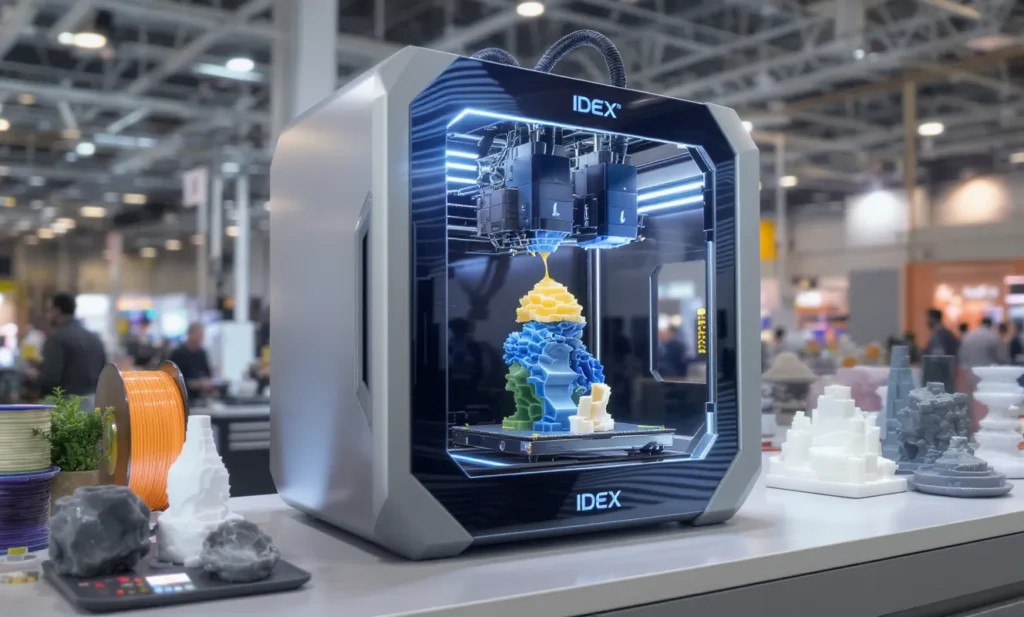
Mastering Multi-Material 3D Printing with IDEX and Klipper in Professional Workflows
In Australia’s rapidly evolving manufacturing landscape, the demand for faster prototyping, functional multi-material parts, and production-grade tooling is pushing engineers and technical educators to rethink traditional FDM workflows. Multi-material 3D printing, powered by Independent Dual Extrusion (IDEX) systems and optimized with Klipper firmware integration, is emerging as a cornerstone technology for those seeking both speed and precision. Moreover, multi-material 3D printing enables manufacturers to combine diverse material properties in a single build, unlocking new possibilities in design.
For industrial engineers, the value proposition is clear: combine the flexibility of multi-material 3D printing with the efficiency gains from Klipper’s advanced motion control, and you get a system capable of producing complex parts in record time without sacrificing quality. In this article, we’ll explore how IDEX and Klipper work together, dive into their applications in professional workflows, and outline strategies to integrate them into your production environment.
Understanding Multi-Material 3D Printing with IDEX Dual Extrusion in Industrial Contexts
Independent Dual Extrusion (IDEX) technology allows two printheads to operate independently on the same gantry. This means you can print two identical parts simultaneously (duplication mode), create mirrored parts for symmetrical assemblies, or combine different materials into a single part in one build cycle. In industrial contexts, multi-material 3D printing capability enables manufacturers to optimize machine uptime and reduce changeover delays, particularly in environments where multiple product variants are needed quickly. For example, a factory producing custom medical devices can run mirrored builds for left and right-handed components without reprogramming toolpaths, saving both engineering and production time.
Independent dual extrusion isn’t just about printing in two colors, it’s about unlocking true multi-material functionality in a single job, which can drastically cut lead times in manufacturing.
According to the 2025 All3DP market review, IDEX printers account for 18% of professional-grade FDM printer sales globally. This is driven by applications such as:
- Combining rigid and flexible materials for functional prototypes
- Printing dissolvable supports to simplify post-processing
- Parallel production of small-batch parts
| Application | Benefit | Example |
|---|---|---|
| Rigid + Flexible Materials | Functional prototypes | TPU grips on PLA enclosures |
| Dissolvable Supports | Easy post-processing | PVA supports for PETG parts |
| Parallel Printing | Reduced production time | Two identical aerospace brackets |
As shown above, the versatility of IDEX extends far beyond aesthetic color changes. Its ability to handle dissimilar materials simultaneously opens the door to producing composite parts with enhanced mechanical properties, such as vibration damping or chemical resistance. This flexibility makes multi-material 3D printing ideal for industries like aerospace, automotive, and electronics, where complex geometries and mixed-material properties are critical to meeting stringent performance requirements.
How Klipper Firmware Supercharges Multi-Material 3D Printing with IDEX Systems
Klipper firmware is known for its advanced motion control algorithms, including input shaping, pressure advance, and real-time kinematics optimization. These features translate into higher print speeds, 30, 50% faster than stock firmware, without compromising dimensional accuracy. In high-volume production scenarios, these gains can mean the difference between meeting tight delivery schedules and missing deadlines, especially for contract manufacturers working with diverse clients.
Klipper’s ability to handle complex motion control while maintaining high precision makes it a game-changer for multi-material workflows, especially when paired with IDEX systems.
Klipper also supports multi-extruder synchronization, allowing for seamless material changes and efficient purge tower management. This can reduce filament waste by up to 40%, which is significant when working with expensive engineering polymers. The firmware’s real-time control also enables dynamic adjustments during printing, compensating for thermal drift or mechanical deviations before they impact part quality.
For Australian manufacturers, this means faster iteration cycles and reduced operational costs. Engineers can run parallel prints or mirrored parts, doubling throughput without additional machines, a point highlighted by Dr. Peter Branson in the AMGC Industry Report 2025. In sectors like defense or mining equipment manufacturing, where turnaround speed directly impacts operational readiness, Klipper’s acceleration of multi-material 3D printing with IDEX systems is a clear competitive advantage.
Integrating Multi-Material 3D Printing with IDEX + Klipper into Professional Workflows
The integration process involves both hardware and software considerations. Hardware-wise, ensure your printer’s motion system can handle the weight and complexity of dual extruders without introducing wobble or backlash. High-rigidity frames, precision linear rails, and quality stepper drivers are essential for maintaining print accuracy at high speeds. On the software side, Klipper’s modular architecture makes it easier to customize motion profiles and integrate advanced features, such as automated toolhead parking or multi-zone bed leveling.
Key steps for integration:
- Firmware Installation: Flash Klipper onto a compatible controller board.
- Configuration: Define each extruder’s parameters, offsets, and temperature profiles.
- Calibration: Use calibration prints to fine-tune alignment and extrusion.
- Workflow Optimization: Implement print modes like duplication and mirror to match production needs.
According to Luis Martinez from All3DP Technical Review, Klipper’s modularity is ideal for engineers who need to adapt firmware to unique material handling systems, such as integrating custom spool feeders for high-performance filaments. In practice, this could mean adding moisture-controlled enclosures for hygroscopic materials or integrating conveyor systems for automated part removal.
For those working with advanced materials, consider reading 3D Printer Thermal Management for Industrial 3D Printing to ensure optimal chamber temperature control during high-speed operations. Proper integration not only boosts productivity but also enhances repeatability, ensuring consistent quality across production batches.
Real-World Applications of Multi-Material 3D Printing in Australian Manufacturing
Australian manufacturers are leveraging IDEX + Klipper setups for:
- Custom Jigs & Fixtures: Aerospace teams produce multi-material jigs with embedded soft grips.
- Functional Prototypes: Electronics firms combine rigid housings with flexible cable management features.
- Short-Run Production: Consumer goods companies create end-use products with mixed material properties.
| Industry | Use Case | Outcome |
|---|---|---|
| Aerospace | Multi-material jigs | Improved assembly efficiency |
| Electronics | Rigid-flex prototypes | Reduced iteration cycles |
| Consumer Goods | Short-run end-use parts | Lower tooling costs |
With the local FDM market growing at 22% annually (AMGC 2025), multi-material 3D printing systems are becoming a competitive advantage for companies aiming to stay ahead. In mining equipment maintenance, for example, custom tool inserts combining wear-resistant nylon with softer TPU cushioning can be produced on-demand, reducing downtime. Similarly, in marine manufacturing, combining corrosion-resistant PETG with flexible seals in one print reduces assembly complexity and improves long-term performance.
Avoiding Common Pitfalls in Multi-Material 3D Printing
While IDEX + Klipper setups offer significant benefits, there are common mistakes to avoid:
- Poor Calibration: Misaligned extruders can cause layer shifts and poor adhesion.
- Inadequate Thermal Management: Multi-material prints often require precise chamber temperatures to prevent warping.
- Filament Handling Issues: Moisture-sensitive filaments like PVA need proper storage.
Another frequent oversight is failing to adjust slicer settings for different material shrinkage rates, which can lead to dimensional inaccuracies in assembled parts. Regularly inspecting nozzle condition and maintaining clean purge routines also helps prevent cross-contamination between materials. For best practices, review Complete Guide to 3D Printing Filaments: Selection, Storage, and Handling for Precision Results to avoid material degradation. Implementing a preventive maintenance schedule for both hardware and firmware ensures long-term reliability and optimal output.
Future Trends: Hybrid Systems and Beyond
Emerging hybrid systems combine IDEX printing with CNC milling or laser engraving. This allows additive and subtractive processes in one platform, reducing post-processing time and expanding design possibilities. For example, a hybrid machine could print a composite drone frame and then engrave serial numbers directly onto the part without removing it from the build plate.
Manufacturers like Raise3D and BCN3D are already offering IDEX machines with Klipper integration capable of 300mm/s print speeds. As toolpath optimization and AI-driven quality control become mainstream, expect these systems to further reduce waste and improve precision. Predictive maintenance algorithms could soon alert operators to potential mechanical issues before they cause print failures, further improving uptime.
Australian technical educators are also adopting these setups to teach advanced manufacturing concepts, preparing the next generation of engineers for multi-material 3D printing design challenges. In vocational training programs, hybrid IDEX platforms serve as hands-on learning tools that bridge the gap between additive manufacturing theory and industrial application.
Building Your Success with Multi-Material 3D Printing Using IDEX + Klipper
Mastering multi-material 3D printing with IDEX and Klipper isn’t just a technical upgrade, it’s a strategic investment in speed, precision, and versatility. Whether you’re producing aerospace tooling, consumer electronics prototypes, or short-run production parts, the combination of independent dual extrusion and advanced firmware can reshape your workflow. Leveraging these capabilities enables businesses to respond more effectively to custom orders and evolving market demands.
Start by assessing your current production needs, identifying where multi-material 3D printing can save time or improve product functionality. Then, plan your integration with careful attention to calibration, thermal management, and material handling. Consider conducting pilot runs to validate process stability before scaling up, and track performance metrics to quantify ROI.
For Australian professionals ready to take the next step, Raven 3D Tech offers tailored solutions, from assembled RatRig V-Core systems to Klipper firmware integration services. By leveraging these tools, you can position your business at the forefront of industrial 3D printing innovation. Partnering with experienced integrators ensures that your transition to multi-material 3D printing with IDEX + Klipper is smooth, efficient, and aligned with long-term operational goals.
The future of manufacturing in Australia is multi-material, high-speed, and precision-focused, and with IDEX and Klipper, you’re ready to lead that charge.
