
Table of Contents
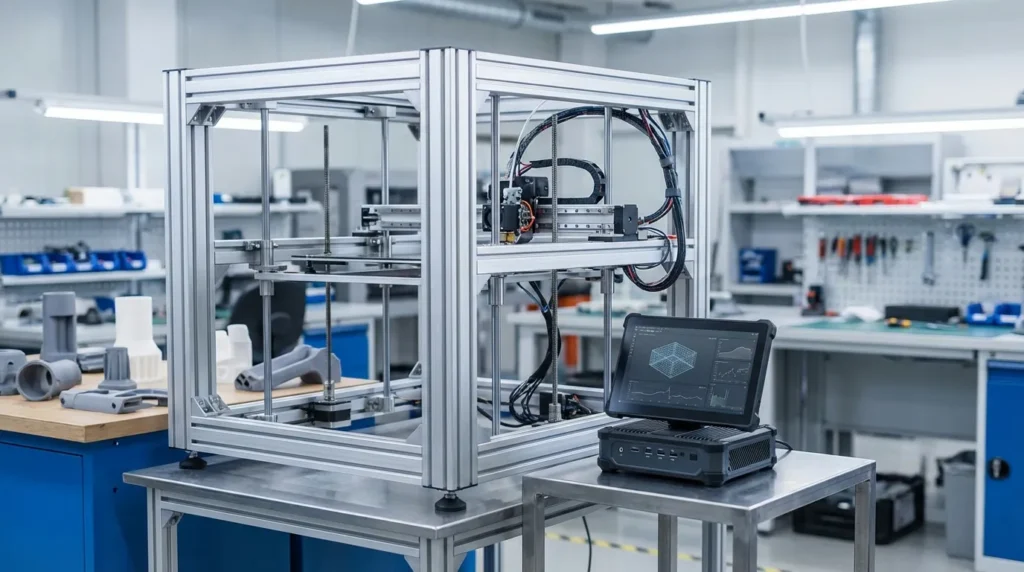
Integrating Klipper Firmware for Enhanced 3D Printing Performance
High-speed FDM printing always sounds great on paper. In real use, though, engineers and advanced users often run into the same problems, and you’ve probably seen it yourself. As speeds increase, prints can fail, surface quality drops, and accuracy suffers. This is where Klipper firmware makes a difference. Rather than chasing raw acceleration numbers, Klipper uses a different approach to motion control and overall print behavior. The focus is on speed, consistency, and fine control, and you can see the results in finished parts.
For Australian manufacturers and educators, along with serious hobbyists who push their machines hard, this offers a practical way to improve 3D printing performance without buying a whole new printer.
The focus stays on real production needs. This article looks at how Klipper works, why it matters for industrial printing, and how it fits into workflows. It covers speed gains, accuracy improvements, setup tips, common mistakes, and support for IDEX dual extrusion, larger machines, and large-format printers, where tuning often makes the biggest difference.
Why Klipper Firmware Changes 3D Printing Performance
The most obvious change usually shows up in speed that still stays accurate. Traditional firmware like Marlin does motion calculations directly on the printer’s controller. This often limits speed and acceleration sooner than people expect, especially on long prints where those limits appear quickly. Klipper uses a different approach, and it works well. The heavy calculations are handled by an external computer, usually a Raspberry Pi or a similar small device. This setup allows the printer controller to focus on clean, precise step movements instead of handling several tasks at the same time.
Because of this change, printers can often run faster without giving up accuracy, which users usually notice right away. Many industrial users report real time savings after switching to Klipper, not just numbers on paper. Print speeds go up while surface quality usually stays steady instead of getting worse. Acceleration can be pushed higher without the ringing or ghosting that frustrates people. Engineering studies shared by manufacturing platforms, often based on tuned, real-world machines, show total print times dropping by 30 to 50 percent compared to Marlin, which is a big improvement.
| Performance Metric | Typical Range | Impact on Production |
|---|---|---|
| Sustained print speed | 250, 500 mm/s | Faster prototyping cycles |
| Acceleration | 3,000, 20,000 mm/s² | Sharper corners at speed |
| Print time reduction | 30, 50% | Lower cost per part |
For Australian workshops running several printers, this difference shows up in day-to-day work. Faster prints often mean more output and more finished parts each day, reducing prototype wait times and the back-and-forth that slows teams down. Klipper also works well across groups of printers, making it a good choice for education labs and small production lines where multiple machines run at the same time.
How Klipper Firmware Improves Accuracy at High Speed
Speed only really helps when accuracy keeps up, and Klipper firmware is built with that in mind. Much of its design focuses on motion control, which shows up during long, fast moves where planning makes a difference. One standout feature is input shaping, and it matters a lot here. Instead of pushing the printer harder and hoping vibrations behave, Klipper changes how motion commands are sent. Rather than slowing everything down to deal with frame resonance, it often works around those limits in a smarter way. That’s a big reason it performs so consistently.
Input shaping is now a common calibration step for many users. It often makes high-speed printing workable on existing machines, without rebuilding the frame or swapping parts. That can matter a lot in industrial settings. Performance improves without changing hardware, and dimensional accuracy usually stays steady even during aggressive moves that would normally cause problems. Fewer surprises is always a good thing.
Step timing is another area where Klipper helps in a very practical way. With over 600,000 steps per second available, small details like tight holes and sharp corners stay clean at speed. That level of control is important for tooling and functional prototypes, where tolerances aren’t optional. Engineers printing press-fit parts or alignment tools often notice the difference right away.
The real-world results are easy to see. On a well-tuned system, a standard benchmark print can finish in under 20 minutes and still come out with sharp edges and smooth walls. Still clean. Still usable.
| Feature | Benefit | Why It Matters |
|---|---|---|
| Input shaping | Reduced vibration | Cleaner surfaces at speed |
| High step rate | Precise motion | Better dimensional accuracy |
| External computation | Stable control | Consistent repeatability |
Practical Setup Considerations for Industrial Users
What usually slows teams down isn’t installing Klipper itself, but figuring out how to host it. That pause makes sense. The host computer shapes how everything works afterward. Raspberry Pi systems are common, and so are industrial single‑board computers built to run for long periods. In production environments, reliability often matters more than raw speed, so steady power is a big deal. Cooling also matters more than many expect, and it often leads to fewer annoying failures later on.
Once the hardware decision is made, focus moves to printer setup. Klipper uses simple text‑based config files, which many engineers already know how to work with. Because of that, version control is easy, changes are quick, and there’s no need to recompile the full firmware for every tweak. During calibration and regular updates, those time savings become clear. Small improvements add up when the same tasks are repeated often.
The next noticeable upgrade is usually a web dashboard. These interfaces show live graphs, allow direct temperature control, and offer basic job tracking that’s especially helpful during long prints. In classrooms, the same setup supports teaching by making changes visible in real time. Some teams also learn useful tips from walkthroughs shared by experienced users.
For industrial printers, writing down each configuration and keeping backups is a smart habit, even if it feels tedious. Using the same profiles across machines helps keep behavior predictable and makes everyday troubleshooting easier.
Klipper Firmware and Advanced Systems Like IDEX and Large-Format Printers
Klipper firmware works best when paired with advanced hardware, and that’s easy to see with IDEX dual extrusion systems. These machines need careful coordination between toolheads, especially during tool changes or mirrored printing, which can feel tricky to manage. Klipper usually handles this without much fuss, keeping motion planning steady even as setups get more complex. On long prints, that steady timing matters, since small errors can add up over many hours.
IDEX setups are a practical choice for manufacturers making fixtures or enclosures. They allow dual‑material printing, with one nozzle laying down a strong structural polymer while the other prints supports or flexible filament for difficult shapes. With Klipper’s accurate timing, layers from both tools tend to line up well. That often leads to less cleanup, fewer failed parts, and less frustration during post‑processing.
Large‑format printers see clear gains too. Bigger print beds mean more inertia, which can trip up some firmware. Klipper’s acceleration control and input shaping help keep print quality steady during long moves. This helps during extended production runs for jigs and trays in Australia’s mining or medical sectors, where reliability often matters more than raw speed.
Mistakes still happen. Skipping resonance testing is common, and pushing speed without checking cooling or extrusion limits is another frequent issue. Klipper can run fast, but the machine’s physical limits still matter.
Maintenance, Stability, and Long-Term Use
Industrial users often ask about long-term stability, and that usually comes from real uptime pressure. Klipper is open-source firmware and is actively maintained, which matters when machines need to run day after day. Updates come out regularly, but they aren’t totally hands-off, so applying them takes some care. In production environments, stability often comes before everything else. That’s why many teams test updates on one machine before rolling changes out across the shop floor.
Regular maintenance often feels easier with Klipper. Its logs are detailed in a practical way, the kind technicians actually read and use. Error messages are usually clearer and often include helpful context, which can speed up troubleshooting during overnight shifts or long production runs. Catching small issues early often lowers the risk of part failures later on.
Training matters too. Teams need a good handle on calibration steps like pressure advance and input shaping. These skills usually transfer well between machines, which helps with workforce flexibility, especially in education and training settings.
Looking ahead, Klipper is expanding into tool changers and CNC-style research platforms. Its growing use in Industry 4.0 workflows makes that flexibility a real advantage for Australian manufacturers who want to stay competitive.
Putting Klipper Firmware to Work in Your Operation
Klipper firmware isn’t really about chasing top speed numbers. Most teams use it for day‑to‑day manufacturing work, the practical jobs that keep production running. The real value often shows up as shorter cycle times and prints that are more consistent from one run to the next. Same parts, fewer surprises. One benefit that doesn’t get talked about much is how Klipper can help existing machines stay useful longer. That often means putting off the cost of buying new equipment, which is usually a win.
What stands out is how quickly improvements can show up when the setup is done with care. For high‑precision FDM printers used in prototyping or production, it makes sense to start small. Choose one machine instead of switching everything at once. Install Klipper and then watch what actually changes. Track print time, failure rates, part quality, and how often operators need to step in. With that focus, many teams see real improvements sooner than expected.
In education settings, Klipper works well as a hands‑on teaching tool. It’s practical, not just theory. Students learn motion control ideas used in industry, and engineers often like the deep tuning options and the freedom from closed systems.
Overall, Klipper helps unlock performance that many printers already have but don’t fully use. With a solid setup and a practical approach, it becomes a dependable base for fast, accurate 3D printing, turning an underused machine into a reliable daily workhorse.
