
Table of Contents
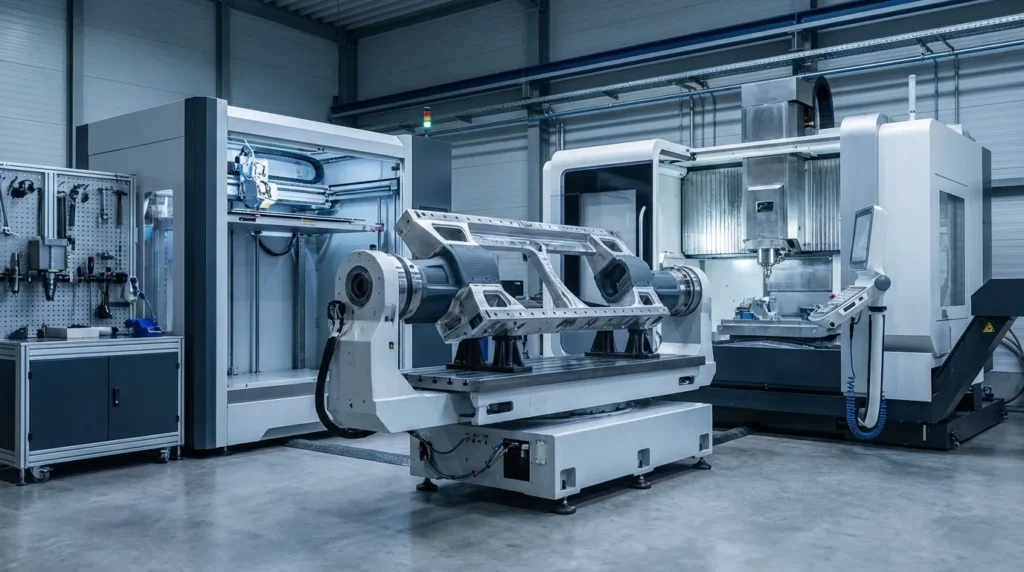
Hybrid Manufacturing: Integrating 3D Printing and CNC
Manufacturing is changing fast, and you can feel the pressure everywhere. Engineers and makers are expected to build parts faster, hit tighter tolerances, reduce waste, and control costs, often all at once. Traditional CNC machining is still the go‑to choice for precision and repeatability, especially on demanding jobs where accuracy matters most. But as shapes become more complex or designs keep changing, that same reliability can slow progress and drive costs higher than expected. 3D printing adds speed and design freedom, which helps when updates are frequent and geometries are hard to machine. The downside is that printed parts often need extra finishing to meet industrial standards, and those extra steps take time. That overlap is usually where hybrid manufacturing makes sense.
What stands out is how hybrid manufacturing brings 3D printing and CNC machining together in one connected workflow. In some systems, both steps happen in the same machine, so the part stays put and re‑alignment problems are mostly avoided. For Australian manufacturers, training providers, researchers, and advanced hobbyists, this creates real opportunities, as noted here. Faster prototyping, quicker iteration, and in‑house tooling that can be adjusted and used right away all shift how work gets done. Small‑batch production becomes more realistic, especially when avoiding offshore delays or minimum order sizes, a common frustration, and teams gain more control.
This article looks at how hybrid manufacturing works and why it matters right now, as design cycles shorten and cost pressure grows. It focuses on real market data and hands‑on examples, with special attention on high‑speed FDM 3D printing in shops running industrial‑grade systems like RatRig V‑Core platforms with Klipper firmware, such as printing a tool insert and machining it to final tolerance in one workflow.
What Hybrid Manufacturing Really Means on the Factory Floor
Hybrid manufacturing isn’t a flashy buzzword meant to grab attention, even if it can sound like one at first. There’s usually no hype around it. It simply means using additive methods, like 3D printing, together with subtractive ones such as CNC milling. The idea is simple: each method is used where it works best, often on specific sections of a part instead of the whole thing at once.
On the factory floor, production often starts with 3D printing to get close to the final form, what many call a near‑net shape. It’s not perfect, but it works as a solid first draft. CNC machining then takes over to clean up the features that matter most over time, holes, edges, and tight tolerances that need to stay consistent. This setup usually reduces wasted material and cuts down machining time. When designs become more complex, it often changes how parts are made in a better way (at least in practice).
Market data shows how quickly this space is growing.
| Metric | Value | Period |
|---|---|---|
| Hybrid AM market size | USD 1.9 billion | 2024 |
| Projected market size | USD 13.2 billion | 2034 |
| Estimated CAGR | 21.4% | 2024, 2034 |
A lot of that growth likely comes from industries where speed and precision both matter, like aerospace, automotive manufacturing, and specialized tooling. Deadlines are tight, and accuracy isn’t optional. Hybrid systems handle both needs well, which is why many manufacturers are moving toward workflows that mix CNC and 3D printing into one process.
Rich Garrity from Stratasys explains this shift clearly.
In 2024, manufacturing leaders should recognize that additive manufacturing (AM) isn’t competing with traditional methods. Instead, it offers manufacturers opportunities for efficiency gains, increased supply chain security, and reduced carbon footprints in automotive, aerospace, and other industries.
Why High-Speed FDM Matters in Hybrid CNC Workflows
When people talk about hybrid manufacturing, metal systems usually come up first. That makes sense. Still, high-speed FDM 3D printing plays a bigger part than many expect, especially across Australia. Industrial FDM printers are now accurate, repeatable, and fast enough for real production tasks. These aren’t just test parts or throwaway prototypes anymore; they’re parts that earn a spot on the shop floor.
High-speed FDM is often a good fit for jigs, fixtures, molds, and functional prototypes. In these cases, full metal strength usually isn’t needed. What matters more is fast turnaround and reliable dimensions. Carbon fiber, reinforced filaments and engineering plastics handle this balance well, standing up to oil, vibration, and everyday handling without much trouble.
A common hybrid workflow brings these tools together in a practical way:
- Design the part in CAD with both printing and machining in mind from the start, using clear datums to make later steps easier.
- Print the base shape on a high-precision FDM system, often overnight or during off-hours when other machines aren’t running.
- CNC machine the key faces, holes, or interfaces where tight tolerances matter, like mounting surfaces or bearing seats.
- Put the part into service or assemble it as needed.
The process is straightforward, and it works well in real shops. Market.us analysts often point out that near-net shape manufacturing cuts down on post-processing and material waste. For small and medium businesses, those savings can add up faster than expected.
High-speed motion systems, rigid frames, and firmware like Klipper have changed what FDM can reliably deliver. With proper tuning, printed parts are consistent enough for CNC machines to work with, which is where industrial systems usually differ from hobby-grade machines.
The video above shows how these workflows come together in real shops, with practical examples that are easy to picture using day to day.
Process Consolidation and Fewer Mistakes
One big benefit of hybrid manufacturing is process consolidation, especially on busy shop floors. Instead of moving a part between several machines and benches, more work usually happens in fewer steps, sometimes a lot fewer. That shift often keeps operators working within a single workflow instead of handing parts off all day. From what I’ve seen, that focus helps more than most people expect. It usually cuts down errors and lead times without quietly adding complexity somewhere else.
The Sinterit technical team often points to this for a reason. This isn’t theory or marketing talk. It comes from shop-floor experience, the kind you gain after a few things go wrong and you learn what actually works.
The main advantage of hybrid manufacturing is process consolidation. It reduces the number of machines, setups, and manual interventions required, leading to lower lead times and fewer sources of error.
For engineers, fewer setups often lead to better repeatability. Every time a part is re-clamped, there’s a chance for small alignment issues to slip in, and those can stack up over time. Hybrid workflows reduce those touchpoints, so dimensional drift shows up less often, which becomes clear in production runs.
Tooling production is an easy example. Many Australian manufacturers now print fixture bodies overnight, then CNC machine datum surfaces the next day. That often means a usable, accurate tool in days instead of weeks, along with faster feedback.
Mistakes still happen. Treating 3D printing as an afterthought is a common one, and results usually improve when parts are designed for both processes from the start. Calibration issues and thermal instability also appear quickly. Printer setup, temperature control, and filament handling all matter. Predictable prints tend to handle machining forces better, simple, but often missed.
Where Hybrid Manufacturing Is Headed Next
What’s most interesting right now is how closely hybrid manufacturing is connecting automation and software. CAM and AM tools are starting to come together, so engineers can plan printing and machining toolpaths in one shared space. That often cuts down on back-and-forth, which you really feel during busy production weeks when handoffs slow things down. Life is usually easier with fewer systems to manage.
Industry forecasts still point to solid growth with no real slowdown ahead. That matters because investment and hiring often follow these trends, especially over the next few years as shops decide where to focus their money and time.
| Segment | Projected Value | Year |
|---|---|---|
| Hybrid AM, CNC systems | USD 25.5 billion | 2035 |
| Hybrid CNC machines | USD 1.3 billion | 2033 |
Future Market Insights, often referenced for sector trends, points to multi-function machines as a main driver. These systems reduce waste and shorten timelines. In Australia, this supports onshore manufacturing by keeping supply chains more flexible.
Education is catching up too. Universities and TAFE programs now teach CNC and 3D printing together, which better matches real shop work from day one. Sustainability adds another push: less scrap and fewer shipped parts usually mean lower energy use, like printing near-net parts before final machining.
Practical Steps to Start Using Hybrid Manufacturing
What surprises many people about hybrid manufacturing is how small it usually starts. Buying one huge all‑in‑one machine isn’t common, even though that worry comes up a lot. Most shops build on equipment they already have and add new capability a bit at a time. This tends to lower risk and fits how real teams actually work day to day.
So what does a realistic path look like?
Often, the first step is a solid, high‑precision FDM printer. A stiff frame, linear rails, and a motion system that stays reliable during long jobs really matter. Speed helps, but steady, repeatable output is usually more important, especially when printed parts are machined later and small errors can stack up.
What about controls? A practical option is upgrading firmware. Klipper‑based systems allow finer motion tuning and faster moves without losing accuracy, which becomes obvious once CNC finishing begins.
Next comes material choice. Fiber‑reinforced engineering filaments usually machine cleaner and hold tolerances better under cutting tools.
Finally, think about the people. Hybrid manufacturing means a shift in mindset. Designers, operators, and even educators need to understand both sides of the workflow, and this part is often overlooked.
Bringing It All Together for Real Results
Hybrid manufacturing isn’t some future idea waiting to happen. It’s already shaping how parts are made every day, often right on busy shop floors. Teams often run 3D printing next to CNC machining, which usually cuts turnaround times while still hitting the tight tolerances shops rely on. That combination gives companies more control over their supply chains, and it pushes educators to teach skills people actually use in production, not just read about in textbooks. It’s hands-on work with clear impact, at least from what I see.
High-speed FDM 3D printing often shows up early in the production line, before finishing steps begin. When paired with CNC finishing, it tends to hold up in real production runs, not just in one-off prototypes sitting on a bench, which happens more than people like to admit. Market data points to steady growth, and expert opinions usually match what shops are already experiencing. This is working in practice, not just on paper.
Designing jigs and fixtures, or teaching advanced manufacturing? This is often a good time to try hybrid workflows. Start small, adjust as you go, and see what works in your space, since no two shops are the same. Hybrid manufacturing usually pays off with solid planning and the right tools. With the right setup in Australia, teams can often move faster, make better parts, and cut down on waste. Simple wins, in my view.
