
Table of Contents
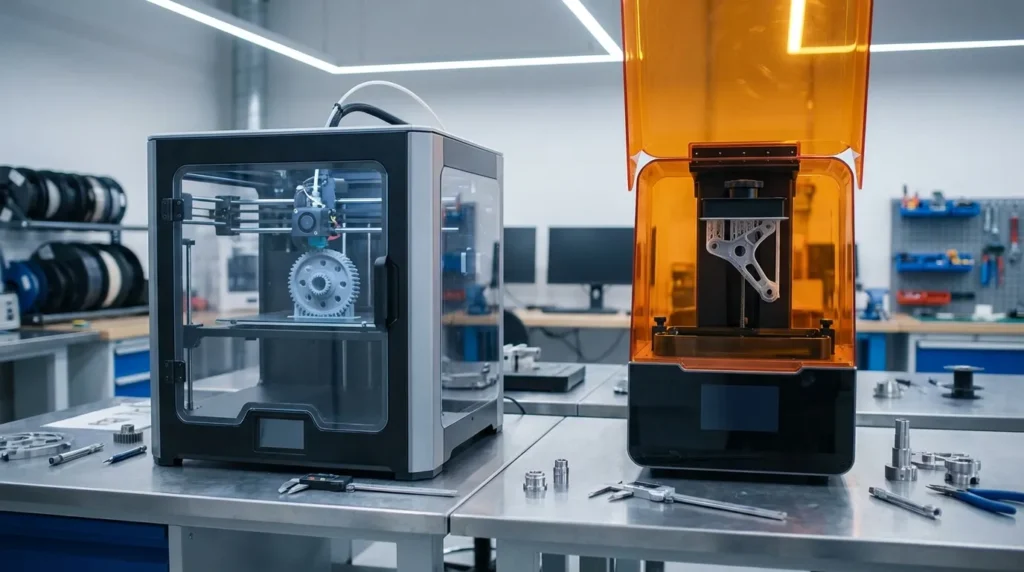
FDM 3D printing vs SLA: Best Fit for Manufacturing
Choosing between FDM 3D printing and SLA can feel confusing, especially when every supplier says their tech is the best (you’ve probably heard the sales talk). For engineers and manufacturers, this choice shows up quickly in speed, part strength, cost, and surface finish during day‑to‑day work. It matters, in my view. When the match is wrong, teams often slow down, reviews drag on, and hand‑offs get messy. When it’s right, development cycles can shrink by weeks, keeping design, testing, and production moving together, which really matters in practice.
This guide is written for professionals in Australia who want reliable, high‑precision output they can actually use, not results that only work in a lab. It explains how FDM and SLA work, where each one usually does well, and the limits that tend to show up on real jobs. No fluff. The focus stays on industrial production, with costs and use cases explained in a practical way, not hobby examples.
It also ties in modern high‑speed FDM systems used on real shop floors. That includes enclosed machines, advanced motion systems, IDEX dual extrusion, and firmware like Klipper. These updates often change what FDM can do today, and how teams use it in production, sometimes in surprising ways.
How FDM 3D Printing and SLA Technologies Actually Work
At a basic level, FDM and SLA are usually trying to solve the same problem, just by taking very different routes. That difference is the whole point. FDM 3D printing melts thermoplastic filament and places it layer by layer as a part forms. SLA takes another approach, using liquid resin that hardens when exposed to light, creating each layer in place instead. Same goal, different methods. This core difference shapes how each system behaves, from material options and accuracy to day-to-day workflow and handling. In my view, it strongly affects how people end up choosing between them for real-world use.
FDM systems work by pushing solid filament through a heated nozzle. Materials like PLA, ABS, PETG, and several engineering plastics are common, and you’ve probably heard of at least one. The process is simple and reliable, and it scales well, from small desktop printers to large industrial machines on factory floors. That helps explain why FDM holds the largest share of the global 3D printing market. Part strength and accuracy often depend on details like layer bonding and extrusion temperature, and those details matter more than many people expect. Cooling behavior also has an effect. Modern machines manage these factors with sensors and firmware, so consistency has improved a lot over time.
Fused Deposition Modeling (FDM) technology captured the maximum market share in 2024. The growth of FDM is mainly due to the ease of operation and advantages associated with the technology.
SLA works by curing resin with a laser or an LCD screen. Each layer forms all at once, often upside down on desktop machines, which surprises many people. This method usually supports very fine detail and smooth surfaces, making sharp edges and readable text easier to achieve. The prints look clean, but the work doesn’t end when printing finishes. Parts need washing and curing, and they require more careful handling overall. That adds chemical and safety steps to the workflow, which you’ll notice pretty quickly.
Here is how the two compare on core technical benchmarks used in manufacturing.
| Parameter | FDM | SLA |
|---|---|---|
| Typical layer height | 0.1, 0.3 mm | 0.05, 0.15 mm |
| Minimum feature size | ~1 mm | ~0.1 mm |
| Surface finish | Visible layers | Smooth |
| Post‑processing | Minimal | Required |
Speed, Throughput, and the Reality of Production Printing
Speed usually isn’t just about how fast the printer moves. It also includes setup time, failed prints, how much attention the operator needs, and everything that happens once the machine stops. These parts of the process are easy to miss. They start to matter quickly when teams compare real workflows against slicer time estimates. Those estimates look exact, but they rarely tell the full story.
SLA can seem very fast for small, detailed parts. A visual prototype, for example, may finish sooner than FDM if you only compare layer exposure times. On paper, that looks great. The catch shows up right after printing ends. Parts need solvent washing, then UV curing, and supports must be removed carefully. This work takes time and focus. After a few production runs, the extra labor and added consumables are hard to ignore.
FDM layers often take longer on their own, but the part usually comes off the bed ready to use. In most cases, there are no follow‑up steps. With newer high‑speed FDM systems, the difference has shrunk a lot. Klipper firmware with input shaping, paired with stiff motion systems, allows much higher acceleration without losing accuracy. Many users are still surprised by this. In real shops, it can mean close to double the usable output from the same printer.
In production, throughput often matters more than top speed numbers. FDM works well for daily use. Several printers can run at once with little supervision, and material swaps often take just minutes. When a print fails, fixing it is simple and doesn’t mean draining resin or stopping nearby jobs, which many teams see as a clear advantage.
Formlabs benchmark testing shows that a multi‑part assembly can finish faster on SLA if you only count machine time. Even so, many manufacturers stick with FDM because hands‑on time stays lower and schedules are easier to manage week to week.
This is where industrial FDM systems often stand out. Enclosed chambers, rigid frames, and well‑tuned firmware allow nonstop printing for days or even weeks, as long as maintenance stays on schedule. For Australian workshops making tooling and fixtures for short‑run manufacturing, that steady reliability often matters more than surface finish alone.
Strength, Materials, and Functional Performance
In rough, real‑world conditions, parts usually succeed or fail because of how they’re made, not how they look in theory. That gap helps explain why FDM often leads industrial 3D printing and ongoing production support. When the same job needs to run over and over, reliability matters. People want results they can count on every time.
That confidence comes from materials teams already trust. FDM uses thermoplastics common on factory floors, including reinforced nylons, carbon‑fiber blends, glass‑filled polymers, and higher‑temperature options like PC and PA‑CF. In daily use, these materials handle mechanical loads, deal with heat, and stay stable around oils, solvents, and other chemicals. Most of the time, they just work without issues.
SLA has improved, with tougher and more flexible resins now on the market. Still, resins are often more brittle than thermoplastics. That difference shows up once parts move past visual models or dental forms. With constant loading, higher heat, or repeated stress, limits usually appear sooner than people expect.
SLA produces parts with excellent surface finish and highly detailed features and can print quicker when compared to FDM. FDM on the other hand is cheaper, has more material options, and produces stronger parts.
For jigs, fixtures, and production aids, FDM is usually the safer choice, especially in mining, agriculture, and manufacturing across Australia. In these settings, parts that take impacts, last longer, and can be repaired often matter more than a flawless surface finish. Many teams learn this after testing SLA for functional prototypes, then moving back to FDM once real loads hit the shop floor.
Cost, Maintenance, and Long‑Term Ownership
The upfront price of a printer gets most of the attention, but that’s rarely where the real cost shows up. What’s often missed is everything that comes after: materials, maintenance, downtime, safety gear, and labour over the machine’s lifetime. In many cases, these ongoing pieces are where costs slowly add up and where teams feel the strain day to day.
With FDM, filament is easy to find and usually affordable, thanks to many suppliers and local distributors, handy when material is needed fast. Storage is simple for common filaments, with no special handling or tight controls. If a print fails, the wasted material is usually small and easy to live with. Regular upkeep, like swapping a nozzle or tightening a belt, is quick and low risk, and it’s often done by the team already on site (which I think matters).
SLA changes that picture. Resin costs more and reacts to light and temperature, so storage and handling need extra care. Waste disposal adds more rules and cost. Maintenance focuses on optics, vats, and cleaning systems, and if that slips, production can stop. Over time, these details tend to push running costs higher.
That’s why, in schools and small manufacturing teams, FDM often reduces operational risk. Training is easier, confidence grows faster, daily use involves fewer safety steps, and slowdowns happen less often, less friction in real terms.
Where High‑Precision FDM 3D Printing Fits Today and Tomorrow
For functional parts and factory support, high‑precision FDM 3D printing is still a top choice, and that didn’t happen by chance. Over the last five years, the technology has changed fast. Accuracy and repeatability that once felt limited to SLA are now common on advanced FDM systems. That shift comes from several upgrades coming together at the same time. Better motion control, stiffer frames, and more dependable extrusion now usually show up as a single package. That wasn’t always the case, and expectations have gone up because of it.
IDEX dual extrusion is a big driver of this change. Soluble supports and true multi‑material printing often lead to cleaner surfaces and more accurate internal features, especially with complex shapes. With fewer trade‑offs, designers can build assemblies without awkward workarounds. Enclosures with active thermal control also help when running engineering plastics and composites.
Firmware like Klipper adds real‑time tuning and vibration control, which changes how motion is handled at higher speeds. In continuous production, this level of control often matters more than raw resolution numbers.
SLA will keep growing in medical and dental work where very fine detail and smooth finishes are required. That part is clear.
Stereolithography (SLA) is estimated to grow at a high CAGR in the forecast period due to its ability to deliver exceptional precision, fine detail, and smooth surface finishes.
FDM continues to pull ideas from industrial automation and modern software, and that steady progress is why teams still depend on it every day, something you likely see yourself.
Making the Right Choice for Your Workshop
The technology that usually works best is the one that fits how a workshop actually runs, not the one with the longest feature list. I think it helps to start with a few down‑to‑earth questions instead of overthinking it. Are the parts meant to handle real loads, or are they mostly for show? Will heat or chemicals be part of daily use? How much does fast iteration affect everyday work? In most shops, you’re dealing with multiple users, shift changes, and imperfect conditions, and those factors often matter more than ideal setups.
When the answers point to repeatable results and materials that directly support output, FDM 3D printing is often the more practical option in workshops. It’s generally built for steady, ongoing work. SLA tends to work better as a support tool, especially for fine details or display models, where surface finish matters more than volume.
For Australian professionals, local support, easy access to spare parts, and real industrial systems can make a clear difference when issues come up. From my perspective, putting money into accurate FDM platforms with good integration and hands‑on training often pays off quickly by cutting downtime and making iteration smoother, something teams notice right away in daily use.
