
Table of Contents
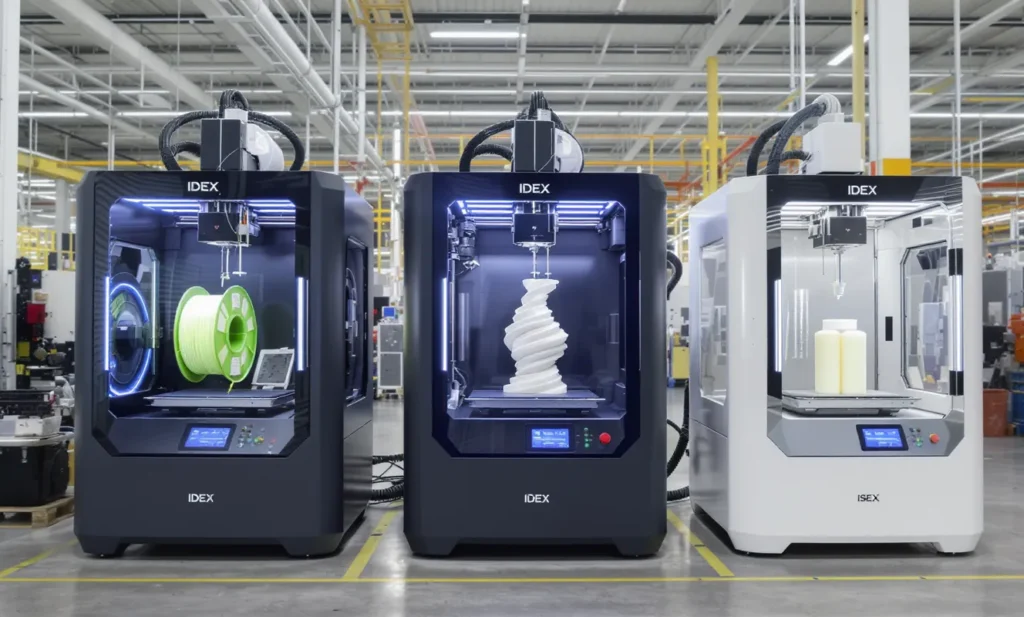
FDM 3D printers vs SLA vs SLS: 2025 Industrial Guide
In 2025, industrial 3D printing is no longer a niche capability; therefore, it’s a core manufacturing tool shaping production lines in aerospace, automotive, medical, and advanced prototyping across Australia. While FDM 3D printers have historically been viewed as entry-level, recent advancements in speed, material science, and multi-head extrusion have positioned them as serious contenders against SLA and SLS technologies for many industrial applications.
Moreover, this guide explores FDM vs SLA vs SLS in detail, providing Australian engineers, manufacturing professionals, and technical educators with the insights needed to choose the right technology for prototyping, tooling, and production-grade applications.
FDM’s industrial role is shifting from simple prototyping to production-grade tooling, thanks to advancements in high-speed extrusion and carbon-fiber-reinforced filaments.
FDM 3D Printers: Industrial Evolution
Fused Deposition Modeling (FDM) remains the most widely adopted 3D printing method globally. Furthermore, in 2025, it has evolved far beyond its desktop origins. Industrial FDM systems now feature hardened nozzles, enclosed build chambers with thermal management, and motion control systems capable of print speeds exceeding 500 mm/s.
Additionally, the material range has expanded to include engineering-grade polymers like PEEK, ULTEM, and carbon-fiber-reinforced nylon, making FDM suitable for functional tooling and low-volume production runs. In many facilities, these machines are integrated directly into production cells, allowing manufacturers to produce tooling overnight for next-day use. With embedded sensors and AI-driven print optimization, FDM systems can now predict extrusion anomalies before they affect part quality, further increasing reliability.
| Feature | Industrial FDM | Advancements |
|---|---|---|
| Speed | Up to 500 mm/s | High-flow heads, Klipper firmware |
| Materials | PEEK, ULTEM, CF-nylon | Improved extrusion systems |
| Applications | Tooling, jigs, fixtures | Production-grade reliability |
For Australian manufacturers, the cost efficiency of FDM 3D printers, especially in short-run production, is a compelling advantage. Moreover, with multi-nozzle and IDEX systems, teams can produce complex multi-material parts without the prohibitive costs associated with resin or powder-based systems. In regions with limited access to imported materials, the ability to source and print with locally available filaments adds another layer of resilience to supply chains.
Learn more about industrial-grade dual extrusion setups for advanced FDM workflows.
SLA Technology vs FDM 3D Printers: Precision and Surface Quality
Stereolithography (SLA) uses photopolymer resins cured by laser or LCD projection to achieve exceptional detail, with tolerances as fine as ±0.025 mm. SLA is the go-to choice for dental, medical, and aesthetic prototyping applications where surface finish is critical. In high-value industries, SLA’s ability to replicate fine features such as micro-textures or intricate engravings makes it indispensable.
However, SLA’s limitations in build volume and the brittleness of many resins make it less suitable for large-scale functional parts. Post-processing is minimal compared to FDM, but resin costs and handling requirements increase operational overhead. Many Australian labs address this by implementing resin recycling systems and optimizing part orientation to reduce waste. Furthermore, SLA’s growing material portfolio, including toughened and heat-resistant resins, is expanding its scope into functional prototypes that endure moderate mechanical stress.
SLS remains unmatched for complex geometries and functional assemblies without support structures, but FDM is closing the gap in mechanical performance for certain industrial parts.
SLS Technology vs FDM 3D Printers: Strength and Complexity
Selective Laser Sintering (SLS) fuses powdered polymers, most commonly Nylon 12 or PA11, using a laser, producing strong, complex geometries without the need for support structures. SLS excels in aerospace, automotive, and defense sectors where load-bearing parts and intricate internal channels are required. Consequently, the isotropic mechanical properties achieved with SLS mean parts can perform reliably across multiple axes, a critical factor in safety-critical applications.
Its batch-production efficiency is high, but entry costs are significant due to the need for industrial-grade powder handling and post-processing equipment. In Australia, SLS adoption is concentrated in specialized hubs, often for prototyping high-performance parts. Facilities using SLS often pair it with automated depowdering stations to speed up turnaround times, making it more viable for short production cycles. Moreover, the technology’s ability to integrate multiple functional elements, like hinges, ducts, and lattices, into a single print reduces assembly labor and potential points of failure.
| Metric | FDM | SLA | SLS |
|---|---|---|---|
| Speed | High | Moderate | High |
| Precision | ±0.1–0.2 mm | ±0.025–0.05 mm | ±0.1 mm |
| Material Range | Wide polymers | Photopolymer resins | Nylon, composites |
| Surface Finish | Requires post-processing | Excellent | Good, grainy |
| Cost per Part | Lowest | Moderate | High initial |
Decision Factors for FDM 3D Printers in Industrial Applications
When selecting between FDM 3D printers, SLA, and SLS for industrial use, consider:
- Part Size: Large functional parts favor FDM or SLS.
- Precision: SLA dominates fine-detail prototyping.
- Material Properties: FDM offers broad polymer compatibility; SLS excels in mechanical strength.
- Production Volume: SLS suits batch runs; FDM is optimal for short-run, custom tooling.
Additionally, environmental factors such as temperature stability, humidity control, and operator skill level can influence technology choice. Australian manufacturers working in remote areas often choose FDM 3D printers for their lower maintenance demands, while high-tech medical labs in urban centers may prefer SLA for its accuracy. For continuous operation, maintaining your printer’s reliability is essential. Our industrial 3D printer maintenance guide covers strategies to minimize downtime, including predictive analytics and spare-part inventory planning.
Case Studies: Australian Manufacturing Success with FDM 3D Printers
One Melbourne-based automotive supplier adopted high-speed FDM 3D printers for producing jigs and fixtures, cutting lead times by 65% compared to outsourced CNC machining. By integrating Klipper firmware and hardened nozzles, they achieved consistent precision while reducing material costs. Consequently, this shift allowed them to respond faster to design changes and reduce dependency on external machining services.
In Brisbane, a medical device prototyping lab uses SLA for surgical guides, leveraging its biocompatible resin capabilities. The lab reports a 40% improvement in fit accuracy over traditional manufacturing methods, improving patient outcomes. Meanwhile, a Sydney aerospace company runs SLS for complex ducting components, eliminating assembly steps thanks to intricate internal geometries and reducing part weight by 15% through lattice structures.
| Company | Technology | Outcome |
|---|---|---|
| Melbourne Auto Supplier | FDM | 65% faster tooling |
| Brisbane Medical Lab | SLA | High-precision surgical guides |
| Sydney Aerospace | SLS | Integrated ducting components |
These examples highlight how tailoring technology to specific operational needs delivers measurable benefits. Moreover, whether in speed, precision, or functional performance, the diversity in application reflects a growing trend toward multi-technology integration across Australian manufacturing.
Industry Trends and Future Outlook
The next five years will see:
- Hybrid Manufacturing: Combining FDM with CNC for final finishing.
- Automation: Robotic part removal and FDM print farms.
- Sustainable Materials: Bio-based filaments and recyclable powders.
Furthermore, expect AI-assisted design tools that automatically optimize parts for specific printing technologies, reducing material use and print time. Australian manufacturers are increasingly blending technologies, using FDM for cost-effective tooling, SLA for high-detail parts, and SLS for structural components. Consequently, as government incentives for advanced manufacturing expand, more small-to-medium enterprises will gain access to these technologies, boosting competitiveness and innovation.
Implementation Strategies for 2025 with FDM 3D Printers
To maximize ROI:
- Match technology to application requirements.
- Invest in operator training for material handling and calibration.
- Use multi-head or IDEX setups for complex parts.
- Implement predictive maintenance to avoid downtime.
In addition, integrating workflow software that manages print queues across different technologies can streamline production. Data-driven scheduling ensures that high-priority parts are allocated to the fastest suitable machine, while longer jobs run overnight.
For short-run production, FDM’s speed and material cost efficiency are hard to beat, especially with new multi-nozzle and high-temperature systems.
Conclusion: Why FDM 3D Printers Lead in 2025
In 2025, choosing between FDM 3D printers, SLA, and SLS for industrial applications comes down to matching the technology to your specific production needs. FDM’s advancements make it a viable alternative to SLA and SLS in many scenarios, offering speed, versatility, and cost efficiency. SLA continues to lead in precision and finish, while SLS dominates in strength and complexity.
Ultimately, Australian manufacturers can benefit from integrating multiple technologies into their workflows, leveraging each for its strengths. Whether you’re producing high-detail prototypes, functional tooling, or complex assemblies, the right choice will enhance productivity and quality. The future will likely see increased interoperability between these systems, with shared data streams enabling real-time quality control across mixed-technology production lines.
For those seeking industrial-grade FDM 3D printers, Raven 3D Tech offers tailored systems and upgrades, ensuring your operation stays competitive in the evolving manufacturing landscape. By staying informed and investing strategically, Australian manufacturers can position themselves at the forefront of the global 3D printing evolution.
