
Table of Contents
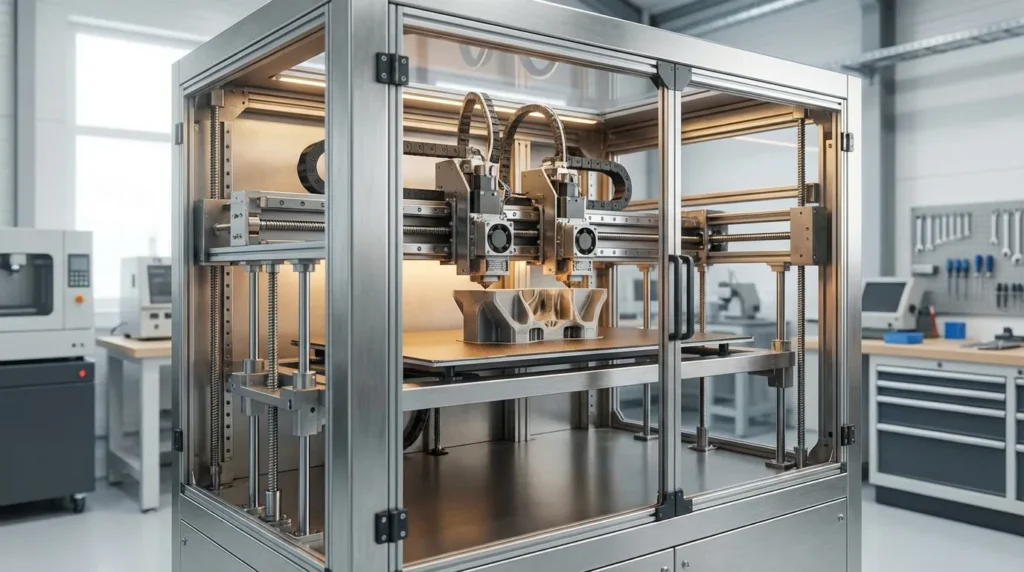
FDM 3D Printer Setup for Industrial Applications
Industrial FDM printing isn’t just about parts that look nice anymore. These days, how well a part performs usually matters more, especially when production timelines are tight and mistakes get expensive fast (and they often do). For engineers and manufacturers across Australia, setting up an FDM 3D printer has become an important step toward reliable tooling and faster moves from prototypes to short production runs. When setup is rushed, or treated like a weekend hobby, material gets wasted, prints fail, and machines sit unused. That kind of downtime adds up faster than most teams expect.
What makes this guide helpful is its focus on what actually works under real pressure. Speed, precision, thermal control, and repeatability come first, because in production-grade printing those usually matter more than flashy extras. Whether the machine is a RatRig V-Core system or a more complex industrial platform with dual extrusion, the same core ideas tend to hold true.
You’ll find practical advice on preparing the machine properly, tuning motion systems so they behave under real load, and controlling heat during long print cycles that run overnight. The focus stays on hands-on details. Think about how consistent material handling cuts down on surprises, or how locked-in workflows keep results steady from job to job. We also look at current market data and industry trends to show why careful FDM 3D printer setup matters more now than it did just a few years ago.
Understand the Industrial Role of FDM 3D Printer Setup
It’s easy to focus on tools and settings, but the more interesting part usually comes earlier: where FDM actually fits in modern manufacturing. This isn’t a fringe process anymore. FDM now leads industrial polymer printing because it’s fast, affordable, and flexible enough to handle very different production needs, which helps explain why it has stayed relevant. In day‑to‑day use, industrial teams often depend on it for jigs, fixtures, functional prototypes, and even end‑use parts that need to work the same way every time. This is real production work, not lab‑only testing.
That change shows up clearly in recent market data. Industrial users now make up most global FDM use, and that has quietly raised expectations. Standards are higher, mostly out of necessity. Repeatability and uptime are treated as basics, while process control is part of daily operations, the unglamorous but necessary parts of the workflow.
| Metric | Value | Year |
|---|---|---|
| Global FDM market size | USD 2.10 billion | 2024 |
| Industrial share of FDM usage | 76% | 2024 |
| FDM share of all 3D printing | 35.7% | 2025 |
| Industrial 3D printing CAGR | 15.1% | 2026, 2035 |
Those numbers help explain why setup gets so much attention. In production settings, small setup mistakes usually scale fast and become obvious. A minor calibration issue can affect dozens of parts in a single shift, which adds up when one team is responsible. Industry leaders also point to growing use in high‑reliability sectors, where failure usually isn’t tolerated, even once.
Throughout 2024, additive manufacturing (AM) has continued to demonstrate tremendous value as it’s integrated into production manufacturing workflows. As we look to the coming year, I expect we’ll see adoption continue to accelerate in high reliability markets such as energy, oil and gas, semiconductor capital equipment manufacturing, and aerospace and defense.
Build a Rigid and Accurate Mechanical Foundation for FDM 3D Printer Setup
Mechanical accuracy sits at the center of high-speed, high-precision FDM printing. Industrial machines often run at 300 to 500 mm/s or more, and at those speeds, small mechanical problems don’t stay hidden for long. Ringing, layer shifts, small size errors, and uneven surfaces tend to appear quickly, and once you see them, they’re hard to unsee.
The frame is one of the first places where this becomes obvious. A stiff frame cuts down vibration and keeps the printer’s geometry stable while everything is moving fast. Systems like the RatRig V-Core are built with this goal, but careful assembly still matters a lot. Every fastener should be tight, and the frame needs to be square. Even a small twist can come back later as accuracy trouble, which is especially annoying after a long print.
The motion system also deserves close attention. Belt tension often matters more than people expect. Belts that are too loose can cause backlash and sloppy movement, while belts that are too tight can wear out bearings and motors faster. Rails or rods should move smoothly without binding. Spending extra time here usually saves you from repeated tweaks later.
High-speed printers also depend on firmware motion tuning. Tools like input shaping counter resonance and reduce vibration. Klipper firmware is common in industrial FDM setups because it handles this well. With the right FDM 3D printer setup, printers can move faster and still leave clean surfaces, which makes a real difference at high speeds.
We covered how high-speed motion tuning works in a video that shows it clearly.
Axis alignment and steps-per-millimetre should still be checked at the end. Measure real movement instead of trusting only the screen. It’s a quick step, but skipping it often leads to prints that are just slightly off where accuracy matters most.
Control Heat for Consistent Industrial Results
The shift from hobby to industrial FDM usually shows up first in thermal management, often more than people expect. Many industrial materials don’t just need to melt and stick together; they need steady heat to print cleanly and hold their shape. When that steadiness drops, warping and layer separation show up quickly, often in the first few layers (which is always annoying). You’ll see it as curled corners or weak seams. Either way, it’s frustrating to deal with.
One of the key upgrades is an enclosed build volume. Enclosures reduce drafts and sudden room-temperature changes that can cool parts unevenly. For engineering plastics, passive enclosures are often not enough. Actively heated chambers keep the entire print at a steady temperature from start to finish. That consistency matters most on taller parts (that’s usually where failures start). The result is prints that behave much more predictably.
Hotend performance is often the next weak spot. Industrial printing usually means higher flow rates and higher temperatures over long runs. If heat control drifts, uneven extrusion can show up later, even if the first layers looked fine. That’s tough to spot early, in my view.
The build plate also needs attention. A flat, evenly heated surface helps first-layer adhesion and keeps parts accurate where they touch the plate. Using more than one temperature sensor can confirm heat stays even across the surface (especially near the edges). Small check. Big payoff.
Handle Materials Like Production Inputs, Not Consumables
In industrial settings, filament is usually treated as a raw input, not something you grab and forget about. It’s closer to ingredients than office supplies, and that difference often shows in the results. Moisture control matters a lot, especially with nylon, carbon fibre blends, PPS, and other engineering plastics. It may sound like a small detail, but it often has a big impact. Once filament absorbs moisture, prints can form bubbles, layer bonding weakens, and surface quality often drops sooner than expected.
Sealed, dry storage makes a real difference, especially when paired with active drying when needed (yes, even if it feels a bit obsessive). This simple habit often pays off. Even PLA can run into problems after sitting in humid Australian conditions, which happens more often than people think. For long, continuous jobs, why risk it? Inline dryers help keep moisture out during extended runs and cut down on mid‑print surprises nobody wants.
Nozzle and extruder choices matter too. Abrasive materials usually need hardened nozzles to limit wear over time, worth it here. Dual‑drive extruders tend to grip better at higher speeds and often reduce slip that can derail prints.
Once material profiles are tested and proven, they should be locked in. Shortcuts rarely help. Dr. Scott Dunham from Additive Manufacturing Research notes that industrial users now focus heavily on utilisation rates and uptime, which explains why predictable material behaviour matters so much.
Mixing brands or grades without revalidation is risky. Even small changes in diameter or formulation can affect results, so any material change should be treated like a process change, because it usually is.
Establish Repeatable Calibration and Workflow Standards
Repeatability is what usually turns an FDM printer into a dependable production tool in day‑to‑day use. It often begins with bed leveling, but the real gains come from slowing down and giving first‑layer calibration proper attention, this is an easy step to rush. Automated probing saves time and cuts down on guesswork, but manual checks still matter. That first layer often sets the tone for the whole print. When it’s right, scrap goes down and rework becomes rare, which makes daily printing far less frustrating.
Once that base is set, extrusion flow and pressure advance deserve attention. These settings control how material behaves when speeds change during a job, especially on short moves. With careful tuning, corners get sharper, surfaces look cleaner, and parts land much closer to their intended dimensions, often one of the clearest improvements you’ll see.
IDEX systems add flexibility, but they also require patience. Each toolhead needs its own calibration, and even small nozzle offset errors can add up fast, especially with dual‑material or mirrored parts.
Documenting settings as you go usually pays off. Notes on firmware, slicer profiles, and materials help keep production runs consistent. When changes are needed, testing them one at a time mirrors CNC‑style control and, for most teams, works well, much like adding calibration checks to routine maintenance.
Prepare for Scaling and Long-Term Reliability
What really makes scaling less stressful, at least in my view, is long-term reliability. That often matters more than short-term output once industrial FDM moves beyond just a few jobs. In Australia, high-mix, low-volume production is growing, and FDM usually fits this approach well. It only works over time, though, when machines can run day after day without needing constant attention, which can wear people out fast.
You will often see that remote monitoring changes how teams handle prints. Being able to follow a job while it runs and catch problems early gives clearer insight, especially on longer prints. AI-assisted tools can spot layer shifts or extrusion loss before a job is fully ruined, which can save both material and time.
Maintenance planning matters just as much. Instead of waiting for breakdowns, scheduled checks like cleaning rails, inspecting belts, and replacing wear parts help avoid trouble. Preventive maintenance usually costs less and helps avoid downtime no one wants.
As materials and print speeds improve and standards rise, printers built with solid industrial discipline adapt more easily and keep operations ready for what comes next.
Put Industrial FDM Setup Into Practice
What usually makes industrial FDM work is steady performance over time, not a single setup day. The process often gets better as the system settles in. A solid mechanical build comes first, especially the frame, motion system, and bed, because that’s where stability really shows. From there, reliable thermal control keeps long prints running smoothly, and careful material handling matters from storage right up to the moment printing starts. You will see that repeatable workflows help the most when teams need clear steps for FDM 3D printer setup, loading, and daily use. Ongoing maintenance then treats the printer like the production asset it is, without shortcuts.
For Australian engineers and manufacturers, this approach often leads to faster prototyping and tooling, along with steady short-run production week to week. It also protects the investment by reducing failures and wasted time during normal use.
When upgrading a machine or bringing a new industrial printer online, these steps deserve attention. The payoff shows up in better prints and confidence in every part that comes off the bed.
