
Table of Contents
Exploring the Benefits of Automation in 3D Printing Workflows
Automation is changing how industrial 3D printing works. What once felt very hands-on and manual now usually runs faster, with fewer surprises along the way, which is, honestly, a relief. For engineers and manufacturers, this shift isn’t about replacing people. It’s mostly about cutting out friction from everyday tasks. Less hassle and fewer interruptions really do help. Long setup times and repeated errors slow teams down, and production cycles can stretch out. Automation helps reduce those issues and makes workdays smoother, and usually less frustrating for everyone involved.
In industrial 3D printing, especially with high-speed FDM, workflows often matter just as much as the printer itself, sometimes even more on busy days. A fast machine can still struggle if calibration drifts, or if a job stalls overnight and no one notices. Automated workflows lower those risks in practical, visible ways. They help keep machines running, improve part quality, and make each print more reliable, even during long production runs, which often matter when deadlines are tight. That’s why automation is now seen as a basic requirement, not just a nice extra.
This article looks at how automation supports industrial 3D printing, starting with setup and moving into full production, step by step. It uses real data and expert insight, with hands-on examples throughout. The focus stays on FDM systems used for prototyping, tooling, and end-use parts. If you work in manufacturing or education, or hold an advanced technical role in Australia, this should help you see where automation fits into your setup, and where it can help the most.
Why Automation Is Becoming Essential in Industrial 3D Printing
Industrial 3D printing has moved well beyond simple prototypes. Many companies now rely on FDM systems for jigs, fixtures, and finished parts that are bolted onto machines or used every day on the shop floor. That’s real production, not test pieces. As demand grows, manual workflows often start to struggle and fall behind. Automation helps keep output steady across shifts and can make scaling feel simpler, without adding extra staff or confusion. For many teams, this makes growth easier to handle.
This change is happening quickly, and market data supports it. It doesn’t need much explanation, because the trend is easy to see.
| Metric | Value | Year |
|---|---|---|
| Automated 3D printing market size | USD 5.6 billion | 2024 |
| Market growth rate | 24.8% CAGR | 2024, 2030 |
| Manufacturers increasing 3D printed parts | 70% | 2023 |
Those numbers show a clear pattern. Businesses want faster turnaround and better use of their machines, which likely sounds familiar. Industry reports say 47% of manufacturers point to lead-time reduction as their main reason for automation. With automated scheduling and machine monitoring, issues are spotted sooner, downtime is flagged, and daily production runs more smoothly. Fewer surprises usually help a lot.
Automation is often seen as the step between short runs and full production as volumes grow.
Additive manufacturing isn’t competing with traditional methods. Instead, it offers manufacturers opportunities for efficiency gains, increased supply chain security, and reduced carbon footprints. The integration of artificial intelligence and automation is improving AM precision and speed, making mass production easier.
For Australian manufacturers dealing with high labour costs and long supply chains, these benefits often matter even more.
Automating the Core Steps of an FDM Workflow
An FDM workflow usually includes more steps than people expect at first, and that’s often where small risks slip in. File prep moves into slicing and calibration (the setup stage many people rush), then printing, followed by part removal and quality checks. When these steps are done by hand, each one can add small differences that build up over time. Automation turns this into a repeatable process that runs the same way job after job, which is often where the real value comes from.
Automated calibration is one of the clearest benefits. Modern industrial printers can level beds, adjust flow, and check offsets in a single setup step, usually right before heating starts. This removes a lot of guesswork and, in many cases, reduces failed prints. It can also lower long-term wear on machine parts.
Job handling is another area where automation helps. With saved slicing profiles and print queues, operators don’t have to constantly monitor screens. Jobs are set up once and reused, which is especially useful for printer fleets making the same parts, where consistency often matters more than speed.
Material handling also improves. Sensors can pause prints when filament runs out or catch jams early, before problems spread. Combined with dry storage, this keeps moisture-sensitive materials more stable.
To bring it all together, many engineers prefer visual walkthroughs, such as watching an automated calibration step by step, since it’s often clearer than reading specs.
Higher Utilisation and Real ROI From Automation in 3D Printing Systems
The most interesting change with automation isn’t convenience, it’s how reliably machines stay busy. When printers sit idle, money quietly slips away, and most shops notice it faster than they expect. Automated workflows usually keep machines running at a steady pace, often through full shifts, and that’s where the real difference shows up.
In 2024, global 3D printing industry revenue reached USD 3.47 billion in Q3 alone, with services growing at 14% year over year. Much of that growth comes not from buying more hardware, but from using existing machines more efficiently, which is a small change with a big payoff.
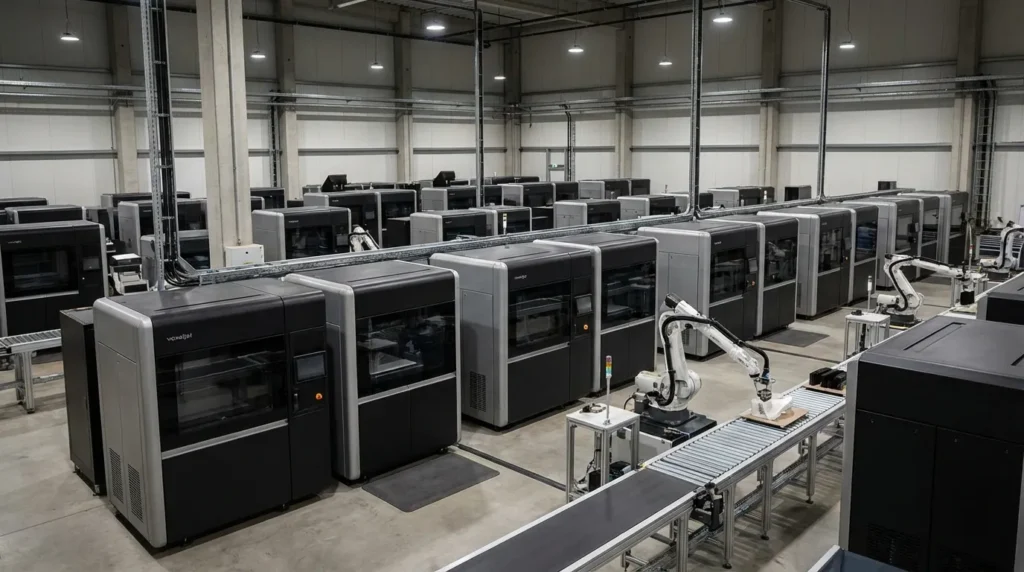
With central control software, printer farms can run day and night without someone watching constantly. Jobs queue on their own, failures send alerts, and operators stay informed instead of stuck staring at screens. This setup, often called lights-out manufacturing, usually leads to higher output.
The results show up clearly in production numbers.
| Automation Benefit | Operational Impact | Business Result |
|---|---|---|
| Automated scheduling | Higher uptime | Lower cost per part |
| In-situ monitoring | Fewer failed prints | Less material waste |
| Repeatable profiles | Consistent quality | Easier certification |
Industry leaders expect this trend to continue, and many are already planning around it.
2026 will not be the year of more printers, but the year of more industrial parts produced, higher machine utilization, and clearly measurable return on investment.
Avoiding Common Automation Mistakes in Production Environments
More downtime instead of less is usually the first sign that something went wrong. Automation has clear benefits, but only when it’s handled carefully, which teams sometimes miss. Automating an unstable system is a common mistake. If a printer isn’t mechanically sound, automation just repeats the same problems, only faster. The issues don’t change, they just appear more often.
Profile control is another area where problems show up. Using one slicing profile for every material and shape often causes quality issues. Automation works best when profiles are tested in real production conditions and then locked for use. Clear names linked to specific materials and geometries help make sure no one has to guess later.
Training is often underestimated too. Automation reduces daily manual tasks, but operators still need to understand the system well. Alerts don’t explain themselves, and when they appear, staff must know what they mean and how to respond. There really aren’t any shortcuts here.
Ignoring data adds another risk. Automated systems create logs, metrics, and long-term trends. Print times, failure rates, and material usage can point to ways to improve, but only if someone actually reviews them.
Experts predict that handling this data well will shape the next phase of industrial additive manufacturing.
For me, 2026 marks the tipping point: the year AM finally breaks free from its prototyping roots and establishes itself as a practical, scalable production technology across multiple mainstream industries.
Automation Trends Shaping the Future of Automation in 3D Printing
Several trends show where automation in 3D printing is heading over the next few years. One of the more noticeable shifts is autonomous print farms. These setups run dozens of machines through one dashboard, usually on a factory network, which often makes day‑to‑day oversight easier for you. Jobs often move on their own to open printers and select the right material, with very little manual input. In day‑to‑day use, that usually means less hands‑on work and fewer routine checks, which is welcome on busy production floors.
AI‑driven quality control is another major change. Cameras and sensors watch prints as they run, often checking quality layer by layer. When defects show up, the system can pause or stop a job, cutting down wasted machine time and unnecessary reprints. Having fewer surprises helps, especially during overnight runs.
Digital inventory is growing too. Instead of storing shelves of parts, companies keep approved design files and print only when needed. This works especially well in Australia, where remote sites may depend on fast access to spares located hundreds of kilometres away.
Automation is also fitting more smoothly into wider manufacturing systems. 3D printing now connects with planning, scheduling, tracking, and reporting, so it feels like part of the normal workflow instead of a separate island.
Putting Automation Into Practice on the Shop Floor
For industrial users, hardware choices often shape everything that comes after. Rigid frames, steady motion systems, and reliable extrusion usually make the difference between automation that scales and setups that struggle. When the mechanics fall short, automation rarely fixes the problem.
From there, getting started doesn’t mean swapping out everything at once. Most teams begin with calibration tasks and basic monitoring because they bring quick wins with low risk. That early confidence helps people trust the process, and small, clear successes matter more than big promises.
Materials and profiles are then standardised so production stays consistent across shifts and machines. Job queues often follow, along with remote monitoring when it makes sense, like checking machine status without being right there. Step by step, this approach often leads to full workflow automation without overwhelming anyone, which I think matters.
Firmware also comes into play. More advanced control systems allow deeper automation and clearer feedback, including better status data and error reports. Paired with high-speed FDM platforms, this supports real production use. As Dr. Yoav Zeif from Stratasys has said, automation helps move additive manufacturing into production through repeatable quality and digital traceability, which matches what many Australian manufacturers want today.
Where to Go From Here
For industrial users, automation in 3D printing is usually no longer optional. It speeds up production and helps teams keep quality consistent at scale, which is often the toughest part. With automated calibration and printer fleets running overnight, the payoff often shows up fast, sometimes after just a few cycles. Once teams see that, there’s rarely much debate.
What usually comes next for engineers and manufacturers is a clear-eyed review. The biggest clues are often in the messy parts of the workflow. Where do errors show up? Where is time quietly being lost? Those spots are usually where automation helps first, and the signs are often obvious.
Instead of changing everything at once, it makes sense to start small. Changes get tracked, adjustments are made (this step matters), and then things expand. With automated calibration and managed printer fleets in place, industrial 3D printing often runs reliably during real production, including overnight runs that carry through to the next day.
