
Table of Contents
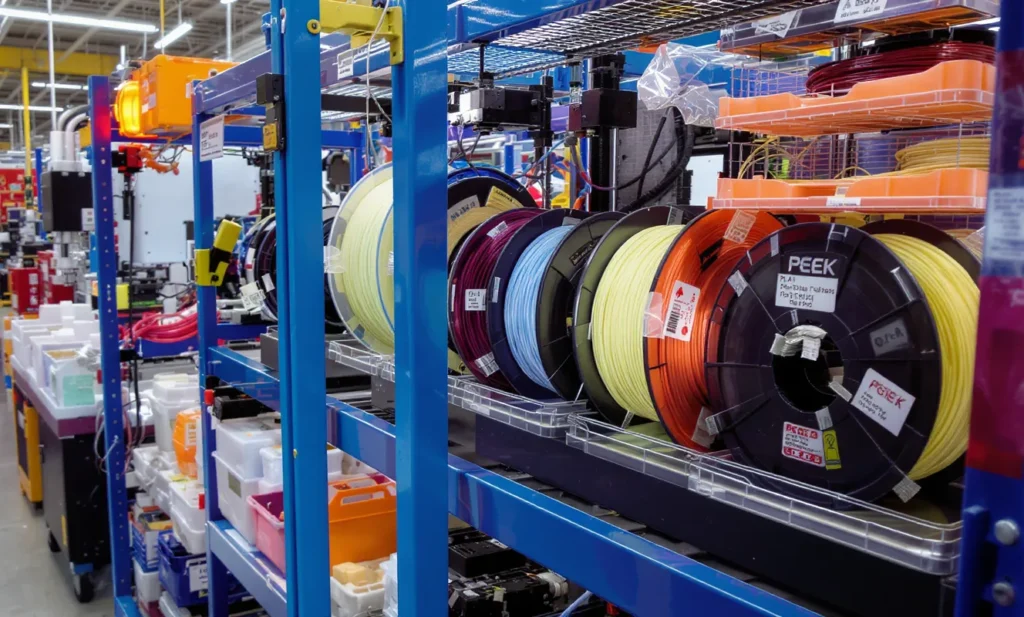
Complete Guide to 3D Printing Filaments: Selection, Storage, and Handling for Precision Results
Industrial engineers and manufacturing professionals in Australia know that precision FDM 3D printing doesn’t start with the printer, it starts with the filament. The wrong material choice, poor storage conditions, or improper handling can undermine even the most advanced RatRig V-Core or IDEX-equipped system. This guide will walk you through filament selection, storage, and handling so you can consistently achieve high-speed, high-precision results.
Understanding 3D Printing Filament Selection for Industrial FDM
Choosing the right 3D printing filament is about matching material properties to your application. For high-speed, high-precision work, especially in prototyping, tooling, and production-grade applications, the choice directly impacts mechanical performance, dimensional accuracy, and surface finish.
PLA filament remains the most widely used in FDM printing, around 40% of global print jobs, thanks to its ease of use, low warp, and biodegradability. However, its limited heat resistance makes it unsuitable for high-temperature applications. For example, PLA may lose structural integrity if used for machine housings exposed to sustained heat. Understanding such limitations ensures your design specifications align with material capabilities.
PETG offers a balance of toughness, chemical resistance, and ease of printing, making it ideal for functional prototypes and parts requiring some flexibility. ABS delivers higher heat resistance and strength but requires a controlled environment to prevent warping, often necessitating enclosed chambers and consistent ambient temperatures.
Engineering-grade filaments like Nylon, PEEK, and PEI (Ultem) are used in aerospace and automotive prototyping for their exceptional strength and thermal performance. These materials often require specialized hotends capable of reaching 350°C or more. Composite filaments reinforced with carbon fiber or glass fiber add rigidity and specialized properties, such as reduced thermal expansion, which is vital in precision tooling.
Selecting the correct filament isn’t just about reading datasheets, it involves testing under real-world conditions. Many industrial teams create small benchmark parts to evaluate layer bonding, finish quality, and tolerance compliance before committing to full production.
| Filament Type | Key Properties | Typical Applications |
|---|---|---|
| PLA | Biodegradable, easy to print | Prototypes, educational models |
| PETG | Impact and chemical resistant | Functional parts, jigs |
| ABS | Heat resistant, strong | Enclosures, tooling |
| Nylon | High strength, wear resistant | Gears, mechanical parts |
| PEEK | Extreme heat tolerance | Aerospace, medical devices |
For precision FDM printing, filament storage is as critical as printer calibration. Moisture ingress can ruin dimensional accuracy and surface finish, especially with hygroscopic materials like nylon and PETG.
Moisture Management: Why 3D Printing Filament Storage Matters
Moisture is the silent killer of filament quality. Hygroscopic materials like Nylon, PETG, and PVA can absorb up to 10% of their weight in water over a few weeks. This leads to poor layer adhesion, stringing, and surface defects, ultimately compromising the mechanical integrity of parts. Water in the filament vaporizes during extrusion, creating bubbles and microvoids that weaken the structure.
In humid regions of Australia, airtight containers with desiccants are a must. Silica gel packs, molecular sieves, or rechargeable desiccants help maintain low humidity levels inside storage boxes. Many industrial setups now use filament dryers that maintain 45–60°C for Nylon, or dry boxes with integrated humidity sensors that provide real-time readings. Some facilities even integrate automated alerts when humidity exceeds a set threshold, ensuring proactive maintenance.
When storing PLA, avoid prolonged exposure to sunlight or high temperatures, PLA can deform at around 60°C, which can easily occur if left near machinery exhausts or windows. Climate-controlled storage ensures consistent extrusion performance and prevents spools from becoming brittle over time. In large-scale operations, centralized filament storage rooms with temperature and humidity regulation have become standard practice, reducing variability across production lines.
Handling 3D Printing Filament for Precision Results
Proper handling starts with controlling environmental factors during use. Always feed filament directly from a dry box when printing with moisture-sensitive materials. This prevents absorption during longer prints, especially for parts that may take several hours to complete. Even a small increase in moisture during a print can cause dimensional drift.
Label each spool with its purchase date, batch number, and any drying cycles it has undergone. Industrial users often employ QR-coded spools to track storage history and usage data, linking this information to print quality records for traceability. This process is particularly important in regulated industries like medical device manufacturing, where material provenance is critical.
When switching between materials, purge the hotend thoroughly to avoid cross-contamination, which can cause surface defects or weak layer bonding. For instance, residual carbon fiber composite can scratch a brass nozzle if not properly cleared, affecting extrusion consistency.
Additionally, ensure spools are mounted securely with smooth feeding paths to prevent tangles or uneven tension. Poor spool management can introduce micro-pauses in extrusion, visible as artifacts in the print surface.
The next big leap in filament technology will be AI-driven material profiling, allowing printers to auto-adjust extrusion parameters based on real-time feedback about filament condition and geometry.
Integrating 3D Printing Filament Management into High-Speed Workflows
High-speed 3D printing amplifies any inconsistencies in filament condition. At 200–300 mm/s, even slight moisture content can cause extrusion instability, leading to skipped layers or poor adhesion between passes. The faster you print, the less margin for error exists, making integrated filament management systems a necessity.
For advanced RatRig V-Core or IDEX dual extrusion systems, consider pairing filament management with 3D printer thermal management to stabilize print chamber conditions. This combination supports continuous production with engineering-grade materials, ensuring that both environmental and material variables are controlled.
In lean manufacturing environments, integrating filament handling into standard operating procedures streamlines workflow. For example, automated spool changers can be synchronized with production schedules, while predictive maintenance systems monitor filament usage and alert operators before quality issues arise. This level of integration helps maintain consistent output even under demanding timelines.
Common Mistakes to Avoid
- Neglecting moisture control: Skipping filament drying for Nylon or PETG often leads to failed prints, wasted material, and downtime for rework.
- Improper storage: Leaving spools in open air between prints allows moisture ingress, especially in coastal areas with high ambient humidity.
- Mixing filaments without purging: Leads to inconsistent extrusion and poor surface finish. Residual high-temperature materials in a hotend can char when exposed to lower-temperature filaments.
- Ignoring batch variations: Different batches can have slight diameter differences, track them to adjust slicer settings and maintain dimensional accuracy.
- Overlooking environmental impact: Not accounting for seasonal humidity changes in storage conditions can cause performance shifts in otherwise stable materials.
Advanced 3D Printing Filament Considerations for Australian Manufacturers
Localized manufacturing trends mean more SMEs are investing in in-house high-speed FDM. With Australia’s varying climate, from humid coastal cities to dry inland regions, storage solutions must be tailored. In coastal Queensland, dehumidified storage is critical, whereas in arid Western Australia, dust control may be more relevant.
AI slicing tools can now optimize profiles for specific filament conditions, reducing trial-and-error. These systems are particularly valuable in multi-material printing with IDEX setups, as covered in IDEX system installation and calibration. For manufacturers producing parts under ISO or AS standards, integrating filament condition data into compliance documentation can streamline audits and certification.
Another consideration is supply chain stability. With global filament demand rising, securing consistent quality from suppliers and performing incoming material inspections is becoming standard practice for advanced Australian facilities. Investing in local filament production can mitigate shipping delays and reduce environmental footprint.
Building Your Success with 3D Printing Filament Management
Selecting the right filament and maintaining its quality through proper storage and handling is non-negotiable for high-precision results. Pairing these practices with advanced printer technologies and environmental control will set you apart in industrial applications.
Start by auditing your current filament storage setup, introducing airtight containers and dryers where needed. Train your team on handling protocols, and integrate tracking systems for filament batches. Consider implementing preventive maintenance schedules for drying equipment to ensure consistent performance.
By mastering filament management, you not only improve print quality but also reduce waste, align with sustainability goals, and maximize the return on your high-speed FDM investment. Over time, these practices lead to predictable manufacturing outcomes, which is invaluable for scaling production.
For further reading, explore how FDM compares to alternative technologies in FDM 3D printers vs SLA vs SLS, and how thermal management can boost your production reliability.
Your path forward: treat filament as a critical asset, not a consumable. Precision results start here, and with disciplined management, your filament will consistently deliver the performance your industrial applications demand.
