
Table of Contents
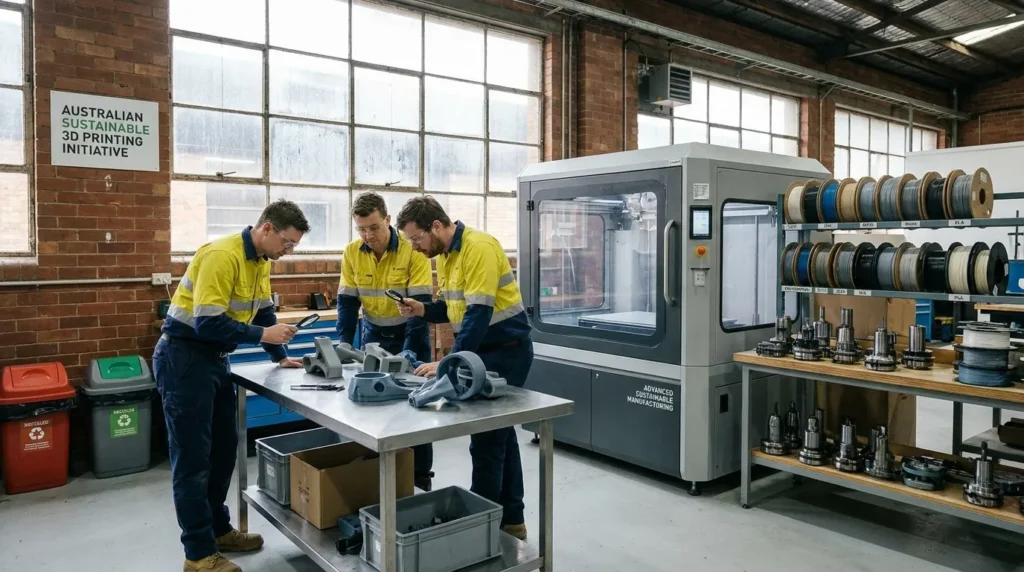
Sustainability in 3D Printing: Practices for Industrial Applications
Industrial 3D printing is often described as a cleaner way to make parts, and in many cases that’s true. Still, the full picture is a bit more complex. A printer is not automatically sustainable just because it builds parts layer by layer. In practice, better results usually come from smart design, reliable machines, better material choices, and careful process control (that’s the part that really matters). That’s usually where the real difference comes from.
This becomes even more important as additive manufacturing moves further into production. The global 3D printing market is projected at USD 23.41 billion in 2025 and USD 28.55 billion in 2026, and the industrial 3D printer market is growing quickly too. As more factories bring in additive methods, the question is no longer just “Can we print this?” It is more often “Can we print this in a way that reduces waste, saves time, supports long-term operations, and works reliably day after day?” That means paying closer attention to output, downtime, and material use (not just whether the part prints at all). It’s a bigger question now, and a more practical one.
For engineers, production teams, educators, and advanced users in Australia, sustainable 3D printing goes beyond environmental goals alone. It is also closely tied to part cost, freight, stock levels, uptime, and repeatability. So in this guide, we’ll look at what sustainability really means in industrial applications, where FDM fits best, the mistakes that create waste, and practical steps you can take to improve results on the factory floor (which is probably where this matters most). Straightforward, but important.
Why sustainability now matters in industrial 3D printing
Sustainability is no longer just a side issue in manufacturing. It now shows up in everyday buying decisions. Companies are paying more attention to waste, energy use, transport distance, repairability, and how much scrap is created before a part is ever used, which is a pretty big shift. Because of that, industrial applications are often planned differently than they used to be.
In a 2026 outlook, de Vet said the technology’s impact is now defined less by possibility and more by measurable results across production, repair, and sustainability initiatives.
Recent industry data gives a clearer picture of why this matters. Depending on the process and the part design, additive methods can cut material waste by 30% to 95%, and some industrial cases are even stronger. GE Aviation’s fuel nozzle manufacturing, for example, has been cited at 95% material efficiency. At the same time, it’s not a one-sided story. In some cases, certain additive manufacturing processes can be 50% to 100% more energy-intensive than traditional manufacturing. That is worth keeping in mind when comparing methods.
| Metric | Value | Why it matters |
|---|---|---|
| Global 3D printing market | USD 23.41B in 2025 | Shows fast adoption and rising impact |
| Material waste reduction | 30% to 95% | Strong sustainability potential |
| Some AM energy use | 50% to 100% higher | Efficiency depends on process and part |
| GE fuel nozzle efficiency | 95% material efficiency | High-value case for additive design |
The table sums up the main idea. Sustainable 3D printing can offer major benefits when it is matched to the right type of job. For simple, low-cost, high-volume parts, older methods may still be the better choice. Additive usually makes a stronger case for complex parts, tooling, fixtures, spare parts, and short production runs. That is the straightforward version, and often the most useful one when comparing options.
Design choices drive most sustainability gains
One of the biggest myths in industrial 3D printing is the belief that material alone decides whether a process is sustainable. In real use, design usually has more impact. When a part is designed badly, it often needs more supports, takes longer to print, ends up heavier, and needs extra post-processing. That adds up fast. Better design cuts those problems in a very direct way.
For industrial FDM systems, this starts early with decisions about orientation, wall thickness, infill, support strategy, and part consolidation. One redesigned part can sometimes replace several machined parts or assembled sections. That means fewer fasteners, less labour, fewer assembly steps, and less inventory to handle. It can also improve serviceability, often because there are simply fewer separate pieces involved. Even a small design change can make a noticeable difference here.
A clear example comes from metal powder bed fusion, where support design strongly affects waste. AMFG reports that support structures can account for around 10% of waste. With better design decisions, that number can drop to around 2%, which shows a pretty big difference.
In metal powder bed fusion (PBF), supports can generate around 10 per cent of waste. However, with a good design approach, aimed at minimising supports, it is possible to reduce this number to around 2 per cent.
The same idea applies to high-speed FDM. A fixture printed flat instead of vertically may need less support and finish faster. When infill is matched to real load requirements instead of being set by habit, material use goes down. Careful use of dual extrusion or IDEX can also make support removal easier without adding unnecessary production time. Early design choices often shape the result more than people expect.
So for teams working with fast, precise FDM systems, design for additive should include a simple checklist: reduce supports, right-size infill, combine parts where it makes sense, and avoid overbuilding non-critical features when the extra material is not really needed.
Materials, waste, and the real value of print success
Material waste is often the clearest part of the sustainability story. Failed prints, support purge, damaged spools, wet filament, and poor storage can quickly turn good plans into waste in the bin. In industrial settings, print success rate matters just as much as the material itself, because scrap ends up on the floor and reruns use machine time.
That is where machine quality and maintenance start to really matter. A well-tuned printer with stable motion, accurate temperature control, and reliable filament handling will often waste less material over time. For production teams, maintenance is not just about uptime. It also affects sustainability and the material budget.
In FDM, common waste points include nozzle clogs, poor first layers, wrong cooling, and moisture in engineering-grade filament. These may seem like small problems, but they often lead to scrap, reruns, and lost machine hours. Technical educators and workshop managers see this regularly. When a printer fails often, it can teach bad habits and use up stock.
Practical waste reduction steps are simple:
Build a repeatable maintenance routine
Set a schedule that works for you to check belts, nozzle condition, bed surface, extrusion path, and calibration. It’s a simple habit, and a steady printer usually means fewer failed parts.
Store filament correctly
Sealed storage really helps, and hygroscopic materials should be dried. Wet filament often causes weak parts, stringing, and failed prints, so this may be a simple fix.
Match material to application
If PLA, PETG, or a tougher standard material can do the job, there’s usually no need to choose a polymer that’s harder to process. Durability matters, but over-specifying often creates waste and uses extra energy.
Measure scrap, not just output
Track failed print percentage, kilos of support used, and part acceptance rate, including the small stuff. These numbers often reveal easy savings and can usually show where waste really happens.
As teams improve process control over time, it often gets much easier to show the sustainability value of industrial applications with real numbers instead of broad claims.
Energy use, machine efficiency, and local production in Australia
Material savings matter, but energy use can change the whole result. Some additive processes use much more power than people expect, especially when print times are long, machine use is low, or a job fails right near the end, which is always frustrating. Because of that, sustainable 3D printing usually needs to be looked at across the whole workflow rather than at just one step.
Environmental pressure to reduce energy consumption and emissions is also accelerating adoption, she noted, as AM enables component consolidation and lighter, more efficient designs.
For FDM users, energy performance usually comes down to a few practical factors: bed temperature, chamber heat, print time, failed jobs, and how often the machine is left on while idle. They sound minor, but they build up over time. Faster printers can support sustainability when they reduce cycle times without creating accuracy problems or leading to more failed prints. Speed by itself is not really the goal, though. In most cases, the more useful measure is efficient throughput across the full job.
This is especially relevant in Australia. Long supply chains, freight costs, and remote operations can make local production much more useful, especially for regional sites. Printing a replacement jig, bracket, maintenance tool, or similar part on site can reduce transport emissions while also cutting downtime at a mine, workshop, or service location. On-demand production can also reduce the need to keep large amounts of slow-moving stock in storage, which is a very practical benefit.
In many industrial environments, this local model is often where additive manufacturing becomes most useful. It helps regional workshops, education labs, maintenance teams, and manufacturers that need parts straight away instead of waiting through a long freight delay. Right away, not days later.
A supplier focused on robust, high-precision FDM systems such as Raven 3D Tech fits naturally into this kind of workflow, where speed, repeatability, and integration usually matter more than consumer-grade convenience, and that is arguably the real distinction.
Circular thinking: reuse, repair, and smarter material planning
A more sustainable workflow does not end once a part leaves the build plate. The next step is circular thinking. The idea is pretty simple: ask how long the part is likely to last, whether it can replace a more wasteful assembly, and whether the process allows reuse or repair, which is often the practical part people leave out.
Reuse is getting better across additive manufacturing. In powder-based systems, unused material can often go back into later builds. As one industry source notes, ‘For most industrial applications, unused metal powder can easily be recycled and used for the next build job.’ FDM does not work quite the same way, though, so better planning usually matters even more there, especially when the goal is to cut waste before printing begins.
A durable printed fixture that lasts six months is often more sustainable than a weaker part that needs reprinting every two weeks. In the same way, a printed spare part that keeps a machine running can often be more useful than replacing the whole assembly. That helps explain why repair applications are getting more attention.
There are limits too. Around 50% of AM materials are currently non-renewable or difficult to recycle. Because of that, broad green claims are best avoided. It usually makes more sense to look at the feedstock source, part life, local availability, and disposal options. In technical education, this is a useful teaching point as well: sustainability depends on systems thinking, not just a simple label, and that often becomes clearer through examples like a longer-lasting fixture or a repaired machine.
How to build a practical sustainability plan for your print operation
A sustainability plan doesn’t need to be complicated, which is probably a relief. It should be measurable, though, especially around the operational metrics that matter most in industrial use. Then focus on improving one area step by step, so tracking progress stays realistic.
A simple framework often works well, and in most cases it keeps things practical.
1. Audit the current process
Start by tracking failed prints, support use, and machine idle time. If possible, also note kWh per part, freight avoided with on-demand printing, and lower stock obsolescence.
2. Improve the printer setup
Focus on calibration, thermal stability, and preventive maintenance, since that often makes a real difference. For many teams, this is still a big gap. Maintenance also directly affects waste and energy use, so it’s worth closer attention.
3. Standardise material handling
Set clear rules for storage, drying, labelling, and spool rotation, simple steps that are easy to miss. Good handling often lowers scrap and reduces downtime too.
4. Redesign parts for additive
Use lighter shapes, avoid support-heavy setups, and combine parts where it makes sense, usually in most cases. Pretty simple stuff, I think.
5. Review each use case honestly
Additive makes the most sense for prototypes, tooling, fixtures, spare parts, low-volume end-use parts, and complex components; that is usually where it works best. It should not be pushed into every job or every situation.
A peer-reviewed 2024 review from AIMS Press found that several 3D printing methods can support sustainable production, though the outcome likely depends on the process and should be checked across the full lifecycle, not just one step. That approach usually helps here: measure it, compare the results, and keep improving.
Putting sustainable 3D printing into practice
The best sustainability results in 3D printing usually do not come from marketing claims. They come from steady daily discipline, even if that is less flashy. Parts need to be designed so they truly fit additive manufacturing. Materials should be used carefully. Machines need to stay calibrated so failed prints happen less often. Local printing can make more sense when freight costs rise or when storing parts for too long gets expensive. Success is best measured with real data instead of assumptions.
For industrial engineers and manufacturing teams, the point is pretty simple: sustainable 3D printing works best when it helps meet real factory goals. That can mean cutting scrap, speeding up tooling, keeping fewer spare parts in a warehouse, or reducing downtime at remote sites. It is very practical. For educators and advanced users, it also means teaching better process habits early and continuing to use them.
The opportunity is growing fast, and so is the need for clear thinking. Not every printed part is greener, and not every material is easy to reuse. Some jobs may simply not be worth the energy cost. But in the right industrial uses, additive manufacturing can reduce waste, shorten supply chains, and support a more flexible production model.
One useful approach is to start with one production cell, one material workflow, or one group of printed tools. Track the results, then expand what actually proves it works. That is usually how sustainability becomes practical and believable for your team.
