
Table of Contents
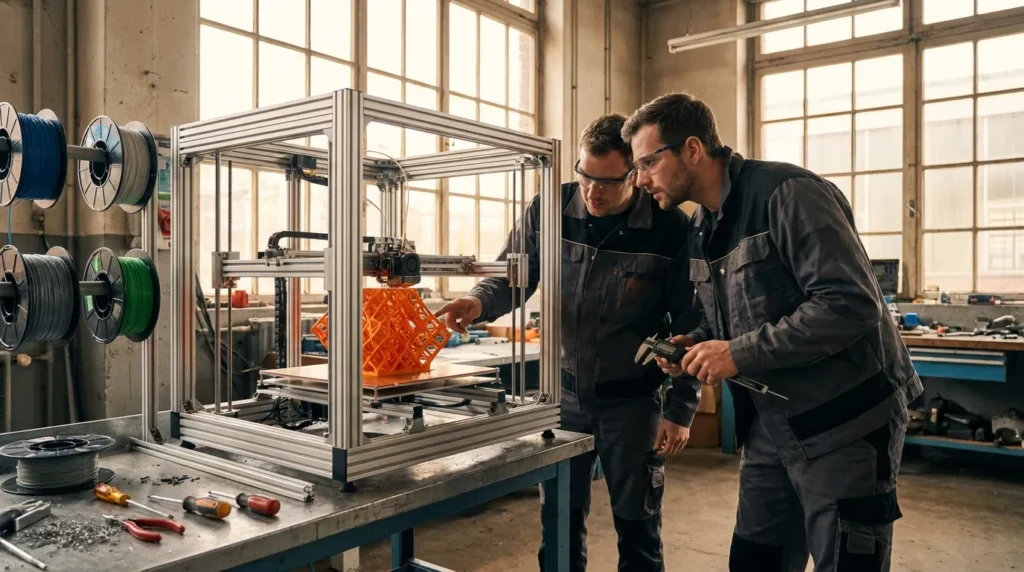
FDM 3D Printers: Key Concepts and Best Practices
FDM 3D printing has grown well beyond simple hobby use. Today, it supports prototyping, jigs, fixtures, teaching labs, and low-volume production too. For industrial engineers and technical teams in Australia, that shift matters because it can shorten design cycles, cut downtime on the factory floor, and give teams more control over how parts are made. In many cases, it also offers a more practical way to test ideas before moving into full production, which is often where time and cost pressure really starts to show. For teams working with fdm 3d printers, these benefits are becoming even more relevant as systems get faster and more precise.
For anyone learning 3d printing basics or revisiting what modern fdm 3d printers can actually do, it helps to start with the fundamentals. FDM, short for fused deposition modelling, builds parts layer by layer by pushing melted thermoplastic filament through a nozzle. That process sounds simple, and in some ways it is. Even so, results still depend on process control, material choice, machine setup, and part design, which usually explains why two prints from similar machines can look or perform very differently.
This article covers the main ideas behind FDM in plain language. It explains where FDM usually fits best, how high-speed systems are changing production costs, and which practices can improve accuracy, strength, and repeatability. It also looks at design for additive manufacturing, calibration, thermal control, and maintenance habits that often help teams get more out of each print. For professionals comparing local options, companies like Raven 3D Tech reflect the growing demand for industrial-grade FDM solutions built for speed and precision.
What FDM 3D Printers Are and Why They Matter
FDM is the most widely used type of additive manufacturing because it’s easy to understand, flexible, and affordable for many teams, which is likely a big reason it became so widely used. A spool of filament feeds into a hot end, and the process is fairly simple. The nozzle melts the material, places it along set paths, and the printer repeats that pattern layer by layer until the part is finished.
That same basic process now supports much more than early concept models, and recent market data helps explain why. The global 3D printing market is estimated at USD 29.3 billion in 2025, with one forecast putting it at USD 34.85 billion in 2026. The FDM 3D printer market by itself is expected to reach USD 3.07 billion in 2026 and keep growing strongly through 2035.
| Metric | Value | Timeframe |
|---|---|---|
| Global 3D printing market | USD 29.3 billion | 2025 |
| Global 3D printing market | USD 34.85 billion | 2026 |
| FDM 3D printer market | USD 3.07 billion | 2026 |
| Australia 3D printing market | AUD 821.94 million | 2025 |
These figures matter because they show FDM is no longer a niche option. In Australia, the 3D printing market is projected to grow at 18.70% through 2035. That growth is also helping increase adoption across mining, manufacturing, product development, and technical education, so it’s clearly not coming from only one sector.
Knowledge will continue to be democratized. Knowledge will enable users to make previously difficult parts, and produce parts faster; making AM more economically viable. AM will be adopted faster due to knowledge sharing.
Put simply, FDM matters because it gives teams a fast way to move from CAD to a physical part without tooling delays. That’s usually where the value becomes clear. If a team needs a prototype, a test part, or a quick design check, FDM often offers a practical way to get there faster.
How Modern FDM 3D Printers Deliver Speed and Precision
One of the biggest changes in recent years is speed. Newer desktop and industrial FDM systems are often described as 5x to 10x faster than machines from about three years ago. In the right conditions, some can now reach 500 mm/s, which is pretty amazing. Even so, not every job should run at full speed, but it still changes what these machines can do in most cases.
For engineers, faster printing means fewer machine hours for each part. It can also reduce labor costs, and iteration usually happens much faster. FlashForge industry analysis also points to a 40% drop in cost per part over three years by 2026, which is a big change. That is a main reason FDM is moving beyond prototyping and into production support.
To get both speed and precision, four things need to work together:
Motion system
A rigid frame, good rails, tuned belts, and stable toolheads help reduce vibration, which often matters a lot on fast machines. That seems very important.
Extrusion control
The printer needs to melt and feed filament at a steady pace. Bad flow can cause weak layers, rough surfaces, and lost detail, even from very small flaws.
Firmware tuning
Systems with advanced motion control can often reduce ringing and improve consistency, which really helps. That’s why many professional users pay close attention to firmware setup and tuning.
Thermal stability
Fast printing only really works when the hot end, bed, and chamber stay consistent, and that usually makes the difference.
In real use, this becomes practical pretty fast. A manufacturing team can print fixture revisions overnight instead of waiting days. A technical educator can show design changes within one class block, which honestly helps. An advanced hobbyist can also test functional assemblies much faster than before, so iteration moves more quickly.
Core 3D Printing Basics That Affect Print Quality
A lot of failed prints come from the same small issues. Once the basics are clear, it’s easier to spot and fix most problems early, before they turn into bigger ones. That’s why 3D printing basics matter, even for people who’ve been doing this for a while.
First-layer adhesion
The first layer usually decides how the whole build goes. If it doesn’t stick properly, the part can warp, shift, or fail, which is pretty frustrating, and you’ll probably notice the problem early.
Good results usually come from correct bed levelling, a clean build surface, and the right bed temperature. Some guidance also suggests raising bed temperature by 5°C to 15°C above the base setting when extra adhesion is needed, especially for trickier prints.
Nozzle and bed temperature
Temperature control affects bonding, surface finish, and dimensional stability, which matters a lot. If the nozzle is too cool, layers probably will not stick together well. If it gets too hot, surfaces can start to look messy and dimensions can shift. Bed temperature matters too, and you will often notice it right away because it affects first-layer grip and warping.
Cooling and ambient conditions
With some materials, too much cooling can weaken layer bonding. Too little cooling, though, can soften edges or overhangs, which is frustrating. It may seem like a small detail, but drafts and room-temperature changes can also hurt consistency.
Filament condition
Wet filament often causes popping sounds, a rough finish, and weaker parts. Good storage usually helps a lot, especially in humid places (it really does).
| Factor | If Too Low | If Too High |
|---|---|---|
| Nozzle temperature | Weak bonding, under-extrusion | Stringing, poor surface finish |
| Bed temperature | Poor adhesion, warping | Soft first layers, elephant foot |
| Cooling | Soft details | Weak interlayer bonding |
One common mistake is changing too many settings at once. It’s better to adjust one setting, test it, and then write down the result (just to keep things clear). That usually makes troubleshooting a lot easier.
Design for Additive Manufacturing Makes the Biggest Difference
A good printer can’t fully save a part that was never designed for FDM in the first place. Design for Additive Manufacturing, usually called DfAM, helps teams create prints that are stronger, faster to make, and cheaper overall, which is usually the goal. It’s one of the main reasons parts turn out reliable.
One of the first things to think about is how the part is built up in layers. That sounds simple, but with FDM it matters a lot. Parts are often weaker between layers than they are within a single layer, so orientation makes a big difference. If a bracket needs to handle a pulling force, it should be placed so the main load follows the strongest direction instead of crossing weaker layer lines.
It also helps to cut down supports whenever possible. They use more material, add print time, and leave extra post-processing work behind. Even small geometry changes can help. A chamfer instead of a flat bridge, for example, can make a part much easier to print and usually less annoying to clean up afterward.
Combining parts is another useful rule, when it really fits the job. With FDM, several simple components can often become one printed part. That can reduce assembly work and lower the number of possible failure points, which is often a real advantage.
A factory fixture is a good example. Instead of machining separate pieces and bolting them together, an engineer can design one printed fixture body with cable channels, grip features, locating points, and everything built in. Lead time gets shorter, and the fixture is easier to use on the production floor.
I highly recommend for any manufacturer to take a hard look at what it’s capable of today and make a decision if it’s suitable for the high-end production applications. And then, if it is, go for it. If not, keep it on the agenda to revisit on an annual basis because, some time in the future, it is very likely to be appropriate for an increasing number of manufacturers.
Common mistakes include ignoring anisotropy, using far too much support, and expecting moulded-part finishes straight off the bed. FDM usually works best when the design truly fits the process.
Materials, Dual Extrusion, and Industrial Use Cases for FDM 3D Printers
Material choice affects the result almost as much as machine choice. PLA is easy to print and usually works well for visual models, teaching, and some fit checks, so it is a fairly simple option. PETG gives you better toughness and chemical resistance. ABS, ASA, nylon, and other engineering polymers often make more sense for demanding work, especially when the printer can handle heat properly. It sounds simple, but here it really does matter.
Recent industry reporting shows that some modern FDM materials can handle thermal resistance above 200°C. That matters because it creates more options. So tooling and functional FDM parts become more realistic in more situations, especially when higher heat is part of the job.
Dual extrusion and IDEX systems also add flexibility. They allow support material, soluble interfaces, and even multi-material builds. In practice, that often means easier support removal. They can also help with mirrored production or with printing two versions of a part in one cycle, which lets teams do more at once.
For industrial teams, the strongest use cases today include:
Prototyping
Quick design checks, I think. Also assembly reviews and parts for functional testing.
Tooling and fixtures
Custom soft jaws, drill guides, assembly aids, and inspection tools are all pretty handy, useful stuff.
Bridge production
Short-run parts made while you wait, which usually helps. For machined tooling or injection moulds, maybe.
Education and training
Hands-on teaching in CAD, process control, and manufacturing workflow, the practical side of things.
Industry analysis suggests FDM is moving beyond prototyping and becoming a true production method for end-use parts that go straight into commercial products. That often matters for Australian teams, especially when they need local manufacturing, more flexibility, and in many cases, faster turnaround too.
Maintenance, Calibration, and Thermal Control for Reliable Output on FDM 3D Printers
A fast printer only helps if it stays reliable. Maintenance is where a lot of teams quietly lose performance, and they often do not notice it right away. Small checks now can prevent bigger quality problems later. It is easy to miss, honestly.
Start with the calibration basics: confirm bed level, Z offset, extrusion flow, and belt tension. Also inspect nozzles and fans, and check build surfaces on a regular schedule. Nothing complicated, just stay consistent. If dimensional accuracy starts to drift, mechanical looseness is usually a better first thing to check than slicer settings. In many cases, that saves time and avoids unnecessary changes.
Thermal management is also a big part of continuous printing. Stable temperatures help keep results repeatable, especially with engineering materials. During long jobs, watch for heat creep, enclosure overheating, or chamber conditions that keep changing. Problems like that can lead to clogs, layer shifts, or warping halfway through a print, which is often the most frustrating time for a failure.
Filament handling deserves attention too. Dry boxes and sealed storage help prevent avoidable defects, and clear material labels make tracking easier. In shared labs or production environments, simple handling rules can save a surprising amount of time. It is a small habit with a payoff teams usually notice pretty fast.
One more practical step is to create a standard print validation routine. Use one benchmark part for each material and nozzle size. Track print time, dimensions, weight, and any visible defects. That gives the team a baseline for machine health and process control.
We’re finally moving past the ‘wow factor’ and into true, scalable adoption, largely because platforms like HP’s Multi Jet Fusion are proving that 3D printing is a volume manufacturing solution, delivering isotropic, end-use parts with the throughput businesses actually need to scale.
That comment applies to additive manufacturing more broadly, but the same idea works for FDM. Scalable results usually depend on disciplined process control, not just owning the machine.
Putting FDM 3D Printers to Work in Your Operation
FDM is one of the simplest ways to bring additive manufacturing into everyday engineering work. It’s easy to understand, and good results usually come from getting the basics right. Since layers are built in a fairly straightforward way, it helps to understand that process first. Then fit the material to the job, keep first-layer adhesion under control, especially on the build plate, and pay close attention to temperature and cooling. Parts also need to be designed around the strengths and limits of the process. Good calibration, regular maintenance, and careful filament handling also help keep the printer running well, and that part often matters more than people expect.
For industrial engineers, manufacturing professionals, educators, and advanced hobbyists, modern fdm 3d printers now offer more than convenience. They support rapid iteration, custom tooling, practical low-volume production, and other everyday uses. Genuinely useful ones, honestly. Better materials and high-speed systems have improved the business case in real ways, I think. Australia’s growing market also shows that local demand is increasing quickly.
One simple next step is to review the current workflow and find an area where FDM can cut delays or reduce cost. That could be a prototype, a fixture, a spare part, or a teaching aid. Start with one clear application, measure the result, and build from there; the first try will probably teach a lot. That’s usually how real additive capability grows in practice, one useful part at a time.
