
Table of Contents
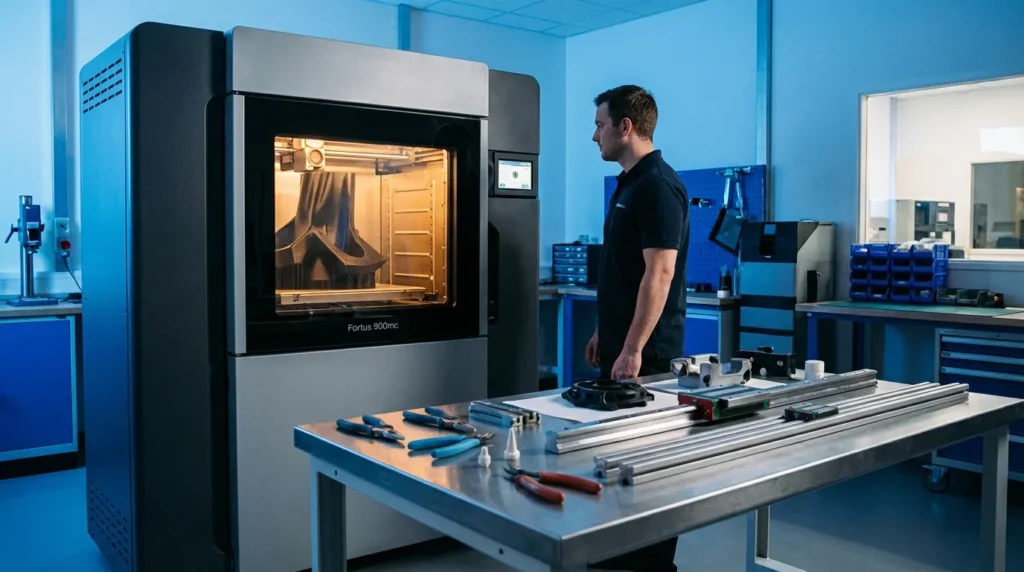
Navigating High-Temperature Materials for Industrial 3D Printing
Industrial 3D printing has moved quickly over the last few years, often faster than many people expected. What once felt experimental now appears every day on factory floors and in labs, including training spaces, not just R&D. Short production cycles are now normal. For many engineers and makers, the main challenge usually isn’t the printer anymore. It’s picking the right material and understanding how that material behaves under load as temperatures increase. High‑temperature 3D printing allows for stronger parts and real production use, with built‑in heat resistance for tough environments. At the same time, it brings new risks when settings, handling, or expectations are slightly off, which happens more often than people think. Small mistakes in this area can lead to much bigger problems.
This guide is designed to help explain industrial 3D printing materials that need careful heat control, especially in everyday production. Instead of focusing only on theory, it looks at what actually defines a “high‑temperature” material and why that matters when matching materials with the right industrial FDM printer setup. It also looks at common mistakes seen in real Australian use cases, which are often the most useful to learn from. The guide wraps up by looking at where the market is heading as adoption continues to grow.
For tooling, jigs, fixtures, or short‑run production, this usually matters more than printer speed. Reliability is part of the same discussion. For those teaching advanced manufacturing, it matters there too. Ultimately, understanding the principles of high‑temperature 3D printing early helps avoid many of the problems that appear later in production.
What High-Temperature 3D Printing Really Means
What often confuses people is that high‑temperature 3D printing isn’t just about running a nozzle hotter. The bigger challenge is managing heat across the whole system, the hot end, build plate, and, just as often, a heated chamber that many people overlook. When that balance slips, even well‑known industrial materials can fail in real-world use, and it often happens sooner than expected.
That’s why materials like PEEK and PEKK/PEI matter here. They’re built for tough environments, keeping their strength as temperatures climb while chemicals cause fewer problems. Under load, they usually creep far less than standard plastics, which helps explain why they’re common in aerospace, mining, oil and gas, and transport, places where failure isn’t an option.
The market growth makes this trend hard to ignore.
| Metric | Value | Year |
|---|---|---|
| High-performance 3D printing plastics market | USD 0.18B | 2025 |
| Projected market size | USD 0.45B | 2030 |
| CAGR | 20.4% | 2025, 2030 |
| High-temperature plastics market | USD 902.57M | 2025 |
Seen this way, the growth comes from production needs, not hype. Engineers want parts that can handle heat and pressure over long service lives, often measured in years. High‑temperature 3D printing can do that, but only with the right setup.
As one expert points out, thermal control matters at every level, with no real shortcuts.
There are a number of components that are key to consider when looking at an industrial 3D printer for PEEK, PEKK and ULTEM™, not least of which are the elements involved in managing the temperature of your key environments inside the printer: the hot ends, the build plate, and the chamber.
That’s usually why desktop machines fall short, and why industrial success depends so heavily on serious thermal design.
Comparing PEEK, PEKK, and Other Industrial FDM Materials
High-temperature materials often look similar on spec sheets, but they act very differently once they’re actually printed. Anyone who’s dealt with warped parts or a print failing halfway through knows this firsthand. Picking the wrong material can mean poor layer bonding or nonstop reprints, which gets frustrating quickly. In industrial FDM, the discussion usually comes down to PEEK and PEKK, with PEI showing up as a practical choice for some jobs.
PEEK is usually treated as the standard, and for good reason. It offers strong mechanical performance, excellent chemical resistance, and can handle continuous use around 260 degrees Celsius. The downside shows up during printing. PEEK is very demanding, especially for larger parts. If the printer doesn’t have extremely high nozzle temperatures and a well-controlled heated chamber, warping tends to appear early and often.
PEKK is often seen as the easier option. It comes from the same polymer family as PEEK, but it prints more reliably on the machines most shops already have. Materials engineers at 3DXTech often point to PEKK’s lower, adjustable crystallinity, which helps reduce shrinkage and keeps large prints from twisting. That difference matters in day-to-day production.
PEI, commonly sold under names like ULTEM™, is an amorphous material that prints at lower temperatures than PEEK. That’s a big reason it’s popular. It still provides solid strength and built-in flame resistance, making it a dependable choice for fixtures and housings.
The processing requirements show one thing clearly: the printer itself often matters more than expected. There aren’t many shortcuts.
| Material | Nozzle Temperature | Chamber Temperature |
|---|---|---|
| PEEK | 375, 450°C | 90, 200°C |
| PEKK | 350, 380°C | 25, 150°C |
| PEI | 340, 370°C | Heated recommended |
When a printer can’t reliably reach or maintain these ranges, print quality usually drops fast, and in most shops, that’s exactly what happens.
Printer Setup and Thermal Control That Actually Works
Material choice is only half the story, and this is where many prints start to fail. Printer setup often decides whether a job works or not, yet high‑temperature problems still get blamed on filament. In many cases, uneven heat inside the machine is the real cause. It’s a common situation, and you’ve likely seen it happen before.
In an industrial FDM setup, the hot end needs to run well above a material’s basic melting point. This matters even more with semi‑crystalline polymers, which don’t handle temperature changes very well. When heat drifts, even a little, problems usually show up fast, and rarely in a good way.
For high-performance polymers, you will need a hot end that can reach and exceed the materials melting temperature in the case of semicrystalline polymers, or well above the glass transition temperatures in amorphous polymers.
Chamber control matters just as much. Steady, even heat helps lower layer stress and stops corners from lifting during a print. Bed adhesion also needs to stay stable over long runs, not just at the first layer. In real‑world use, there aren’t many shortcuts here.
Firmware also makes a difference. Advanced systems allow tighter temperature tuning, smarter motion where it counts, and steadier pressure control. The goal is fewer surprises, which is why many Australian professionals use Klipper‑based setups for industrial jobs. This kind of fine control is especially critical in high‑temperature 3D printing, where consistency defines success.
For businesses running systems like RatRig V‑Core machines, careful tuning can turn speed into reliability. Companies such as https://raven3dtech.com.au/ focus on balancing performance with thermal stability so machines keep delivering every day.
Real Industrial Use Cases and Common Mistakes
High‑temperature 3D printing is already fixing real problems across Australia, often right out in the open. Mining companies use PEKK fixtures that handle heat and vibration without failing, which matters on sites with tough conditions. Universities print PEEK test parts for research rigs, and this often overlaps with small manufacturers swapping machined jigs for printed tools. The draw is easy to see when parts arrive in days instead of weeks, and those time savings add up fast.
From my experience, a common success path starts with PEKK and later moves to PEEK. This usually lowers risk while still giving reliable performance, making it a sensible step‑by‑step approach. Another route is using high‑temperature materials only for inserts or wear areas, while keeping the rest conventional, and that mix often works well.
Mistakes happen just as often. Moisture issues usually come from poor filament storage. Open‑frame printers can cause uneven cooling, and pushing print speeds too hard often weakens layer bonding. Skipping calibration adds to the problem, since high‑temperature materials magnify small errors. A slight bed tilt or small flow issue can easily ruin a print at 400 degrees.
Post‑processing is often overlooked. Annealing, controlled cooling, and inspection can be the difference between a usable part and a disappointing one.
Trends Shaping the Future of Industrial FDM Materials
What stands out right away is how steady the road ahead looks. The next few years point to gradual change instead of disruption, and that kind of stability helps teams plan with confidence. Major shakeups aren’t expected, and that’s not a downside. PEKK adoption keeps rising because it works on a wider range of printers and often fits into existing workflows without forcing teams to rebuild processes. Market data also shows PEEK materials growing at close to a 14 percent CAGR through 2033. That’s solid growth, even if it isn’t flashy.
Sustainability is becoming more common, which usually happens as technologies mature. Research shows a 25 percent increase in recycled and bio-based filament use across advanced markets. High-temperature polymers are still early here, but industrial FDM is likely to move the same way over time, slow at first, then faster.
Education shows another clear shift. TAFEs and universities now treat high-temperature printing as a standard skill, not a niche topic. That change quickly shapes expectations and helps create a workforce ready for production-level additive manufacturing from day one.
For Australian industry, the impact stays practical. Barriers to entry are lower, the knowledge gap keeps shrinking, and teams are now deciding whether printing fits a specific job, not whether it’s possible at all.
Putting High-Temperature Printing Into Practice
High‑temperature printing works best when you treat it as a connected system, not a one‑off upgrade. Results usually improve only when materials, machine setup, and daily habits line up at the same time.
Clear goals help keep everything on track. Decide if heat resistance or mechanical strength matters more for the job, then pick a material that fits that need. This step often gets skipped, and that choice usually leads to frustration that could have been avoided later.
Now think about the printer itself. Long prints tend to reveal weak spots. A chamber that can hold steady heat and a hot end that really stays above 350 degrees matter more when jobs run for hours. Firmware stability also matters, even if it’s easy to overlook.
Good habits add up over time. Keeping filament dry, doing routine calibration, and writing down settings all help. Running a small test coupon before a full build often saves time and wasted material right away. These consistent practices form the foundation of reliable high‑temperature 3D printing in any industrial environment.
