
Table of Contents
Integrating CNC with 3D Printing: A Guide to Hybrid Manufacturing
Manufacturing is speeding up in very practical ways. Parts are getting more complex, lead times are shorter than ever, and budgets feel tighter year after year (that pressure’s real). For many engineers and makers, choosing between CNC machining and 3D printing can feel like a dead end. CNC machining delivers accuracy and clean finishes, but setup time and heavy material removal can slow things down. 3D printing handles complex shapes quickly, but post‑processing and material limits often get in the way. Neither option covers everything on its own. That gap is where hybrid manufacturing starts to make sense.
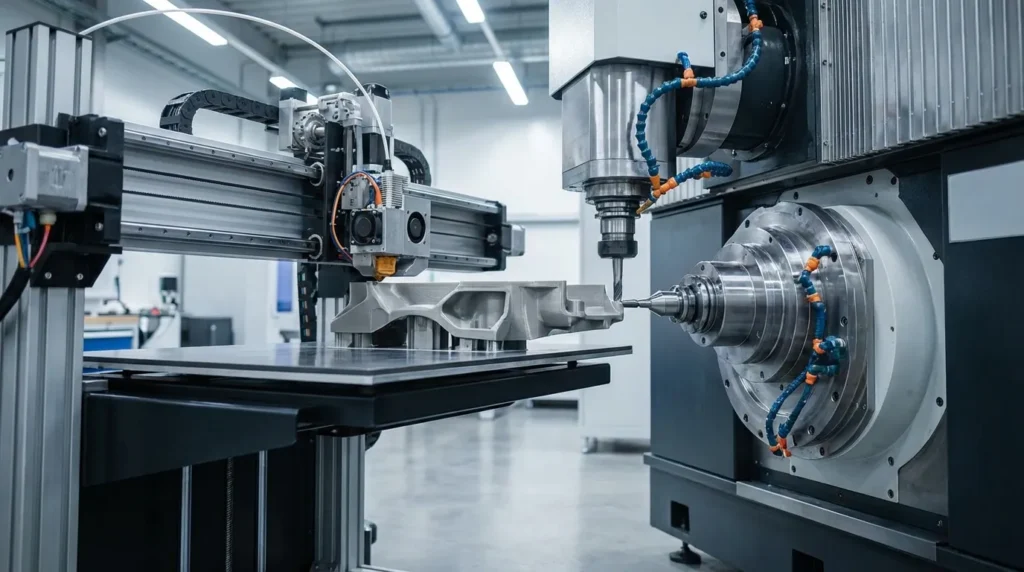
The appeal isn’t abstract. Hybrid manufacturing lets CNC and 3D printing work together in the same workflow. In some shops this happens on a single machine; in others it runs across connected systems on the floor, depending on how things are set up. Complex shapes are printed fast, then critical features are machined to tight tolerances and smooth surfaces. Speed comes from one process, precision from the other, and the finished part gets the benefits of both.
For Australian manufacturers, the timing matters. Local production needs flexibility to stay competitive, with little room for delays. Prototyping has to move quickly from idea to test part, while tooling still needs to hold up in real use and stay accurate. What’s changed is capability. Modern FDM systems now support hybrid manufacturing beyond large metal operations. Polymer parts, custom fixtures, shop‑floor jigs, and even finished end‑use components are all part of the picture.
This guide walks through what hybrid manufacturing looks like in practice. It covers how CNC machining and 3D printing work together, along with real‑world use cases and common mistakes teams run into, so expectations stay realistic from the start.
What Hybrid Manufacturing Really Means
Hybrid manufacturing treats CNC machining and 3D printing as one connected process from the start. Teams design parts knowing both methods will be used, without late handoffs or second guessing. Everything is planned together on purpose. The result isn’t two separate designs, but one better design that considers the whole build right away.
In a hybrid workflow, additive manufacturing usually comes first. 3D printing forms the base shape, including internal channels, complex curves, and lightweight structures, types of geometry that are hard or expensive to machine alone. CNC machining then steps in where accuracy matters most. It trims, drills, faces, and finishes key areas, giving clean edges and tight tolerances on surfaces that need to be exact.
This approach is gaining ground across global industry, and the data helps explain why.
| Metric | Value | Year |
|---|---|---|
| Hybrid additive manufacturing machines market size | USD 3.1 billion | 2025 |
| Projected market size | USD 25.5 billion | 2035 |
| Market growth rate | 23.5% CAGR | 2025, 2035 |
| Global additive manufacturing market size | USD 31.36 billion | 2025 |
The numbers point to real demand. Aerospace, tooling, medical, and energy companies are leading the shift because they depend on complex parts that still need very accurate surfaces, often on tight timelines.
One industry leader puts the value simply.
Hybrid machines enable manufacturers to create much larger parts on larger CNC platforms, and with technological developments like our 2-stage wire arc deployment mechanism, we are able to minimize the offset between machining spindle and welding arm to maximize the printing volume within the CNC machine.
Even when printing and machining happen on different machines, the mindset stays the same. Design once, then add precision where it matters most.
Why CNC and 3D Printing Work Better Together
CNC machining shines when accuracy can’t slip. Flat surfaces stay flat, holes land where they should, threads hold, and tight tolerances line up on faces and bores that have to match. Problems show up once a design needs complex internal geometry. Cutting everything away creates waste, and extra setups tend to drag on longer than planned.
3D printing, mostly FDM, tackles the same problem from the other side. Building parts layer by layer makes internal channels and organic shapes easy to produce. Material use stays efficient, which helps keep costs and cleanup down. The trade‑off is surface finish and tolerance. Printed parts usually need follow‑up work before they’re ready for real use.
Combining the two keeps each process doing what it does best. Instead of pushing one tool to handle everything, the work is split where it fits, which avoids a lot of small frustrations.
Most hybrid jobs follow a familiar pattern. A near‑net shape is printed with FDM, extra material is left on faces that control fit, parts are fixtured with care, and machining focuses on key surfaces and hole interfaces.
This approach cuts machining time and material waste. For tooling and fixtures, saving days per job isn’t unusual, and that time adds up fast.
A technical expert from SolidCAM points out this advantage.
One of the main advantages of this kind of hybrid manufacturing is the ability to use 3D printing to first print a very complex, organic geometry that would otherwise be impossible or cost-prohibitive to produce solely with subtractive machining. Then, subtractive machining is used to attain the high levels of dimensional accuracy and tight tolerance required on critical features of the part.
For Australian workshops, the impact is easy to see. Hybrid workflows reduce reliance on overseas suppliers and cut delays. They also fit low‑volume, high‑mix production, which matches how many local shops actually work.
Real Applications Using High-Speed FDM
High-speed FDM shows up every day in tooling and production support, not only metal work. In many shops, it’s the quickest way to keep work moving when timelines are tight and parts are needed right away.
You’ll see hybrid FDM used for things like:
- Drill guides and checking fixtures
- Assembly jigs with machined datum faces
- Vacuum fixtures with air channels printed straight into the part
- End-of-arm tooling for robotic cells
In day-to-day use, the printed section gives the part its main strength and durability. CNC machining then finishes the interfaces, bores, and datum faces where accuracy really matters. This works well with familiar materials like PLA blends, PETG, ABS, nylon, and fibre‑reinforced filaments, nothing unusual, just materials shops already trust.
Some shops try printing parts to final tolerance and quickly run into issues, especially with fit and repeatability. Hybrid workflows skip that problem by printing fast first, then machining only the surfaces that matter.
Internal features are another clear benefit. Hybrid systems support multiple print-and-machine cycles in one build, making accurate internal surfaces real instead of theoretical.
The complexity of the internal features lends itself very well to a hybrid process. With a hybrid, you can repeat deposition and machining throughout the process. This allows us to produce parts with high-quality machined internal features that would not be possible with a strictly additive manufacturing or CNC process.
For educators and advanced hobbyists, this also shifts how skills are taught. Students move through real industrial workflows, including the imperfect steps, which better match real production environments.
Designing Parts for Hybrid Manufacturing
The biggest gains from hybrid manufacturing show up when design choices happen early. Planning for printing and machining together, instead of treating them as separate steps, cuts delays and avoids a lot of back‑and‑forth. Issues that seem minor on screen often grow later, so spotting them early helps keep projects on track.
A few design choices tend to make things easier:
- Extra stock on areas planned for machining leaves space for clean finishing
- Flat reference faces make fixturing more predictable
- Thin walls near machined features often cause problems
- Clear tool access works best when it’s planned, not improvised
Software matters too. CAD and CAM tools that handle additive and subtractive toolpaths in the same workspace usually cut down on errors and setup time. Fewer handoffs often mean less rework, which teams notice fast.
Thermal behavior is another area people miss. Printed parts can shift as they cool, so lighter finishing passes work better than heavy cuts.
Calibration also matters. An inaccurate FDM printer sets limits that CNC machining can’t fix. Machines with stable frames, solid motion systems, and well‑tuned firmware deliver more consistent hybrid results.
The Future of Hybrid Manufacturing in Australia
Hybrid manufacturing is no longer waiting in the wings. Faster machines, smarter software, and more capable multi‑material systems are showing up on real factory floors, not just demos. The change is easy to see, and it’s picking up speed.
What’s coming next is already clear:
- More hybrid platforms that combine polymers and metals, with polymer‑metal systems standing out for their flexibility
- CAM automation that runs hybrid jobs with much less manual setup, cutting handoffs and reducing errors
- Wider use in defence and mining, where tooling needs accuracy and long service life
- More local production replacing imported parts, which shortens supply chains and cuts delays
Future Market Insights says adoption is strongest in industries that need complex parts with tight tolerances. That fits Australia’s manufacturing reality well: lower volumes, but quality is a must.
High‑speed FDM continues to get better. Stronger materials, improved layer bonding, and tighter motion control mean printed preforms can now be machined with confidence. For many shops, that shifts what’s realistic.
Early investment brings faster turnaround, less waste, more work kept in‑house, and less reliance on outside suppliers. The payoff builds fast.
How to Start Using Hybrid Manufacturing Today
You don’t need a million‑dollar machine to begin. That myth slows people down. Many teams already run reliable hybrid workflows with separate FDM printers and CNC mills. This kind of setup works in real use and can grow when production pressure shows up.
A smart way to start is small with a tight scope. Pick one fixture or jig, redesign it for printing plus machining, then check fit and tolerance. You’ll quickly see what works and can refine the process step by step without locking anything in.
Printers built for speed and accuracy really help. A stable frame matters, and control software like Klipper allows better tuning and repeatability, which saves time and cuts down on hands‑on monitoring.
During upgrades or system integration, local support can matter a lot. Australian‑based providers like https://raven3dtech.com.au/ focus on industrial FDM setups known for reliability and precision, which makes hybrid workflows easier to adopt and grow.
It comes down to mindset: design once, avoid silos, and finish each part the way it actually needs.
Putting Hybrid Manufacturing Into Practice
Pressure hits the shop floor first: tighter timelines, shifting designs, and parts that need both speed and accuracy. Using CNC alongside 3D printing deals with that head‑on. Each step uses the process that makes the most sense, without extra hype. The setup stays flexible, which helps when changes show up late or specs move midstream.
Earlier sections covered what this approach means, how CNC and 3D printing work together, and where FDM fits in real jobs. They also touched on design tips and what may come next, without getting lost in theory. The focus stayed on ideas that carry straight into daily choices on the floor.
So who sees results fastest? Engineers often notice it in their very next fixture. Educators see it show up in the next lab or lesson. Progress usually comes from testing, tweaking, and repeating, where small gains count. Start with one part, watch what changes, and build from there, like a fixture that prints quickly, then gets finished on a CNC for accuracy.
