
Table of Contents
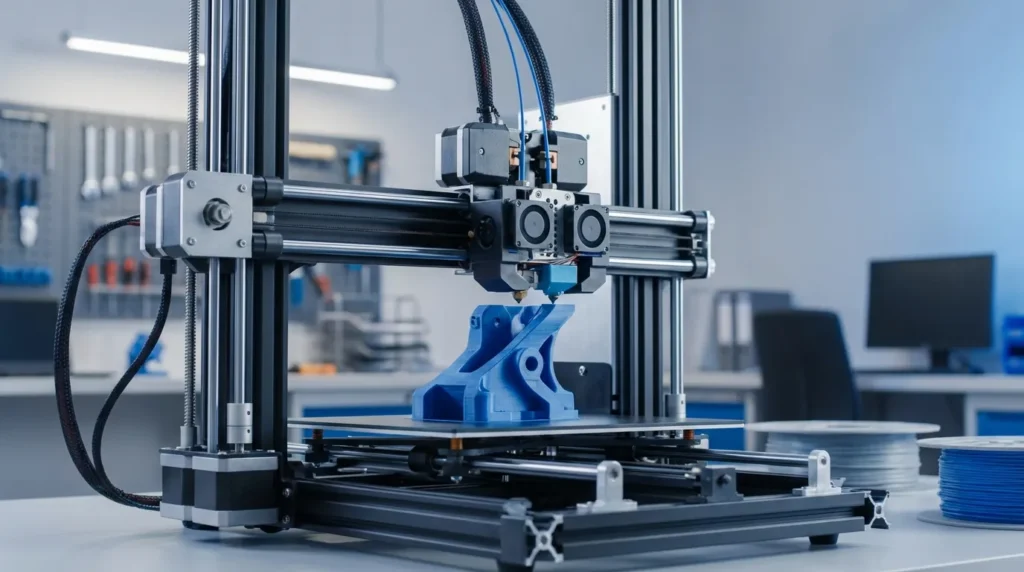
3D Printer for Manufacturing: The Future of Production
Manufacturing is changing fast, and most people in the industry have already felt it. Lead times keep getting shorter, while product life cycles don’t last the way they used to. At the same time, supply chains often feel more fragile than expected, which isn’t surprising lately. Engineers and production teams across many industries keep asking the same practical question: how can parts be made faster, closer to home, and still meet quality expectations every time? In many workplaces, that pressure shows up in everyday decisions, especially when deadlines start stacking up. For many, adopting a 3D printer for manufacturing has become a natural step to meet these challenges effectively.
This is where industrial 3D printing proves its value in real-world use, not just in theory. What started as a prototyping tool has grown into a real production option, probably sooner than many expected. Manufacturing‑grade 3D printers are now widely used for jigs, fixtures, tooling, and even end‑use parts with steady accuracy and repeatability. That shift feels especially relevant in Australia. Local manufacturing, along with mining, defence, and education, often needs solutions that stay flexible and reliable when conditions change, as they often do.
This article looks at where industrial 3D printing is going next and why it’s likely here to stay. It examines market growth and the role of high‑speed FDM systems, and explains why features like IDEX and Klipper firmware are now common expectations in production settings. As a result, thermal control matters more than it used to, and that difference shows up quickly on the shop floor.
Industrial 3D Printing Is Moving Beyond Prototyping
For a long time, 3D printing mostly stayed in the design office. It was used for fit checks and early concept models, the quick tasks teams needed to move fast. Simple wins, most of the time. That picture feels different now. Industrial 3D printing is appearing on the factory floor, where printed parts need to survive real production conditions like heat, mechanical stress, and repeat use, not just look nice sitting on a desk. In this context, a 3D printer for manufacturing is no longer just an innovation showcase but a reliable production asset.
The market numbers help show this change. The industrial 3D printer market reached USD 18.3 billion in 2025 and is expected to reach USD 20.8 billion in 2026. Those are big figures. Looking further ahead, forecasts point to USD 73.8 billion by 2035, with steady growth above 15 percent. Growth at that pace usually comes from daily production work, not hype or short demos.
| Metric | Value | Year |
|---|---|---|
| Industrial 3D printer market size | USD 18.3 billion | 2025 |
| Projected market size | USD 20.8 billion | 2026 |
| Long-term forecast | USD 73.8 billion | 2035 |
| Annual growth rate | 15.1% | 2026, 2035 |
Many industry leaders see this as a real turning point, even if it feels a bit overdue. Additive manufacturing is now compared directly with CNC machining or injection moulding, using the same shop-floor expectations. Cost per part, repeatability, and throughput are now discussed together in planning meetings.
For me, 2026 marks the tipping point: the year AM finally breaks free from its prototyping roots and establishes itself as a practical, scalable production technology across multiple mainstream industries.
With FDM systems, this change shows up in stronger frames, better motion control, and extrusion that stays consistent for hours, often overnight. In most cases, long production runs matter. Teams want machines built for full-day factory use, not printers made mainly for trade shows or demos.
High-Speed FDM and Precision Hardware Take the Lead
Not long ago, printing faster with FDM usually meant giving up print quality. That idea has changed, and it feels like it’s here to stay. High‑speed FDM printers can now produce parts quickly while still holding tight tolerances, which has surprised a lot of people (me included). This didn’t happen by accident. The gains come from stiffer frames, smoother motion systems, smarter firmware, and better thermal design working together as one balanced setup. It’s the result of solid engineering, not cutting corners.
CoreXY and gantry‑style machines, including designs based on the RatRig V‑Core platform, put a strong focus on rigidity. A stiff frame helps cut down vibration at higher speeds. That leads to cleaner surface finishes and more accurate dimensions, even when the printer is moving fast enough that you can watch it happen. That kind of visible stability makes a real difference in everyday use.
Firmware also matters a lot. Klipper moves heavy processing from the printer’s controller to an external computer. Motion planning runs faster, and features like input shaping and pressure advance usually behave more predictably. This lowers hardware strain and improves control in most setups.
For manufacturing teams, these updates show up in daily work. Shorter cycle times are the clearest benefit. A jig that once took eight hours might now finish in four without losing strength. When several machines run at the same time, those saved hours stack up fast.
Precision still comes down to the basics. Automatic bed leveling, steady extrusion, and stable temperatures often decide the final result. Skipping calibration is a common mistake. Even high‑end industrial printers struggle when the fundamentals are ignored, something many teams learn the hard way.
IDEX and Multi-Material Printing Open New Doors
Multi‑material printing has become one of the more noticeable shifts in industrial 3D printing, mostly because it helps fix everyday problems in workshops. IDEX, short for independent dual extrusion, sits right at the centre of that change. With two independent toolheads, each nozzle handles its own task, which usually gives better control during a print. In day‑to‑day use, this means more flexibility, fewer trade‑offs, and less need for awkward workarounds.
The benefits are easy to spot because they’re so practical. One nozzle can run soluble supports while the other prints an engineering‑grade material, so parts often come off cleaner and need much less post‑processing. Less scraping becomes obvious pretty fast. Another clear benefit is mirrored duplication, where small production runs finish sooner simply because two identical parts are printed at the same time.
In Australian workshops, IDEX systems are often picked for tooling jobs. A common example is carbon fibre nylon fixtures printed alongside soft TPU pads in a single build, something that’s usually difficult on single‑extruder machines. When combined with a 3D printer for manufacturing, this approach boosts productivity across multiple sectors.
By 2026, the 3D printing industry will definitely enter a phase of industrial implementation and real scaling. The main trend to watch will be the consolidation of additive manufacturing (AM) as a reliable production technology, especially in metal, where cost, repeatability, and robustness are no longer negotiable.
Even within polymer FDM, the main takeaway stays pretty grounded. Reliability and repeatability usually matter more in daily work than flashy features. Impressive specs sound nice, but if a machine is hard to tune, the advantage fades. Problems like toolhead alignment or uneven filament feeding still happen, and when they do, dual extrusion can quickly lose its edge.
Smarter Printers with AI and Sensor Feedback
Industrial printers are getting smarter in day-to-day use, and you can usually see it directly on the shop floor. Sensors aren’t extra features anymore that only some systems have. They’re often built in by default, mostly because in-print quality checks make jobs run more smoothly. Many machines now track temperature and vibration in real time through short feedback loops. This gives operators a clearer picture of what’s happening during a build, instead of finding out hours later.
Analysts at Global Market Insights often say that AI and sensor-based monitoring help catch problems early, before they turn into bigger issues. That’s likely why predictive maintenance is slowly replacing the old fix-it-when-it-breaks approach. In most setups, this leads to less downtime, lower scrap, and fewer late-night repair sessions.
Closed-loop control is another change worth watching. During long prints, especially large-format jobs that run for hours, printers can tweak settings on the fly to keep dimensions within tolerance. For educators, this adds real teaching value. Students can see live data guiding hardware decisions, like a temperature spike triggering an automatic adjustment mid-print.
Shifting additive manufacturing (AM) from innovation to application was last year’s trend that’s still taking shape. But what’s in store for AM in 2026? Our CEO, Brigitte de Vet, shares her vision where AM delivers real results, scalable solutions, and tangible value on a widespread scale.
Practical Steps to Prepare for Production-Grade 3D Printer for Manufacturing
Production‑grade 3D printing is less about the printer alone and more about whether the whole setup can run day after day, not just when everything goes right. This usually comes with a production mindset. Picking the right printer platform is often the first big decision. Strong frames, motion systems with a track record, and clear upgrade options start to matter as needs grow over time.
Materials are where many teams hit problems. Engineering filaments often need dry storage and controlled conditions, and there’s rarely a quick fix. When material handling slips, print quality can drop fast and is often hard to recover.
Regular calibration and basic maintenance help stop small problems from becoming bigger ones. Simple belt checks and keeping an eye on wear parts like rails and nozzles can save time later. Many teams stick to standard print profiles so results stay steady across different operators.
Why think local at all? Australian‑based suppliers and integrators know local compliance rules, which matters when a printer supports a production line instead of a side project.
The Bottom Line for Australian Manufacturers
The future of 3D printing in manufacturing usually isn’t about replacing traditional processes. It’s more about adding flexibility in the space between one‑off prototypes and full‑scale production, which is often where teams slow down. Industrial 3D printing sits comfortably in that middle space, giving manufacturers more choices without asking for a full overhaul. I see that balance as the real appeal. It comes across as a sensible middle option rather than a dramatic change.
High‑speed FDM systems now offer the strength and accuracy manufacturers expect, with uptime that works on the factory floor, not just in demos. IDEX setups, Klipper firmware, and sensor‑based feedback are now part of day‑to‑day use. In most cases, they’ve shifted from “nice to have” to standard expectations, which says a lot about where the technology is today.
This change shows up in a few ways. Engineers often get quicker iteration cycles that fit real workflows, from CAD adjustments to repeat prints. Educators can focus on skills that industry actually uses now. Advanced hobbyists, meanwhile, can often achieve professional‑level results without huge barriers, which changes who can take part.
So what’s a smart next step? A helpful approach is to start small while keeping the long view in mind. You’ll often find that equipment which can grow with you, paired with proper setup and training (often overlooked), cuts lead times and gives more control, such as when a single prototype becomes consistent, repeatable parts. Ultimately, a 3D printer for manufacturing can bridge the gap between innovation and reliable production for Australian businesses.
