
Table of Contents
3D Printer Upgrades: Future-Proof Your Printing Setup for 2026
Industrial 3D printing is moving fast. What felt solid two years ago can now feel slower, louder, or more limited, and that’s not marketing talk. If FDM systems are used for prototyping or short‑run tooling, planning ahead is hard to avoid. Staying competitive usually pushes teams in that direction. This becomes clear when longer print times or failed jobs start showing up, often sooner than people expect. For Australian engineers, educators, and advanced users, the pressure is often stronger. High labour costs mean downtime gets expensive very quickly. Speed expectations keep rising, and accuracy isn’t impressive anymore, it’s simply expected. What stands out is that replacing the entire machine is often not the right move. That’s likely the main takeaway. The right 3D printer upgrades can bring clear gains in reliability, output, and material options, without ripping everything out or starting from scratch. This guide looks at the must‑have upgrades shaping 2026 printing technology, with no guesswork. The focus stays on practical changes for high‑speed FDM systems that still need tight tolerances. These are real improvements, not theory. It shows where the industry is heading, which upgrades matter most right now, and how to plan investments that are likely to stay useful for years ahead, which is often the hardest call to make.
Why 2026 Is a Turning Point for Industrial FDM
What stands out right away is how easy the change is to see on factory floors. FDM is no longer stuck in the prototyping box, once parts start pulling their weight in day-to-day production, that label tends to drop away. Over the next couple of years, material extrusion is moving into regular use for mechanical parts and tooling, often right where the work happens. The shift feels practical, not theoretical, and it’s already in motion. Market data helps explain why. Investment in additive manufacturing keeps rising, and industrial systems take most of that growth. That usually happens when spending follows real use, not hype.
| Metric | Value | Year |
|---|---|---|
| Global 3D printing market size | USD 23.4B | 2025 |
| Projected global market size | USD 28.6B | 2026 |
| Industrial 3D printer market size | USD 20.8B | 2026 |
| Industrial printer CAGR | 15.1% | 2026, 2035 |
Those figures point to adoption that’s already happening. Automotive and aerospace lead the way, with defence and tooling close behind. That fits Australian industry, where local production and fast turnaround matter, especially for lean teams. One clear signal comes straight from industry leaders, direct and to the point.
I believe that in 2026 material extrusion is going to gain further momentum as a mass manufacturing production technology for mechanical components. Material extrusion has an edge in economic viability, speed, flexibility, and robustness over other additive manufacturing technologies.
As expectations rise, faster machines and steadier uptime are becoming standard. In my view, focused upgrades tend to pay off most, like keeping a tooling line running without constant oversight.
High-Speed Motion and Extrusion 3D Printer Upgrades That Actually Matter
Speed is usually the first upgrade people go after, and that makes sense. But once accuracy starts to drop, raw speed stops being very helpful. By 2026, high‑speed FDM is less about flashy numbers and more about smooth motion and solid frames, with everything tuned to behave the same way on every print. That steady, repeatable behavior often matters more than top speed, especially if you’ve dealt with odd print failures and never fully figured out the cause. So what’s behind this change? CoreXY and newer gantry systems are quickly becoming the standard for industrial‑grade machines. By cutting down on moving weight, they allow higher acceleration without ringing or layer shifts appearing later, sometimes hours into a print. If you’re still using an older Cartesian setup, upgrading motion parts or switching to a modular frame can bring clear improvements very quickly. In some cases, even overnight, which still surprises people.
Extrusion is the other big piece, in my view. High‑flow hotends and hardened nozzles now support speeds three to five times faster than older setups. This really becomes obvious with fibre‑filled nylons and other high‑temperature materials that expose weak hardware fast.
There are still a few common mistakes. Pushing speed without better cooling often leads to poor layer bonding. Ignoring frame stiffness usually results in slow, creeping dimensional drift.
For Australian workshops, faster prints can turn multi‑day jobs into overnight runs, freeing up machines and reducing pressure across the whole production line, like finishing a long nylon fixture before the morning shift starts.
Automation, Calibration, and Firmware 3D Printer Upgrades as the New Baseline
By 2026, manual calibration will usually be the exception, not the norm. Automation is now one of the most useful 3D printer upgrades, especially for teams that want steady results without extra effort or late-night tweaking. It feels like a clear shift, and for busy schedules, it’s a welcome one. The first thing people notice is how much time these systems save. Automated bed leveling, toolhead calibration, input shaping, and basic error checks cut down setup time and help prints finish the same way every time, no matter who presses “start.” On shared machines, that consistency often decides whether handoffs go smoothly or turn into small daily headaches. Firmware platforms like Klipper help by loosening hardware limits and keeping workflows flexible, which usually means less hassle and more control.
Klipper-based setups allow faster processing, more accurate motion planning, smoother acceleration, and easier sensor hookups. With accelerometers and closed-loop feedback, printers can often catch common issues, like ringing or layer shifts, early, before hours of work are wasted.
In production settings, this reliability matters. Engineers don’t want to watch printers all day, and educators want students focused on design, not tuning. Predictable FDM behavior makes scaling easier, especially with remote monitoring. Cameras, alerts, and job tracking help teams see what each machine is doing and catch a bad first layer before a full batch is lost.
Materials and Thermal Management for Production Parts
One thing that often separates hobby machines from industrial FDM systems is material support. By 2026, production users usually expect engineering‑grade polymers to be standard, not special add‑ons or paid upgrades. That change makes sense if you’ve been watching how these machines are actually used. Expectations have simply caught up with reality.
Carbon‑fibre‑reinforced nylon, PPS, PPSU, PEI, and PEEK are now common. You see them in jigs and fixtures, and in end‑use parts that must deal with heat, chemicals, or constant stress, the kind of wear factory floors dish out every day. Printing these materials usually means keeping temperatures stable and airflow controlled inside rigid, well‑sealed enclosures.
Many of the most useful upgrades focus on thermal control. Fully enclosed, actively heated chambers and stronger, more even bed heaters make prints far more reliable. When systems fall short, warping, delamination, or mid‑print failures are common, and that’s frustrating.
Filament handling is another area people often miss. Moisture can ruin prints fast, especially with nylons and composites, so dry boxes, filament dryers, and sealed storage help protect material costs and print quality. These steps sound simple, but they matter more than most expect.
Industry experts also see material extrusion slowly taking share from other manufacturing methods.
It will be interesting to see how powder bed players respond to the industrialisation of simple FFF printers in 2026.
IDEX with Multi-Material Scalable Production Setups
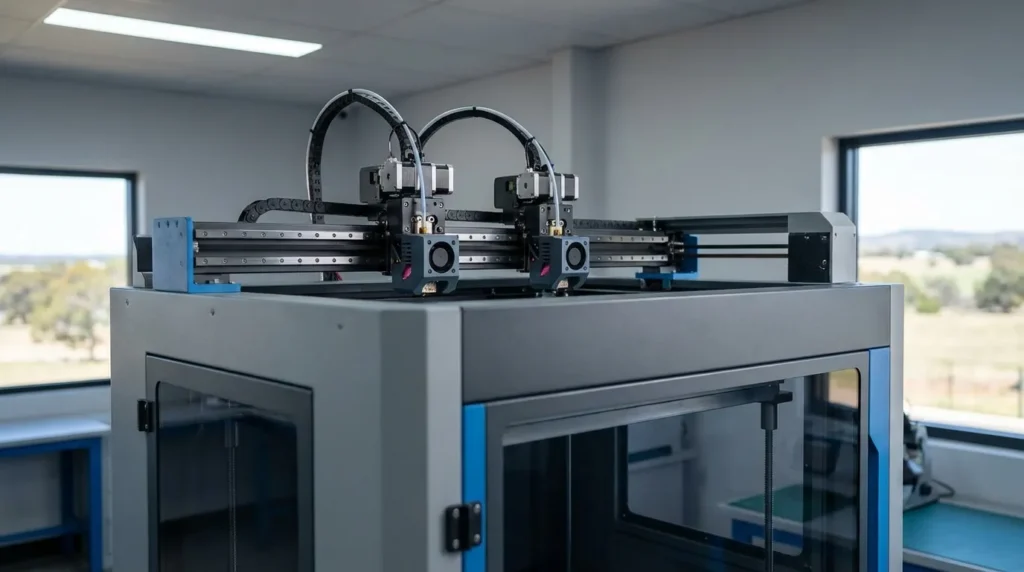
What’s getting attention on shop floors right now is how far dual extrusion has come. IDEX systems are no longer limited to printing support material. They’re now a practical upgrade for professional users who want more control at the printer and less trial and error day to day. That added flexibility tends to show up fast in real jobs, which explains why these systems keep appearing in production settings.
Independent dual extruders allow true multi-material printing, along with mirror and duplication modes. In production, this can raise output without the cost of buying more machines, which matters when budgets are tight. For tooling, teams often pair soluble supports with engineering plastics, cutting cleanup time and reducing failed parts. Fewer reprints usually lead to less waste and fewer work stoppages.
Looking toward 2026, scalability is shaping buying choices. Instead of one high-end system, many manufacturers build print farms that grow over time. A group of reliable FDM printers often delivers better uptime and simpler daily management, which works as a straightforward, effective approach.
This setup works well in Australia. Higher labour costs push automation, and overnight printing makes sense. If one printer stops, the rest keep running, so work continues.
In the next few years, tighter digital integration is expected. Scheduling, traceability, and quality tracking will likely run through connected software as part of normal operations.
By 2026, the 3D printing industry will definitely enter a phase of industrial implementation and real scaling. The main trend to watch will be an increase in part size capability and the usage of AI in additive manufacturing to build an end-to-end digitally controlled manufacturing process.
Putting It All Into Practice for Australian Users
Upgrading for 2026 printing technology isn’t about chasing every new feature, which can feel overwhelming pretty quickly. What usually works better is picking upgrades that fit real production goals and day‑to‑day needs. Day‑to‑day as in what comes up every week, not just what looks good on a spec sheet. Most of the time, practical choices beat flashy ones.
A helpful way to start is by looking at what slows things down. Is print speed the main issue, or is inconsistent quality causing problems? Are material limits affecting part strength and leading to reprints? Those answers often send users down different upgrade paths, and that’s a good thing. Different paths, but clearer direction.
For many Australian users, the biggest gains often come from motion upgrades paired with better thermal control. When that setup is right, it usually leads to faster prints, more reliable parts, and fewer failed jobs. Less restarting, less frustration, and steadier output.
Thinking in stages can also help. Starting with parts that reduce wear and help machines last longer makes sense. Later, when it truly fits the work, options like IDEX support or access to advanced materials can be added. There’s rarely a need to rush.
Future‑proofing mostly comes down to flexibility. Machines that are stable, fast, and adaptable tend to handle whatever 2026 brings better than those chasing raw specs alone.
If a next move is coming up, now is a good time to take an honest look at the current setup, even if that feels a bit uncomfortable. Moving carefully matters. The right 3D printer upgrades today often mean less stress later, better results, and a smoother workflow overall.
