
Table of Contents
Hybrid Manufacturing Guide: 3D Printing and CNC Integration
Hybrid manufacturing isn’t some far‑off idea anymore. It’s already changing how parts are designed and built, with finishing handled along the way instead of added at the end. Many engineers feel stuck between two options. On one side, 3D printing moves fast and adapts easily. On the other, CNC machining offers tight precision and a long history people trust. Picking one often means giving up something useful from the other, which can be frustrating day to day. Hybrid manufacturing helps close that gap, and it usually does it without adding extra complexity.
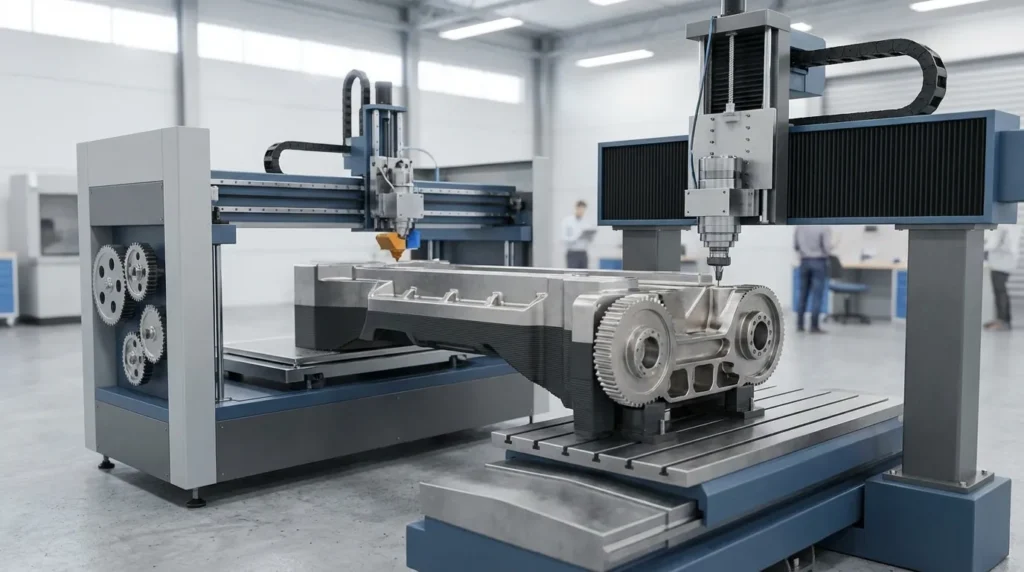
At its core, hybrid manufacturing combines additive methods like FDM 3D printing with subtractive CNC machining in a single workflow. Sometimes everything runs on one machine, which keeps handoffs simple and predictable and cuts down on avoidable mistakes. In other setups, the steps are closely linked across several machines on the shop floor. Either way, the goal stays the same: faster production, more freedom in part shapes, repeatable accuracy, and surfaces that meet spec every time. That level of consistency often makes a real difference.
For Australian manufacturers, this shift matters more than it first seems. Shorter lead times, more local production, and less material waste all stack up. Skilled labour is often limited, so using it wisely counts. With high‑speed FDM systems and better motion control, hybrid workflows now make sense outside large factories. Smart firmware like Klipper helps too, especially when machines need steady, reliable output every day.
This guide explains hybrid manufacturing in plain terms. It covers how 3D printing and CNC work together, where the real value shows up, common mistakes teams make, and how to plan a setup for professional production rather than hobby use. This is especially helpful for tooling, early prototypes, small production runs, and custom parts.
What Hybrid Manufacturing Really Means on the Shop Floor
Hybrid manufacturing combines additive manufacturing and subtractive machining into one connected process. Additive manufacturing builds parts layer by layer, while subtractive machining removes material where precision matters most, like tight fits or smooth surfaces. On their own, each method has limits. Used together, those limits are easier to manage. It’s a simple idea, but the results often matter a lot in real production settings.
The most noticeable part usually happens during the handoff. In a typical workflow, an FDM 3D printer makes a near-net-shape part. It’s close to final size, with extra material left only where strength or accuracy really matters. CNC machining then finishes those areas to tight tolerances. Clean and precise. That transition is where much of the value shows up.
This is no longer treated as a small experiment. Market data shows growing use across aerospace, defence, medical applications, and industrial tooling. This reflects real shop-floor adoption, not hype.
| Metric | Value | Year |
|---|---|---|
| Hybrid manufacturing market size | USD 161.6 million | 2025 |
| Projected market size | USD 25.5 billion | 2035 |
| Market growth rate | 23.5% CAGR | 2025, 2035 |
| Lead time reduction | Up to 30% | 2024 |
| Manufacturers reporting cost efficiency gains | >40% | 2024 |
These numbers matter because they reflect everyday work. Lead times are shorter, costs often drop, and material use is more efficient, which usually means less waste. Reports from ReAnIn and Future Market Insights, both widely used for market tracking, show hybrid systems moving into regular production.
Ryan Hooley from GE Power Services summed up this shift clearly.
Additive manufacturing is not just looking at the value propositions like assembly, cost, and cycle. Now we can look at actually improving performance… Additive manufacturing is fundamentally changing what we can do. It’s not 10 years away. It’s here.
How 3D Printing Integration Works with CNC Systems
Depending on budget and goals, combining 3D printing and CNC usually happens in a few familiar ways, and the difference is easy to spot. Some shops go with a single hybrid machine that both prints and mills inside one enclosure. Keeping everything in the same space helps keep dust and debris contained, which makes everyday cleanup simpler. Other shops link separate high‑speed FDM printers and CNC mills through a shared digital workflow. This lets files and revisions move smoothly from printing to machining without manual steps in between.
In many Australian workshops, the second setup often feels more practical. A dependable FDM printer handles fast material build‑up with little hassle, while CNC machines focus on tight tolerances and important details like flat faces or precise fits. This split usually keeps costs easier to manage and lowers the risk of upgrades, since the printer or the mill can be replaced on its own (which helps, honestly).
So what does the workflow look like? It’s pretty simple. Parts are designed with both processes in mind from the start, so teams decide early which surfaces will be machined and which can stay printed. An FDM printer creates a near‑net‑shape part, often PLA for fixtures, or tougher engineering filaments for production aids, then CNC finishing handles holes, faces, and mating features that need accuracy.
Firmware and motion control matter more than many expect. Chasing speed without accuracy often leads to extra cleanup later. Systems tuned with Klipper firmware tend to keep dimensions steadier at higher speeds, which makes CNC finishing more predictable and less frustrating.
This combined approach shows up most often in tooling, jigs, fixtures, and custom brackets, small parts that can save a lot of time.
Real-World Benefits and Common Mistakes to Avoid
Hybrid manufacturing brings real, hands-on benefits that go past just speed. A big one is material efficiency. With additive methods, material goes only where the part needs it instead of everywhere. CNC machining then removes much less than it would from a solid billet, which changes how waste shows up on the shop floor. Most teams spot that change fast.
The sustainability side is easy to see as well. Data often supports this shift in a clear, practical way, making it harder to brush off during daily planning.
| Metric | Impact |
|---|---|
| Energy consumption reduction | Up to 50% |
| Raw material savings | Up to 91% |
| Carbon footprint reduction | Up to 95% |
These results usually come from near-net-shape printing followed by light machining. Scrap drops in measurable ways, and energy use often stays lower across the full process. That leads to less waste and less strain, something many teams appreciate.
Eric Utley from Protolabs explains why this helps teams move new ideas forward faster and how timing affects that process.
It’s an entirely new way of making things… 3D printing is an entirely new tool. It’s enabling us to solve problems, and ultimately, to make products that previously couldn’t exist.
That said, hybrid manufacturing isn’t a sure win. A common mistake is ignoring print orientation and support plans, which can quietly add hours of CNC work later. Another issue shows up when teams underestimate thermal stability during long prints, causing accuracy problems during machining. Small issues can stack up.
Some teams also push low-cost desktop printers too hard, which is risky. Industrial FDM systems with stiff frames and controlled motion tend to work better in hybrid setups, delivering more steady and dependable results.
Where Hybrid Manufacturing Fits Best in Australian Industry
In Australia, hybrid manufacturing often makes the most sense when time pressure is real and supply chains feel stretched, which many teams notice pretty quickly. Insights from the Australian Manufacturing Growth Centre point to local manufacturers using hybrid workflows to reduce offshore reliance and move tooling along faster. When deadlines are tight and flexibility matters more than pure volume, that balance usually becomes the main reason to adopt it, in my view.
Instead of delivering just one benefit, the value shows up across several practical uses. Tooling and fixtures for CNC machines and assembly lines are common examples. Low‑volume production parts that still need strength and tight accuracy also fit well. Teams also turn to hybrid methods for prototypes that need to behave like final parts, along with mould inserts or custom machine components made for very specific tasks.
High‑speed FDM often fits neatly into this workflow. Large parts can be printed overnight, then sent straight to CNC finishing the next day, a turnaround that’s hard to ignore. That back‑and‑forth creates a steady rhythm, letting teams iterate without tying up expensive machining centres.
Education and training benefit too. Technical educators use hybrid setups to teach real‑world manufacturing logic through hands‑on work. Students move through additive and subtractive design paths together, which often reflects what they’ll see on the job. As machines become more connected, the digital thread grows stronger, with CAD feeding into CAM and printing data guiding smarter machining choices.
Planning a Practical Hybrid Setup That Scales
The fear of tearing apart an entire factory often keeps teams from trying hybrid manufacturing, but that concern is usually bigger than the reality. In practice, it often starts with clear goals and a short list of priorities. Speed and accuracy are usually the first issues to fix. Cost tends to improve later, once those basics are steady. Simple as that, at least in most real shops.
One useful approach is picking an FDM system known for reliability. Rigid frames and solid motion components, the boring parts, often make the biggest difference over time. Why does firmware access matter? Because small tuning tweaks can quietly bring steady gains. Dual extrusion or IDEX setups add flexibility, especially for soluble supports or mixed materials, which usually means less daily friction.
Before anything else, it helps to get the CNC process in shape. Consistent fixturing and printed features made for repeatable clamping are often missed, yet this alone can save hours each week without adding complexity.
Software matters too. Shared coordinate systems keep teams on the same page, and clear naming conventions usually cut mistakes fast, you’ll notice less confusion quickly.
François Minec from HP Additive Manufacturing points to where this is heading.
In 2026, the Additive Manufacturing market will continue the digital thread journey, providing seamless communication, real-time monitoring, and remote diagnostics… enabling manufacturers to scale additive production with confidence and true industrial reliability.
Putting Hybrid Manufacturing Into Practice
Hybrid manufacturing isn’t about replacing CNC with 3D printing. It’s usually about using both together in smarter, more practical ways that fit how most shops already operate. For engineers and manufacturers, this creates real options: quicker turnaround, parts that work better, and often less wasted material. On the shop floor, these benefits tend to show up fast.
The best opportunities usually appear inside workflows you already have. If FDM 3D printing is in use, there are often parts that still need machining afterward, those awkward handoff parts. They’re often the easiest place to begin with a hybrid approach. Already running CNC machines? It can help to look at how much time goes into roughing material that could have been printed first, something many teams simply don’t think about.
Balance matters here. High-speed FDM works well for volume and simple shapes, while CNC is better for tight tolerances and smooth finishes. Used together, they meet current manufacturing needs without adding extra complexity.
For Australian professionals, this supports local production and technical independence, which matters in everyday work. A simple first step is to review one part, like a tool or fixture, and try a hybrid workflow on it.
