
Table of Contents
Hybrid Manufacturing: FDM 3D Printing and CNC Integration
Hybrid manufacturing isn’t a far‑off idea anymore. It’s already changing how parts are designed and finished across many industries, and most people have probably seen it in action without noticing. For engineers and manufacturers, the picture is pretty straightforward. Fast turnaround matters. Tight tolerances often decide whether a part works or not. Lower costs help, and having more freedom in design is usually a plus. On their own, FDM 3D printing and CNC machining each cover only part of these needs. They do their jobs well, just not everything at the same time. Put them together, though, and the range of problems they can solve becomes much wider, often wider than expected. Much wider.
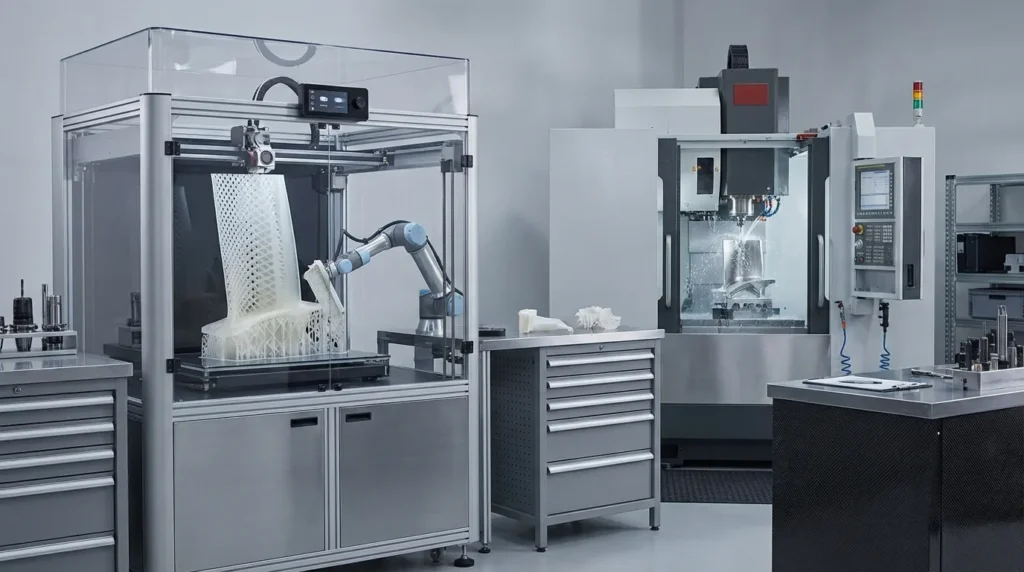
At its core, hybrid manufacturing brings FDM 3D printing and CNC machining into one workflow, sometimes even inside a single machine. In other setups, it runs across connected systems that share the same data. The key is how the work is split. Complex shapes are printed quickly, while only the important features are machined for accuracy and surface finish. This balance matters because it avoids extra work on areas that don’t need it, which is useful when speed and precision both matter, as they often do.
In Australia, this approach is gaining real momentum. Local manufacturers deal with high labour costs and supply chains that are long, hard to manage, and not always reliable. Add constant pressure for faster delivery, and the benefits are easy to see. Hybrid manufacturing supports rapid prototyping, tooling, and even end‑use parts, without sending work offshore. These advantages are already showing up in everyday production.
What Hybrid Manufacturing Really Means in Practice
Hybrid manufacturing is often explained in a clean, simple way, but what it actually does usually goes further than people expect. At a basic level, it mixes additive manufacturing, like FDM 3D printing, with subtractive CNC machining. The part gets printed first, close to the final shape. It is not perfect, just accurate enough to matter. Then CNC machining cleans up only the areas that need real precision, such as tight fits or flat reference surfaces. The idea sounds simple, but the results are bigger than they first appear, at least from my perspective.
What people usually notice right away is speed and flexibility. FDM is fast and easy to adjust, which makes it hard to ignore. At the same time, its limits show up quickly in real parts. Surface finish and tight tolerances are hard to achieve straight off the printer, as anyone with hands-on experience knows. CNC machining, on the other hand, delivers accuracy and repeatability, but it can be slower and often cuts away a lot of material. Hybrid manufacturing brings these strengths together in a practical way, cutting frustration and avoiding unnecessary trade-offs in many cases.
The market numbers show why this approach is picking up speed.
| Metric | Value | Year |
|---|---|---|
| Hybrid manufacturing market size | USD 3.1 billion | 2025 |
| Projected market size | USD 25.5 billion | 2035 |
| Market growth rate | 23.5% CAGR | 2025, 2035 |
| 3D printing market size | USD 15.39 billion | 2024 |
Engineers are moving toward hybrid workflows because they often shorten lead times and reduce material waste. Instead of machining a full aluminium or steel block, teams print complex shapes with thermoplastics or composites first. CNC machining then focuses only on functional faces, key holes, mounting points, and contact areas, basically the spots that actually matter. No extra steps.
This shift also changes how parts are designed. Internal channels and lattice structures come naturally with FDM 3D printing, which makes weight reduction feel almost automatic. CNC machining finishes the process, making sure parts fit correctly, move as intended, and seal reliably inside real assemblies, where tolerances cannot just be guessed.
Why FDM 3D Printing Is the Foundation of Hybrid Systems
FDM 3D printing sits at the center of hybrid manufacturing mainly because it balances speed and cost, which usually matters to teams working with real limits. It’s also the most widely used additive process in industry today. Over half of all additive manufacturing systems use FDM, and many companies rely on it for strong, dependable parts that handle daily use. From my experience, that confidence often grows after seeing consistent results over time, not just one good print.
Material performance matters a lot here. Modern FDM systems can process carbon‑fibre reinforced nylon and PEKK with little trouble, which helps explain why so many teams use them. These materials are common for tooling, fixtures, and some end‑use parts. When CNC finishing is added, parts usually become more accurate and repeatable. When tolerances matter, the improvement shows fast.
What happens to accuracy as processes change? That’s the part worth watching closely.
| Process | Typical Tolerance | Surface Finish |
|---|---|---|
| Desktop FDM printing | ±0.5% or ±0.5 mm | Visible layer lines |
| Industrial FDM printing | ±0.15% or ±0.2 mm | Improved but textured |
| Hybrid FDM + CNC | 0.025 mm | Machined finish |
This step up in precision is where hybrid manufacturing shows clear value, often through measurable results rather than ideas alone. According to the Manufacturing Technology Analysis Team at AIP Precision:
While precision 3D printers typically achieve tolerances around 0.1 mm, CNC machining elevates this to 0.025 mm, making hybrid manufacturing ideal for moving parts and assemblies.
For Australian manufacturers, this change resets expectations. FDM 3D printing is no longer only for prototypes. With the right setup, it often works as a practical production method that fits well into existing CNC workflows, making adoption easier.
How Hybrid Workflows Improve Speed and Overall Results
One of the first things people notice with hybrid manufacturing is how fast work moves on the factory floor, which is what matters most day to day. Instead of waiting weeks for fully machined parts, teams can often print near-net shapes in just hours or days. CNC machines then handle the finishing steps, rather than cutting everything from solid stock. That change makes a real difference, and it’s usually where cost savings start to show.
With this setup, lead times for tooling and fixtures often drop by 30 to 60 percent, and material waste tends to drop along with them. In many cases, most of the geometry is already in place before the part ever reaches the machine. Less material to remove means less cleanup, less scrap, and fewer problems overall.
The workflow itself is pretty straightforward. Parts are designed from the beginning with hybrid manufacturing in mind, and critical surfaces are clearly marked so there’s no confusion later. The part is then printed on a high-speed FDM system, fixtured, and machined only where tight tolerances are needed. Nothing extra, just what’s required.
Surface finish is another area where this approach helps. Printed parts can feel rough, but CNC finishing smooths key areas so parts meet functional or regulatory needs. That extra care makes inspection and assembly easier, as AIP Precision explains:
Hybrid processes enhance dimensional accuracy dramatically, from Ra30μm in additive processes to Ra0.4μm after CNC finishing. This enables components to meet the micron-level tolerances required for critical applications.
Issues can still happen. Some teams machine printed parts too aggressively and lose the cost benefit. Others overlook print orientation, which can weaken the final part. Better results usually come from designing specifically for hybrid manufacturing, rather than adding it at the last minute and running into avoidable problems.
Where Hybrid Manufacturing Delivers the Most Value
Hybrid manufacturing shows its value on the shop floor in very practical ways. Tooling is usually the clearest example. Jigs, fixtures, gauges, and mould inserts can be printed quickly, then machined only where accuracy really matters, like mounting faces or alignment holes. It’s a simple approach, but in my view it works especially well for short-run jobs and custom parts that would otherwise take too long to make. Teams often notice the flexibility almost right away.
In aerospace and defence, hybrid parts help reduce weight while keeping precision where it counts. That precision usually comes later through CNC finishing, not all at once. Printing makes complex internal channels for cooling or wiring easier early on. Final machining then brings key interfaces into spec. Mining and energy teams use the same idea, often making replacement parts close to the site, which usually means less downtime and faster recovery.
Education is another good fit. Teaching FDM 3D printing alongside CNC machining reflects what students will see on real factory floors, helping skills stick early.
According to Protolabs manufacturing engineers, FDM remains popular because it’s fast and affordable, and they’re closest to day-to-day production work. That’s why hybrid workflows are now common when tighter tolerances and better surface finishes are needed for end-use parts, especially as companies push for more local, controlled production.
Choosing the Right Hardware and Integration Strategy
Not all FDM systems work the same for hybrid manufacturing, and you usually notice that after spending real time using them. Speed is nice, but in day‑to‑day use, rigidity often matters more. A fast motion system helps, but a solid frame and well‑tuned firmware usually make the biggest difference when printing parts that will later go through CNC finishing, especially on tight‑tolerance surfaces. In those cases, there’s very little room for flex, and issues become obvious fast if the machine isn’t stiff enough.
For this type of work, industrial platforms like RatRig V‑Core systems often make sense. Their stiffness helps keep prints accurate, even when running at higher speeds. IDEX dual extrusion adds flexibility too, and it ends up being useful more often than you might expect. Using soluble supports or combining materials in a single build can simplify difficult jobs and reduce manual cleanup. Less hassle overall, in my view.
Firmware matters here as well. Klipper supports more precise motion control and higher speeds without hurting quality, but the bigger benefit is consistency. In hybrid workflows, prints that come out the same way every time save CNC setup time and reduce rework, especially during repeat jobs.
Integration doesn’t always mean cramming everything into one machine. Many Australian workshops keep FDM and CNC separate and link them with clear, repeatable workflows. It’s simple, and it often works better than an all‑in‑one setup.
Putting Hybrid Manufacturing to Work
Hybrid manufacturing gives Australian engineers and manufacturers a practical way forward. By mixing the flexibility of FDM 3D printing with the accuracy of CNC machining, it often results in quicker turnaround times and lower overall costs. The main benefit usually appears when most of a part is printed fast, and only the key surfaces are machined, instead of trying to hold tight tolerances across the whole part.
This approach works well because it can be very focused. Accuracy is usually needed most around interfaces or mounting faces, not everywhere. A helpful method is to design with machining in mind right from the start, even during early concept work, because this often cuts down on rework later. Choosing FDM systems known for speed and consistency helps, though calibration and thermal control still matter, small setup changes can make a clear difference.
Hybrid manufacturing lets CNC and FDM work alongside each other without extra hassle. As supply chains tighten and demand for local production grows, many teams see this as a natural fit for existing workflows, especially when moving from prototypes to functional parts with machined features where accuracy really matters.
