
Table of Contents
Unlocking the Potential of Multi-Material Printing in Industrial Applications
Industrial manufacturing is changing fast, and engineers often feel that pressure every day. They’re expected to move quicker, waste less, and still deliver strong, reliable parts all at the same time, which isn’t easy. This is where multi-material 3D printing really helps. Modern systems can combine rigid, flexible, and support materials in a single build, sometimes all in one run, instead of printing one plastic at a time. For many industrial jobs, that usually means fewer post-processing steps, lower labour costs, and faster delivery. There’s often less rework too, which engineers are usually happy about.
In Australia, the impact can be even bigger. Local manufacturers often handle short production runs and custom tooling on tight deadlines, where waiting weeks for overseas parts just doesn’t work. With high-speed FDM systems and better material control, teams can print functional assemblies that come off the printer ready to test or install the same day. From my experience, that speed changes how problems get solved, because teams can test ideas right away instead of waiting through long delays.
This article explains how multi-material 3D printing works and why it’s getting more popular across industrial uses, without the hype. It looks at where the value shows up most, including jigs, fixtures, and end-use parts, and walks through real production examples, common mistakes, and how IDEX and Klipper-powered machines help teams get more consistent, usable results.
Why Multi-Material 3D Printing Is Gaining Industrial Momentum
Multi-material 3D printing is no longer seen as a clever extra. Across many industrial settings, it’s becoming normal practice. The shift is mostly driven by practical needs, not hype. Manufacturers want fewer assemblies, less post-processing, and parts that come off the build plate ready to use, or very close. When that happens, projects move faster and teams spend less time passing work back and forth, which often causes delays. Printing multiple materials in one job also cuts down on human error. Manual bonding, fastening, and alignment often introduce small mistakes that build up over time. In many cases, those steps are now removed entirely, and that change alone can save time and rework.
Recent market data makes this trend clear. Industrial systems now make up more than half of the total 3D printing market value, and functional parts are the fastest-growing use case. This points to changing priorities. Analysts are also seeing stronger uptake in maintenance, repair, and operations. In those settings, being able to produce replacement parts quickly often leads to real cost savings and less downtime on the factory floor, something operators notice right away, especially when equipment is already offline.
| Metric | Value | Year |
|---|---|---|
| Global 3D printing market size | USD 28.55 billion | 2026 |
| Industrial printers share | 51.66% | 2026 |
| Industrial AM market CAGR | 15.1% | 2026, 2035 |
Instead of stopping at basic prototypes, companies are focusing on parts they can use straight away. Multi-material systems help by combining strength and flexibility, handling support material automatically, and printing complex features in a single run. A common example is a rigid nylon body with flexible TPU seals printed in place, along with internal supports where needed. With no assembly step, lead times drop and results stay consistent.
Scott Dunham from SmarTech Analysis explains why extrusion-based systems are leading this shift.
Material extrusion has an edge in economic viability, speed, flexibility, and robustness over other additive manufacturing technologies.
For Australian workshops, this often means faster turnaround, lower production risk, and better use of skilled labour, especially when machinist time is limited and expensive.
How Multi-Material FDM Works in Real Industrial Environments
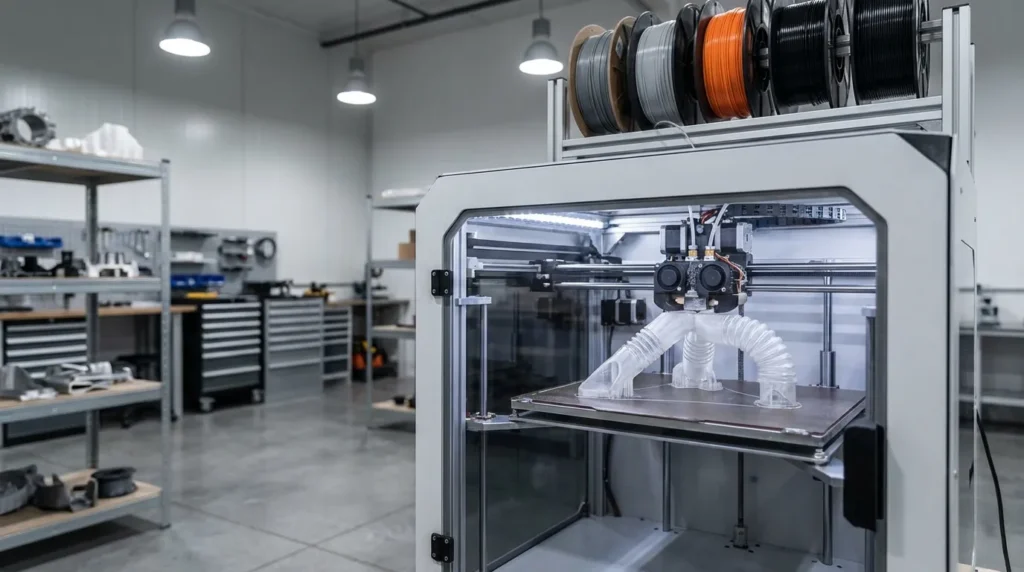
At its core, multi-material FDM means running more than one filament in a single print. In industrial settings, this usually comes down to dual extrusion or IDEX systems working side by side, which are now fairly common. Each toolhead follows its own material path, with matched temperature control and nozzle choices so one material doesn’t interfere with the other. That separation really matters. It helps prevent cross-contamination and makes it easier to fine-tune settings for very different polymers, especially for teams that have dealt with clogs or uneven extrusion before. In most cases, there’s no need to make uncomfortable compromises.
IDEX systems often stand out when accuracy is the main priority, especially on short, demanding jobs where mistakes aren’t an option. Because each extruder moves on its own, printing involves fewer trade-offs. Engineers can combine carbon fibre nylon with soluble supports, or place flexible materials exactly where they’re needed, without constant tool changes slowing things down. This setup works well when short production runs come one after another, schedules are tight, and parts need to be right on the first attempt.
The workflow itself is simple, which is why it scales easily. Material zones are planned during design. Rigid plastics handle structure, while flexible ones cover hinges or contact points. Supports rely on materials that dissolve cleanly in a standard wash. The slicer handles tool changes automatically, so operator involvement stays low, something most teams welcome.
In production settings, firmware matters a lot, since small tweaks add up over time. Klipper-based control supports higher speeds without losing accuracy. Features like input shaping and pressure advance keep material transitions clean, even at higher flow rates. That consistency is key when printing engineering filaments with tight tolerances, shift after shift.
Industrial Applications That Benefit Most from Multi-Material Printing
Some industrial uses see fast, practical gains from multi-material 3D printing. Tooling often comes first, since that’s where teams feel the impact early. Jigs and fixtures usually need a rigid base with softer contact areas, all packed into tight spaces. Printing everything in one pass reduces assembly time and helps parts line up properly, often right at the workstation where they’re used. Less rework ends up mattering more than people expect, especially as fixtures wear down over time, which happens more often than planned. Replacement costs go down, and the overall workflow stays simpler.
In aerospace and automotive workshops, multi-material parts often show up as cable guides and housings, you’ve probably seen them without giving them much thought. These parts combine stiff, load-bearing sections with flexible features that hold components in place. Making them as a single piece improves durability and removes fasteners, which tend to loosen when constant vibration is part of daily operation.
Martin Bondéus from Bondtech AB points to this pattern as one reason adoption is speeding up. It’s a clear signal.
Multimaterial and multicolour printing will see significantly broader adoption. As new enabling technologies, such as advanced material handling and switching systems, become commercially available and scalable, manufacturers will increasingly leverage multimaterial capabilities to produce more functional, integrated, and application-specific parts.
A common mistake is combining materials with very different thermal behavior, which can cause warping or weak bonds. Skipping calibration causes problems too. Dual-material systems need careful offset and flow tuning so accuracy stays solid during long runs and repeat jobs.
Speed, Precision, and the Role of High-End Hardware
What people usually notice first in multi-material printing is how quickly small mistakes show up. When a printer changes materials mid-layer, smooth and steady motion becomes essential, and even tiny errors can pile up fast. That’s why industrial work often needs both speed and accuracy at once, with very little margin for error. CoreXY motion systems and rigid frames matter a lot here, in my view, because they help machines stay controlled when prints get demanding.
Printing faster is much more realistic with high-flow hotends and hardened nozzles, even when abrasive materials are in use. Enclosed build chambers also matter more than many expect. Stable temperatures are especially important for nylon and composite filaments. When that stability slips, material changes tend to fail, and dimensional accuracy usually suffers right after.
Firmware also plays a part. Klipper supports deeper tuning than many standard controllers. With better tuning, industrial teams can often run higher speeds while still getting clean material transitions, where problems usually show up. This leads to better results without pushing the machine too hard.
As Maxence Bourjol from 3DCeram Sinto points out, additive manufacturing is clearly moving beyond prototypes. For Australian manufacturers, investing early in solid platforms often costs less than dealing with downtime and wasted material later, especially when one unstable print can ruin an entire job.
2026 will be characterized by application-driven material innovations, hybrid manufacturing workflows, and truly functional resin systems that enable industries to adopt additive manufacturing at scale, not just for prototypes, but for real products with real performance requirements.
Practical Setup Tips for Reliable Multi-Material Production
Getting consistent results from multi-material 3D printing usually comes down to planning from the start. It often begins with filament handling, and turning that into a simple, repeatable routine helps more than most people think. Engineering materials absorb moisture fast, and you’ll usually see the effects quickly in print quality. That’s why dry storage matters so much in everyday use. Active filament dryers are often needed, especially in humid environments. There really aren’t any shortcuts here, even when skipping steps feels tempting.
Calibration is another place where moving too fast causes trouble. Toolhead alignment, extrusion, and retraction settings all need care for each material. When this work is rushed, material can bleed between toolheads and create weak connection points. These weak spots often show up at the worst possible time, like during functional testing.
Slicing profiles tend to work best when they’re built slowly and carefully. Starting with conservative speeds gives more stable results. Once prints become consistent, throughput can be increased in small, controlled steps.
Standardising material pairs also makes things easier. Using the same combinations across different jobs often cuts setup time and makes results more predictable, with less guesswork overall.
Turning Capability Into Competitive Advantage
What’s most noticeable is how multi-material 3D printing has become part of everyday production. It’s no longer just a nice extra; many teams now treat it as a clear strategy, and that change is easy to see. When it’s paired with high-speed FDM platforms, it works like a true production tool instead of a side project. This matters most during regular production runs, not just testing, and it shows how firmly the technology has moved onto the shop floor.
In industrial settings, the benefits are straightforward. Assembly time often drops, parts ship sooner, and designers can combine rigid and flexible areas in a single print. That level of freedom often changes how parts are designed from the very beginning.
Australian engineers and manufacturers are in a strong position here. Local production and short runs usually fit well with custom tooling, especially when one tool needs multiple materials. The real difference comes from dependable hardware and solid setup and training, so teams use the capability every day instead of fighting with it.
For shops already using industrial FDM machines, adding multi-material printing often feels like the next logical step once single-material limits show up. New buyers tend to see the benefits early when they plan for it from the start.
