
Table of Contents
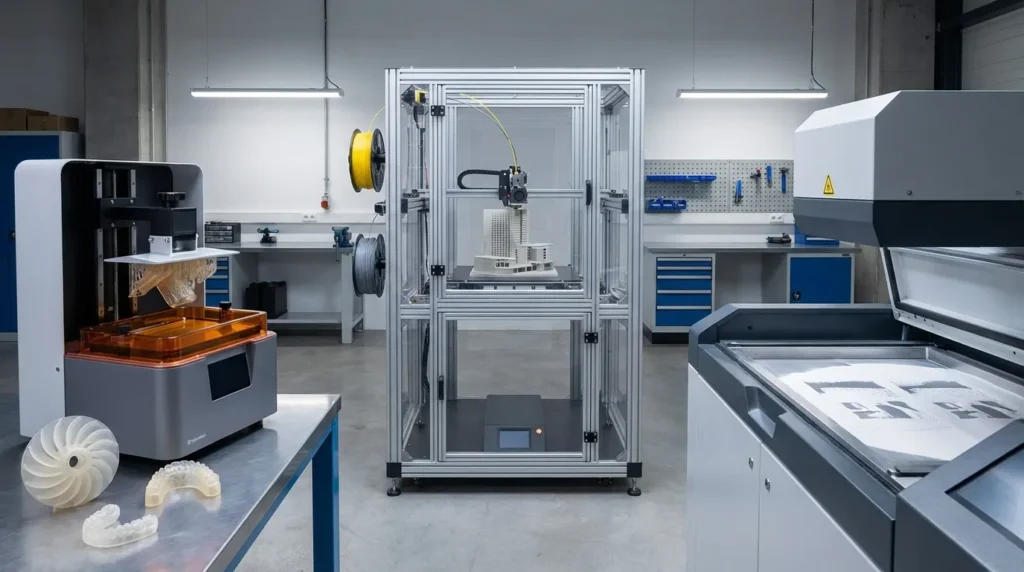
FDM vs SLA vs SLS: A Comprehensive Comparison for Engineers
Choosing the right 3D printing process can feel overwhelming at the start, and that’s usually for good reason. It’s a bigger decision than it first seems. FDM is often the first option people hear about when they’re new, while SLA and SLS are known for precision and speed. In real use, though, they solve different problems, which is easy to miss early on. For engineers in Australia, this choice often shows up fast in cost and lead time. It also affects how smoothly ideas move from concept to the factory floor, something teams notice pretty quickly.
Instead of relying on jargon, this guide keeps things straightforward. It compares FDM with other common industrial processes by looking at how they work and what they cost in everyday use. It also looks closely at where each option tends to work best, like on the workshop bench. The focus stays on real engineering needs such as tooling, jigs, fixtures, and short‑run production. You’ll also see why high‑speed FDM is growing in industrial settings, in my view.
Accuracy, surface finish, strength, and scale are all covered, since those usually matter most. The guide finishes with practical tips based on how teams actually use these machines day to day.
How FDM Works and Why It Dominates Industrial Floors
FDM, short for Fused Deposition Modeling, builds parts by melting filament and laying it down layer by layer. On the surface, that sounds simple. In real industrial use, FDM has moved well past basic printing. Faster motion systems, stiff machine frames, and smarter firmware mean it’s usually reliable enough for real production jobs, the kind that run all week instead of just being a quick demo.
One reason FDM shows up so often on the shop floor is its massive installed base. That scale usually means machines that are well tested, a broad mix of materials, and workflows teams already know. Because of that familiarity, engineers often pick FDM for tooling, fixtures, and functional prototypes. It sits in a practical middle ground between speed and cost, in my view, and industry surveys back that up. More than 70 percent of industrial users start projects with FDM before switching to another process, which often makes sense when deadlines are tight.
Here is a quick technical snapshot that engineers usually check first, even before pricing enters the conversation.
| Metric | FDM | SLA | SLS |
|---|---|---|---|
| Typical layer height | 0.10, 0.30 mm | 0.025, 0.10 mm | 0.10, 0.12 mm |
| Dimensional accuracy | Medium | Very high | High |
| Best use case | Tooling and fixtures | Precision prototypes | End-use parts |
FDM works especially well when parts need strength and quick turnaround. Carbon fiber and glass-filled filaments increase stiffness, while high-temperature materials handle the heat found on factory floors. For Australian manufacturers, this often supports local production, especially when imports are delayed. Shorter supply chains usually lead to less downtime waiting on spare parts.
Modern FDM systems now hit travel speeds above 500 mm per second. Moreover, speed matters, but accuracy stays solid thanks to better motion control. Because of this balance, FDM is often the first process used before moving to more complex options, especially in lean manufacturing setups.
For a deeper overview of FDM principles and materials, you can visit Stratasys FDM Technology Overview, which offers practical engineering insights.
SLA Printing for Detail, Surface Finish, and Validation
SLA, short for Stereolithography, uses light to turn liquid resin into solid parts. What most people notice right away is the surface finish: smooth, clean, and packed with sharp detail that’s easy to see. That finish is often why engineers choose SLA, especially when matching the CAD model closely matters more than strength or long‑term wear. It works well when a prototype needs to look almost finished, even if it’s still early in the design process.
That’s why SLA is so common in dental labs and medical modeling, where small details really matter. With layer heights down to 25 microns, it can handle sharp edges, tiny features, and smooth curves without visible layer lines. In classrooms or training environments, this level of polish helps people focus on the design itself instead of getting distracted by rough surfaces.
There are downsides to keep in mind. SLA usually isn’t a print‑and‑walk‑away setup. Parts must be washed and fully cured before use, which adds extra steps and time. Resins are also more brittle than typical thermoplastics, and material costs per part are often higher. Careful handling is important too, since the chemicals and waste process can catch new users off guard.
Even with that, SLA is useful early in development. Teams use it to check fit, review ergonomics, or gather feedback on how something looks, then move to FDM later for functional tests. It’s a practical way to balance detail and cost.
For engineers comparing resin options, Formlabs SLA Materials Guide provides detailed information on available resins and properties.
SLS and the Path to Production-Grade Polymer Parts
SLS, or Selective Laser Sintering, uses a laser to fuse powder into solid parts. One thing that surprises many people is that it doesn’t need support structures. The loose powder around each build naturally holds parts in place during printing, so stability is handled without extra steps. This setup makes it easier to create complex shapes and tightly nest parts in the build chamber. You can place parts close together without issues, which helps when build space needs to be used efficiently.
For low-volume production runs, SLS is often a popular choice. Parts are strong, and users usually notice the consistency from one build to the next early on. Mechanical properties tend to be more uniform than with many other methods. This reliability is why SLS is often used in aerospace, automotive, and medical fields, where repeatable results and even strength matter for real end-use parts. Fewer surprises is usually the goal.
Here is how the main technologies compare at a high level for production planning.
| Factor | FDM | SLA | SLS |
|---|---|---|---|
| Upfront system cost | Low to medium | Medium | High |
| Material reuse | Limited | Not reusable | High powder reuse |
| Production scalability | Medium | Low | High |
The main downside of SLS is access. The machines are costly, and powder handling needs careful, well-trained processes. Because of this, many Australian businesses outsource SLS at first, or bring it in-house later once volumes and staffing make sense. In most cases, that approach works best.
Choosing SLS too early is a common mistake. When volumes are still low and designs change often, FDM can give faster feedback at a much lower cost. That flexibility helps during early design rounds.
For more insight on SLS applications, EOS SLS Technology Overview explores common industrial use cases.
Speed and Precision in High-Speed FDM
Speed usually isn’t just about raw print time. In practice, it also covers everything around the job, like setup effort and how quickly teams can move through design changes, which is often the real bottleneck. High-speed FDM fits this space well, I think. Parts can be printed, tested, adjusted, and printed again within the same day. These short feedback loops work well for agile engineering workflows, especially when iteration speed matters more than getting it perfect on the first try.
Expectations have gone up as advanced motion systems and updated firmware become more common, and that has raised a few eyebrows too. Engineers now spend more time tuning machine movement, material flow, and heat control during a print. Small details usually make the difference. Careful adjustments help keep accuracy at higher speeds and cut down issues like ringing or weak layer bonding.
IDEX systems bring another layer of flexibility that becomes obvious fast. Dual independent extruders support multi-material parts and help move batches through more quickly. You can print two identical parts side by side, or combine rigid and flexible materials in one build. These are practical assemblies, not just demos.
That flexibility is especially useful for tooling and fixtures. One printer can support several departments without much trouble. Maintenance teams often print replacement parts overnight to avoid delays. Production engineers can adjust jigs as needed instead of waiting weeks on suppliers.
That’s a big reason industrial FDM is gaining traction with Australian SMEs, in my view. It brings hands-on control, faster turnaround, and predictable costs together on one platform, which often matters most when small teams and supply chain pressure shape day-to-day work.
Choosing the Right Technology for Your Workflow
The best choice usually comes down to what you’re trying to test or make. It helps to start with a few simple questions, even if they seem obvious. Do strength and function matter more than surface finish? Is this a one‑off prototype, or something you expect to remake several times as the design changes?
When fast turnaround and functional testing are the main goals, FDM is often a sensible place to start. Using engineering filaments instead of basic plastics can make a clear difference. Spending time tuning the machine is also worth it, since good calibration improves layer bonding and dimensional accuracy. That extra effort often helps control costs too, which matters when iterations add up. Straightforward and reliable.
Visual quality shifts the decision. When fine details or smooth surfaces matter most, SLA often makes sense early on. It works well for checking form and fit in tight assemblies. After that, designs often move to FDM or SLS once durability and heat resistance matter more than looks.
Complex geometry and short‑run production bring new questions. Is SLS the right choice now, or later? Many teams start with outside services, especially when volumes and budgets are still unclear. For short runs, careful planning usually matters more than anything else.
For engineers planning workflows, 3D Printing Industry provides ongoing comparisons and case studies between FDM, SLA, and SLS methods.
The Bottom Line for Engineers Ready to Decide
FDM and SLA aren’t really rivals, in my view, and SLS belongs in the mix too, just filling a different role that often gets overlooked. These tools are made for specific tasks. Teams that get real value usually don’t hunt for one perfect choice. They combine methods into a workflow that grows over time, with clear and practical jobs for each one.
For many industrial teams, FDM often becomes the backbone. It handles fast prototyping and tooling, including production aids used day to day. Early on, SLA adds clarity and fine detail, especially when how parts look matters. SLS often comes in later, when designs turn into end‑use parts that need to handle real wear.
If faster iteration, lower risk, and local control matter, one helpful move is to improve the FDM setup first. Hardware consistency, thermal control, and motion control often pay off. Growth can come later, and usually slower than teams expect. That’s where confidence grows.
Before the next project ramps up, it helps to review the workflow. You’ll spot delays, costs, and bottlenecks where iteration starts to slow down.
For more resources on industrial 3D printing adoption, see Additive Manufacturing Magazine, which features engineering case studies and technology updates.
