
Table of Contents
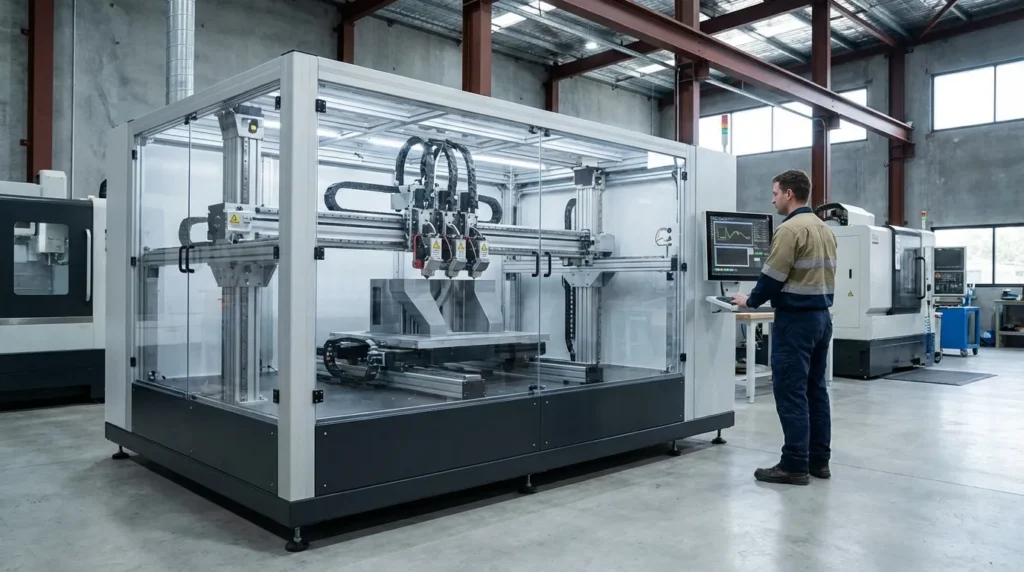
AI in 3D Printing and Automation: Transforming Manufacturing
Manufacturing is changing fast, and the pressure usually shows up first on the workshop floor. Parts need to move quicker, tolerances are tighter, repeatability matters more on busy days, and waste is still a constant headache. Deadlines pile up, while skilled labour keeps getting harder to find, and that often isn’t a short-term issue. This is where AI in 3D printing and automation in manufacturing start to make a real difference. From my experience, these tools already help teams keep up without adding more pressure to staff who are stretched thin (you’ve likely felt that pinch).
For Australian engineers and manufacturers, this shift feels very close to home. Local production often needs to stay flexible day to day, juggling short runs, design changes, and urgent jobs, while still competing with global suppliers and keeping delivery times steady. That’s not easy. High-speed FDM systems paired with automation help close that gap. Many teams now move from a rough prototype to an end-use part on the same machine, without long delays for setup or rework.
So what does this look like on the floor? This article looks at how AI and automation are reshaping industrial 3D printing in real workplaces, not just in theory. It examines how smart software improves layer consistency and dimensional accuracy, how automation cuts down manual loading and checking, and how setup time drops in real production settings. There’s also a practical focus on FDM systems, like high-precision CoreXY and IDEX platforms, that fit Australian workshops and small-scale production especially well.
Why AI in 3D Printing Matters in Modern FDM
In fast FDM printing, one small mistake can ruin a 20‑hour job halfway through, which is usually the most painful point to lose it. AI helps by making smarter, real‑time choices instead of sticking to fixed profiles and hoping for the best. Rather than locking settings at the start, the printer pays attention to what’s actually happening and changes things as it runs. This matters because speed, temperature, material flow, and motion almost never stay perfect for an entire print, especially on high‑speed machines.
What really changes the workflow is AI’s ability to predict problems. Issues are often easier to stop early than to fix later, and learning from past print data lets machines do that. Patterns linked to warping, clogs, or layer flaws can be spotted before they show up on the part. This is especially useful for large prints or overnight jobs when no one is nearby and watching the printer nonstop isn’t realistic. In day‑to‑day use, this usually means a lot less babysitting.
Recent market data shows how serious this shift is.
| Metric | Value | Year |
|---|---|---|
| AI in 3D printing market size | USD 2.36 billion | 2024 |
| Projected market size | USD 3.31 billion | 2025 |
| Estimated growth rate | ~39.9% CAGR | 2024, 2025 |
This growth comes straight from real shop-floor needs, at least in my view. AI-powered slicers now adjust speed and extrusion during the print, not only at the beginning. If a corner gets too hot, the system responds. If under-extrusion starts, settings change, often within seconds. High-speed printing often depends on this flexibility, since static profiles just can’t keep up.
For industrial users, this often means fewer failed prints and more consistent output. For educators and advanced hobbyists, it supports factory-style workflows, with less guesswork and far fewer tuning marathons.
Automation in Manufacturing Starts at the Printer
When people talk about automation in manufacturing, they usually picture robots or long conveyor lines. With 3D printing, though, it often starts much earlier, right at the printer itself. Long before a job runs (often before the first coffee), setup and calibration are already happening. The machine checks itself during the print, too. Tasks that once depended on an experienced operator are now handled by software, and that change is usually bigger than it first appears.
The day‑to‑day impact is easy to see. Shops don’t have to rely as much on deep, hard‑to‑replace know‑how. A newer operator can still get repeatable results because the system quietly applies proven settings, nozzle height, extrusion rates, motion limits, in the background. That alone can be a relief. This helps teams dealing with turnover or trying to increase output without bringing in more specialists.
What makes this work are features like automated bed leveling and flow calibration, which often save 20, 30 minutes on each setup. Motion tuning, once a hands‑on task with acceleration and jerk values, is now handled automatically on some machines. Firmware platforms like Klipper are known for allowing higher speeds while keeping accuracy. With added sensors, printers often check themselves before starting and keep an eye on things during the run.
In real production settings, that saved time adds up to hours each week. Deloitte research, often used to track big manufacturing trends, shows that pairing automation with additive manufacturing can cut lead times by up to 70%. Faster updates to tooling and jigs also make frequent reprints easier to approve.
Automation isn’t only about speed. It also improves consistency. A part printed today should usually match one printed months later, down to dimensions and surface finish. That kind of reliability matters more as FDM is used more in production, with quality checks built right into the process.
Closed-Loop Quality Control for High-Speed Printing
The tricky part about fast FDM printing is that problems often hide in plain sight. A print can look smooth and clean for hours, then shift or collapse near the very end, usually after a lot of time and material are already spent. Closed-loop control is designed to catch these problems early by watching the process nonstop. Instead of hoping everything stays on track, sensors and cameras keep an eye on each layer as it forms, so issues usually show up within a few layers instead of at the finish line.
What makes closed-loop systems useful is the constant reality check. The printer doesn’t just trust what the firmware says should be happening. It compares planned commands, like extrusion rate, cooling output, and motion, to what actually appears on the part’s surface. When something starts to drift, the system notices right away and responds, instead of finding out only after the print is finished. That quick response often saves the job.
In most setups, the workflow looks something like this:
- Sensors watch temperature, vibration, and extrusion pressure, often with overlap so one bad reading doesn’t throw things off.
- Vision systems scan each layer and flag small defects that are easy to miss at full speed, like slight under-extrusion.
- AI models compare live data to what that exact layer should look like.
- The printer adjusts speed, cooling, or material flow on the fly.
This approach is common in industrial 3D printing, especially for long runs where tolerances need to stay tight from part one through part fifty. Many people assume closed-loop control is only for big factories, but plenty of high-precision FDM printers now support it through upgrades or add-ons. Skipping it often leads to wasted filament, lost hours, or batches that don’t quite match, like a fixture run where the last parts suddenly don’t fit.
AI-Assisted Design and Smarter Slicing
Design is one of those areas where AI is quietly making everyday work easier. In real use, AI‑assisted tools often help engineers create parts that print correctly on the first try (a small win that usually feels big). They point to thin walls, awkward overhangs, stress hotspots, and tiny geometry problems before printing even starts. That early heads‑up usually means fewer late‑night failures and less backtracking.
What’s easy to overlook is how much simulation is built in. These tools estimate deformation, thermal stress, load paths, and how a part might flex once it’s actually being used, like when it’s bolted into a jig or squeezed by a clamp. Instead of fixing issues after something warps or snaps, designers can change the geometry earlier. This often means fewer physical test prints, saving material and a lot of waiting.
Generative design goes a step further by suggesting lighter structures with shapes a human might not sketch right away. This is especially helpful for tooling and robotic end‑effectors. Using less material usually means faster prints and lower costs, especially for complex parts.
Industry data suggests AI‑assisted design can cut design‑to‑print time by around 25%. In busy workshops handling multiple jobs, that time savings adds up fast.
For FDM users, smarter slicing matters just as much. Modern slicers use AI models trained on thousands of prints. They suggest layer heights, print speeds, cooling profiles, and small tweaks based on material and geometry. As a result, much of the guesswork fades away, even with tricky materials like carbon‑fibre nylon.
IDEX, Multi-Material Printing, and Automation
IDEX 3D printers are a solid fit for automated workflows, especially on busy production lines where flexibility matters more than flashy features. With two independent toolheads, they handle multi-material jobs and mirrored production, which works well when output needs to grow without adding more machines. AI support keeps toolheads aligned, holds nozzle and bed temperatures steady, and makes material swaps smoother. All of this happens directly on the line, not off in a lab.
So what if one toolhead isn’t being used? New software schedules jobs so both heads stay busy, which often boosts throughput for short-run manufacturing where batches might be 10, 50 parts. These systems are used for real production, not test prints, and fewer surprises usually mean fewer problems.
This matters for:
- Soluble supports on complex parts that are frustrating to remove by hand
- Multi-material prototypes where fit and surface finish really matter
- Small batch production using mirrored prints to save hours, not minutes
- Test runs where one toolhead handles setup parts or quick tweaks
Automation keeps both toolheads calibrated over weeks, not just days. Without it, IDEX setups can drift. In Australian manufacturing, these systems often produce jigs and fixtures: one head prints a tough structural plastic, while the other adds a softer grip or clear markings. Automation keeps results steady across shifts, even with different operators.
What This Means for Australian Manufacturers
One of the biggest changes is how AI and automation are shifting who gets to compete. Australia has its own manufacturing realities, and that shows up every day. Many businesses run lean, with small teams and tight deadlines, often handling several jobs at once. When machines stop, it usually costs real money, sometimes more than people expect in a small workshop, so keeping things running matters.
AI and automation help level the field, especially for smaller operators. Instead of fixing everything, they often keep jobs moving when things might otherwise slow or stop. This also helps regional manufacturing. Workshops outside major cities can reach strong output and consistent quality without large engineering teams or big-city budgets. That spreads capacity more evenly and helps the sector stay steady.
Key benefits include:
- Faster prototyping, even without extra staff
- Reliable low-volume end-use parts that still meet specs
- Easier skills transfer in training settings, especially hands-on ones
- More flexibility when designs change late
TAFEs and universities benefit as well. Students train on systems used in today’s Industry 4.0 workflows, so graduates are usually ready for modern factories. High-speed, AI-assisted FDM also supports reshoring. Parts once ordered from overseas can now be printed locally, on demand, within the same week.
Putting AI in 3D Printing and Automation Into Practice
What surprises many people is that getting started usually doesn’t mean ripping everything out and starting over. Most workshops begin with small, sensible upgrades, which is honestly a relief. Firmware updates paired with better sensors often bring quick improvements within the first few weeks. Better thermal control usually comes next, and it doesn’t require a huge jump in complexity. You can also pause between steps if schedules or budgets require it.
The big idea here is gradual adoption. Each upgrade tends to build trust in automated systems, especially when teams notice fewer issues during long overnight prints. Over time, people often lean more on data-based decisions and spend less time doing manual tweaks. It’s not about one single tool, but about a steady shift in how the work gets done, and that shift usually happens step by step.
A common path looks like this:
- Start with a firmware upgrade. Faster and smarter motion control shows up most clearly during quick infill moves.
- Add sensors next, focusing first on temperature tracking around the hotend and chamber; vibration sensors usually matter later.
- For key materials, try AI-enabled slicer profiles. They adjust speeds and cooling automatically, which reduces the need to constantly watch prints.
- Once things feel stable, add automation for calibration and daily checks.
The order usually matters more than the specific tools.
These updates cut down on manual tuning and help prints stay consistent from job to job. Over time, the printer feels less like a one-off machine and more like part of an automated production setup.
The Bottom Line
AI in 3D printing and automation in manufacturing aren’t really optional anymore for serious users. They’re quickly becoming normal for fast, high-accuracy FDM work. For Australian engineers, educators, and advanced makers pushing their machines hard, this shift opens up real opportunities.
With smarter printers, teams spend less time fixing layer shifts, temperature drift, and failed starts. That usually means more time producing parts that fit well, assemble cleanly, and hold up during testing. Prototypes arrive sooner, tools last longer, and production becomes steady enough to plan weeks ahead.
When reviewing a current setup, it helps to start where automation saves the most time, like calibration or first-layer checks. AI-driven features often improve print quality sooner than expected, and small changes today tend to turn into clear gains before long.
