
Table of Contents
Multi Material 3D Printing: AI and Hybrid Techniques
Multi‑material 3D printing has moved far beyond lab demos and weekend hobby projects. Today, multi material 3D printing is a real production tool on factory floors, often used more than people realise, especially outside major trade shows. When it’s combined with AI in 3D printing and mixed with hybrid manufacturing methods, the impact is easy to see. Builds usually finish faster. Accuracy gets better in ways teams can measure over weeks or months, not just from a single test print. Material waste often goes down. Machines are starting to make smarter decisions on their own, sometimes halfway through a print, which still catches people off guard. Mid‑print changes are now a normal part of the workflow.
For industrial engineers and manufacturing teams in Australia, this shift hits close to home. Local production costs are high, and lead times leave little room for error. That pressure means tools need to be fast and reliable. High‑precision FDM systems with multi‑material support are meeting that need. They let teams prototype fast, stress‑test designs, switch materials mid‑run, and move straight into end‑use parts without changing platforms, cutting down handoffs and delays.
This article keeps things practical. It looks at where multi‑material 3D printing is right now, how AI is changing daily workflows, why hybrid methods are spreading on real shop floors, and what this means for high‑speed FDM setups like IDEX printers. It’s written for people teaching, designing, or making parts that need to work in real conditions every day, not just in theory.
Why Multi Material 3D Printing Is Becoming an Industrial Standard
Multi‑material 3D printing lets a single part be made with two or more materials in one print job. In real use, this often means rigid and flexible plastics working together in the same component, which is genuinely useful in everyday production. It can also mean pairing a strong build material with a soluble support that simply washes away later. Some manufacturers take it further by mixing reinforced filament with a standard polymer to improve strength or heat resistance without adding extra steps. One process, one print, and usually much less hassle.
The biggest impact shows up on the factory floor. By cutting down the number of separate parts, multi‑material printing often reduces assembly time. Fewer joins usually mean fewer failure points, which helps save money and avoids problems later. Designers also get more freedom when testing ideas. Strength can be added only where it’s needed, like load‑bearing areas, while flexibility can be built into hinges, clips, or seals where movement helps. Over time, this approach often lowers lifecycle costs and makes maintenance easier, which most teams welcome.
Another reason adoption keeps growing is repeatability. Modern industrial printers can switch between materials again and again during a single job without constant oversight. This consistency matters a lot in regulated industries such as medical devices, electrical housings, and safety equipment, where “close enough” usually isn’t acceptable. In these cases, reliability is often what sells the technology.
Market data shows how quickly this shift is happening across industrial additive manufacturing. No fluff. Just numbers.
| Metric | Value | Year |
|---|---|---|
| Global 3D printing market size | USD 28.55 billion | 2026 |
| Industrial 3D printer market size | USD 20.8 billion | 2026 |
| AI‑driven defect reduction | ~25% | 2025‑2026 |
These figures reflect real‑world use, not marketing claims. Australian manufacturers are already using multi‑material FDM for tooling, jigs, fixtures, and short‑run production that needs fast turnaround, sometimes in just days. Education providers are also adopting these systems, with more focus on hands‑on manufacturing skills instead of staying purely theoretical, which feels long overdue.
People working with this technology often point out how important material control is, especially when blending different materials into a single functional part without slowing things down or complicating the workflow.
Multi-material additive manufacturing enables the fabrication of parts with spatially varying properties, which is essential for functional integration and performance optimisation.
For readers who want to learn more, the technical side is covered in a practical way in the article on dual extrusion techniques, which explains how this works on real machines used in everyday production.
How AI in 3D Printing Changes Speed, Quality, Reliability, and Uptime
The most interesting shift with AI in 3D printing isn’t robots taking over the workshop (even if sci‑fi keeps pushing that idea). It’s how systems can usually make smarter calls, faster than a person could during a long print. Machine learning models watch sensor data in real time as the job runs. Temperature, extrusion flow, vibration, and layer bonding are all tracked together, not one at a time. It’s basically constant attention, and printers don’t need breaks anyway.
That real‑time awareness is where the gains show up. When a process starts to drift, the system often reacts right away, tweaking settings mid‑print instead of waiting for a visible failure hours later. The result is usually less scrap and fewer wasted hours on rework, which matters when machines are running all day. Multi‑material prints benefit the most, since material changes are often where small problems quietly grow into big ones.
AI also improves throughput in very practical ways. Predictive models can flag risky jobs before printing even begins, which changes how teams plan. The software reviews the design, checks material pairings, and points to combinations that often cause trouble. This lets teams schedule with more confidence and skip jobs that probably weren’t going to work anyway.
In additive manufacturing, artificial intelligence is increasingly being used to improve process monitoring, defect detection, and quality control by analysing large volumes of sensor data in real time.
Before printing starts, AI also helps shape the design itself. Generative tools suggest parts that are lighter, stronger, and usually easier to print, while using less material. That leads to faster design cycles, and in many industrial workflows, design time is already cut by around 25 percent.
AI-driven design tools are now capable of generating manufacturable geometries that would be impossible to create using traditional CAD approaches.
On high‑speed FDM systems running Klipper firmware, AI fits naturally with fast motion control. It helps keep surface quality and layer consistency steady even when acceleration and flow are pushed close to their limits. That kind of stability often makes the difference for real production output, day after day.
Hybrid Manufacturing Brings Additive and Subtractive Together
Hybrid manufacturing combines 3D printing with CNC machining or automated inspection in one connected workflow. The big advantage is that parts don’t need to move back and forth between machines, which often removes small delays that add up fast. With fewer handoffs and less waiting, teams usually get quicker turnaround and easier scheduling. This is especially useful when deadlines are tight and machine time is limited.
This setup works especially well for multi material 3D printing. A near‑net‑shape part can be printed using different materials, then only the areas that truly need it are machined. Surfaces like mating faces or wear zones are finished accurately, while the rest stays as‑printed. That mix suits tooling and fixtures that deal with real shop conditions, not controlled lab use.
Large parts also benefit. Additive steps handle complex shapes and internal features that would otherwise be expensive to machine. Subtractive steps then clean up alignment points or mounting faces where accuracy matters most.
In Australia, industries like mining, defence, aerospace, and energy often see strong results. These sectors need tough, accurate parts in low volumes and short timeframes. Hybrid systems help cut lead times and reduce reliance on overseas suppliers, which matters when shipping slows down.
One thing to watch out for is treating hybrid systems like standard printers. Planning needs to start early, with toolpaths built for both printing and machining. Materials also need to handle cutting forces without failing. That early planning usually makes the difference between smooth projects and frustrating ones.
For a deeper dive, this is covered here: Hybrid Manufacturing in 3D Printing: Integrating Additive and Subtractive Processes. It’s worth a look if you want to explore the topic further.
The Role of IDEX and Advanced FDM Hardware
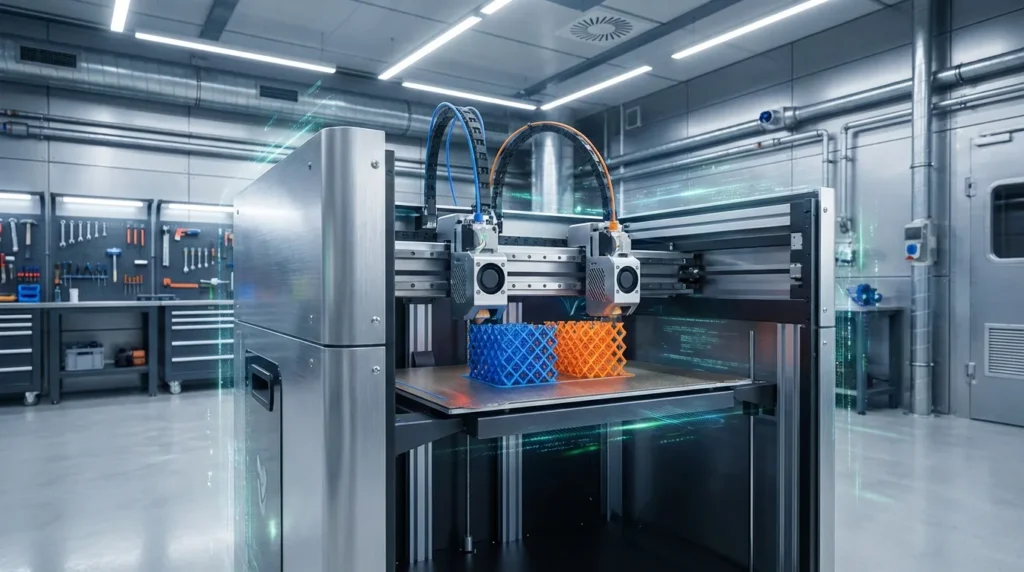
In real production shops, IDEX systems are often why multi‑material printing actually works day to day. Two independent toolheads let each material keep its own nozzle and heat zone. That may sound basic, but in practice it cuts down on cross‑contamination and keeps print quality steady when materials don’t like each other. You notice the benefit fast: fewer failed starts, less cleanup, and first layers that settle down without drama.
You also get clear productivity wins. Printing two parts at once or mirroring parts can push out batches faster, and keeping one toolhead dedicated to supports helps a lot when shapes get complicated. Options matter here. With AI‑assisted calibration and tuning, machines often run at higher speeds without constant manual tweaks, which can save hours over a typical week.
Accuracy still depends on solid fundamentals. Linear rails, stiff frames, rigid gantries, and high‑flow hotends help advanced FDM machines hold tolerances during hard acceleration and long prints that can run all day. There’s no real shortcut around this.
Thermal control often decides if mixed materials behave. Enclosures keep temperatures stable, active cooling manages airflow, dry storage protects filament, and heated chambers help rein in warping filaments when everything is tuned properly.
Raven 3D Tech puts a lot of attention on these details for RatRig V‑Core platforms, building systems meant for nonstop printing and demanding materials. The result is a machine that can handle a complex, multi‑material job overnight without babysitting. For a deeper workflow view, we covered it here: Mastering Multi-Material 3D Printing with IDEX and Klipper in Professional Workflows.
Practical Steps to Prepare for the Next Wave
Getting ready for what comes next usually isn’t about throwing out your current workflows. It often works better to start with small process changes and build from there. One helpful approach is to look at where multi‑material parts could cut assembly time or make builds simpler. Brackets or housings are often the easiest places to get quick results. Small wins really do add up. You may also notice that AI‑based monitoring can spot waste earlier than expected, especially during long production runs where scrap tends to creep in unnoticed.
So what’s worth upgrading first? Hardware updates make sense only when they clearly fit your setup and goals. Dual extrusion and rigid frames are usually safe bets, and dependable motion systems save a lot of headaches over time, even if they’re not exciting. The boring stuff often matters more than people think in daily production. Firmware like Klipper can support automation and easier tuning, but it only helps once the basics are already solid.
Data collection quietly does a lot of work. Tracking print failures and material use gives useful insight without much extra effort. When cycle times are added later, that foundation supports future AI improvement, and even simple numbers can point to problems hiding in plain sight.
Training matters just as much as equipment. Engineers and technicians need a clear feel for how materials behave in real conditions, with slicer settings backing that up instead of leading it. Schools and TAFEs can also use these systems to teach hands‑on industrial skills that carry straight into the workplace.
It also helps to think long term. Hybrid manufacturing and AI‑driven control are becoming standard tools in advanced manufacturing. They’re already shaping day‑to‑day operations, often slowly and without much noise at first. For comparisons on which technology to choose, see Comprehensive Comparison of 3D Printing Technologies: FDM vs SLA vs SLS.
Where Multi Material 3D Printing Is Headed Next
One of the most interesting changes right now is how closely hardware and software are starting to work together in multi‑material 3D printing. This often shows up through AI‑driven, closed‑loop control, where a printer can adjust temperatures or flow rates while a print is still running, instead of reacting after something fails. Hybrid machines are also getting smaller and easier to live with, which matters once they move out of research labs and into workshops or garages. After a few long prints, having less setup work and more control right at the machine simply feels like a win.
Material science is moving ahead in a more focused way too. More filaments are being made specifically for multi‑material systems, leading to better bonding and composites with features like conductivity or added stiffness built in straight from the nozzle.
For Australian manufacturers, this often means faster local prototyping and tighter design loops. Educators get more realistic teaching tools, advanced hobbyists can reach near‑professional results at home, and small product teams can prototype in‑house instead of outsourcing, changing how everyday things get made.
