
Table of Contents
Understanding 3D Printing Nozzles: Selection and Upgrades
When most people think about a 3D printer, the nozzle might seem like a tiny, easy-to-overlook part, kind of like a pen tip you don’t pay attention to until it causes issues. But for anyone printing regularly, whether industrial engineers, manufacturing experts, or experienced hobbyists in Australia, that small piece often decides if a project runs smoothly or stops mid-job. In fact, understanding 3D printing nozzles from the start can help you avoid many common printing problems. Picking the right nozzle, or switching to a better one, can mean quicker prints, cleaner details, and less time spent fixing problems.
A good nozzle can speed up work, improve fine details, handle tricky filaments, and last longer before wearing out. Here, we’ll explore different nozzle styles, sizes, and materials, plus upgrade tips that can make an FDM printer work noticeably better.
Why 3D Printing Nozzles Choice Matters
In industrial and high-precision 3D printing, the nozzle you pick can change the whole result, affecting speed, fine detail, and even how strong the finished part is. It’s not just about picking a certain diameter. The printer’s setup, the filament you’re using, and the real-world job that part will do often have a bigger impact than people expect.
Here’s one manufacturing example: switching to a finer nozzle, plus a few smart setting changes, cut build time by almost 28%. That kind of improvement is more than just nice to have in aerospace or mining, where saving hours can mean hitting a tight deadline instead of scrambling to catch up.
Nozzle choice also affects how layers stick together, how smooth the surface looks, and whether materials like carbon fiber composites or flexible TPU run without constant jams. Pick the wrong one, and you could end up with weak extrusion, parts drifting off spec by a few millimeters, or a lot of extra sanding after printing. In some production runs, using the right nozzle has improved dimensional accuracy by about 15%, which is a big win when tolerances are tight.
If you’re running multiple printers, using the same nozzle type can make maintenance easier, lower unexpected failures, and help teams work with less stress. In large-scale projects, these small choices can add up to big advantages.
| Nozzle Diameter | Speed Impact | Detail Level |
|---|---|---|
| 0.25 mm | Slow | Very High |
| 0.4 mm | Moderate | High |
| 0.6 mm | Fast | Medium |
| 1.0 mm | Very Fast | Low |
Nozzles have different sizes because each controls how much paint or coating is released, which changes the final look. Bigger ones push more material, making them good for thick coatings like heavy primers, while smaller ones work well for precise jobs like edges or details. Picking the right nozzle for your job can save time, cut waste, and make the process easier.
Small Diameter Nozzles (0.25, 0.4 mm)
When you need to capture very fine detail, these nozzles give you just that, great for delicate prototypes or small tooling inserts. They’re popular in classrooms, where teachers impress students with detailed demonstration models, and they’re often used in dental labs or jewelry studios that depend on smooth surfaces and accurate, tiny features. They aren’t meant for fast printing, but with ultra-thin layers around 0.05 mm, the finished pieces can look almost like they were injection molded.
Medium Diameter Nozzles (0.5, 0.6 mm)
For lots of printers, these sizes often hit a sweet spot where speed and detail work well together, quick enough to keep jobs moving, yet sharp enough to keep fine edges looking good. They’re great for making accurate parts without sitting through painfully slow prints. Many RatRig V-Core users in Australia recommend them for everyday industrial work. From PLA and PETG to nylon, they handle a wide range smoothly, and with bigger runs, they keep production flowing instead of slowing down.
Large Diameter Nozzles (0.8, 1.2 mm)
When cranking out large parts or prototypes fast, these big nozzles usually outperform the finer ones by a long shot. They’re great for tooling, jigs, and fixtures where speed matters more than catching every tiny detail, and the thicker extrusion lines help layers stick together well, giving parts the strength needed for hands-on testing. They often shine in oversized architectural models or stage props, where the focus is on size and overall look. In some heavy-duty construction-style 3D printing, nozzles over 2 mm push out huge amounts of material in minutes, amazing to watch in action.
Material Choices for Industrial Applications
Picking the right nozzle material can make a big difference in how well it handles abrasive filaments, and how long it lasts before you have to swap it out mid-job (which can really mess with your schedule).
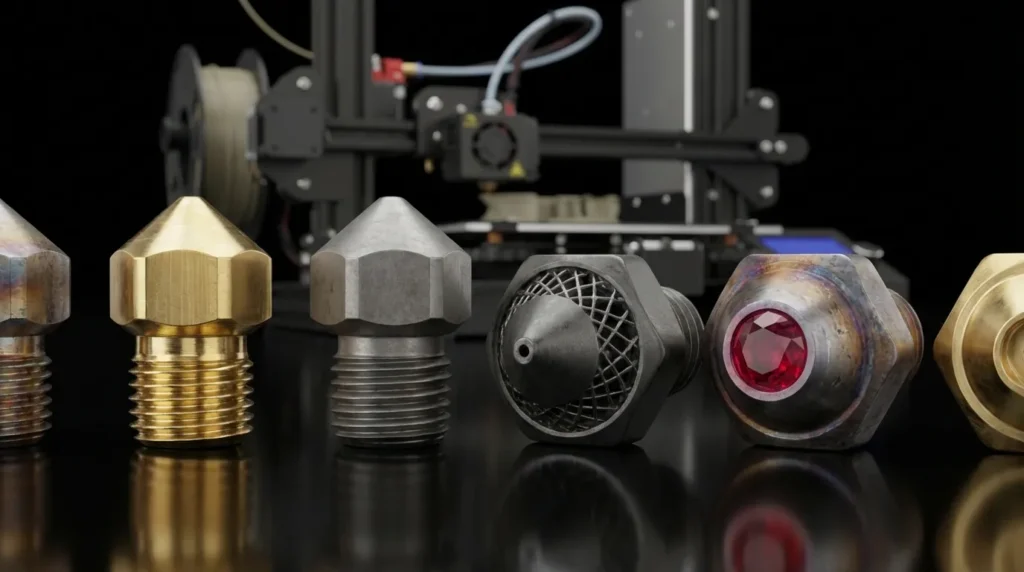
- Brass: Budget-friendly and easy to use for regular prints with PLA or ABS. Installs quickly and produces smooth finishes, but wears down fast with composites or gritty blends.
- Hardened Steel: Stands up well to carbon fiber, glass-filled nylon, and other tough filaments that quickly damage softer metals.
- Tungsten Carbide: Great for long industrial runs where stopping the machine is expensive.
- Ruby-Tipped Nozzles: Extremely wear-resistant, perfect when precision needs to stay sharp through many prints.
InssTek engineers, working with the Korea Aerospace Research Institute, found that pairing precision cooling channels with certain alloys can greatly improve heat control. Their rocket nozzle used Al-Bronze combined with Inconel 625, a mix that balanced strength and heat stability. In industrial 3D printing, the right pairing can extend nozzle life by up to five times. Tungsten carbide may cost more at first, but it often delivers thousands of hours with abrasive prints. Since different materials pass heat differently, a good match can help extrusion stay smooth, especially with polymers that react to small temperature changes.
When to Upgrade Your Nozzle
Upgrading a nozzle isn’t about chasing the newest gadget, it’s usually about fixing those nagging issues that slow you down, and sometimes heading off bigger problems before they cause real trouble.
You might want to switch if you notice:
- Constant clogs that make you want to step away from the printer altogether
- Parts of your print coming out uneven, rough, or with strange textures
- Switching to abrasive materials like carbon fiber or glass-filled nylon, which can quickly wear down softer metals
- Trying to print faster while still keeping accuracy and a clean finish
Real examples make it easier to see the benefits. In Western Australia, a mining gear company replaced brass nozzles with hardened steel and cut downtime by almost half. In Melbourne, a prototyping team used ruby-tipped nozzles for continuous carbon fiber jobs, avoiding costly delays. Let the bore wear too much, and you’ll end up with messy lines, wasted filament, and a stack of failed prints. Swapping early can save both time and materials.
For more examples, check out Understanding 3D Printing Nozzles: Types, Uses, and Upgrades to see how nozzle choices impact different workflows.
Integrating Nozzle Selection into Your Workflow
Modern slicer tools like Cura and PrusaSlicer come with built‑in profiles for different nozzle sizes, so you don’t have to set everything up from zero each time. It’s simple to adjust things like extrusion speed, cooling fan settings, and retraction to match the nozzle you’re using, especially handy when switching from a standard 0.4 mm to a bigger 0.8 mm for faster prints.
In industrial use, the routine often goes like this:
- Pick a nozzle size based on whether you need fine detail or a quick finish
- Choose a filament that handles wear well, carbon fiber blends usually stand up better to abrasion
- Load the matching slicer profile, then adjust layer height or temperature if the material needs it
- Run a short calibration print to spot any problems before full production
- Start production while keeping an eye on extrusion flow for early trouble signs
Choosing the right nozzle early can help avoid headaches later. Some companies link nozzle profiles to job tickets in their MES, so swapping hardware triggers automatic setting updates. In Australia, certain IoT printers track nozzle wear and send alerts before quality drops, helping keep output steady and reducing downtime.
Trends Shaping Nozzle Technology
Recently, variable nozzle systems have been getting a lot of attention, giving operators the ability to switch from ultra‑precise detail work to high‑volume output in seconds. There’s no need for slow recalibration, which helps make long production days feel easier. For workshops that handle different jobs one after another, that kind of quick change can really make a difference.
Across Australia, the interest is spreading beyond a single specialty. Aerospace engineers, defense teams, and small manufacturers are all using these systems, moving from prototype testing to full production without having to move or overhaul entire lines. Inside the nozzles, improvements like smoother flow channels and coatings that stop buildup often mean more reliable extrusion and fewer annoying clogs. Some trials even use heated tips to keep temperatures steady, useful for tough, heat‑dependent polymers. And with sustainability getting more attention, recyclable or modular nozzle designs are gaining fans for cutting waste while keeping costs under control.
Practical Selection Tips for Australian Professionals
Picking the right nozzle for fast, accurate FDM prints usually comes down to a few straightforward choices. Match the nozzle size to the job. Small ones are better for fine detail work, while bigger ones can pump out larger prints more quickly. If you’re using abrasive filament, go for stronger nozzle materials so they last until your project’s finished. A handy trick is to set up slicer profiles for each nozzle type, making it easier to get steady, repeatable results. It’s smart to keep a couple of spare nozzles nearby, ready for a clog or a sudden change in what you’re printing. And before tackling a big, complex job, try the new nozzle on something short and low-risk first.
In Australia, supply chains can be slow, especially for unusual parts from overseas. It’s not rare to wait weeks. That’s why having a small backup kit can be a real lifesaver, especially in fields like mining or agriculture where fixes happen on-site. A mix of nozzles means you’re ready for dusty farm work or hot summer weather. Working with local suppliers or makerspaces can help too, they often share proven setups shaped by real Aussie conditions, saving you from headaches later.
For more details, check out: Maximizing Your 3D Printing Potential: A Comprehensive Guide to 3D Printing Nozzles, Complete Guide to 3D Printing Filaments: Selection, Storage, and Handling for Precision Results and Comprehensive Comparison of 3D Printing Technologies: FDM vs SLA vs SLS.
Your Path Forward
Swapping out a nozzle isn’t just about chasing specs or picking the flashiest material, it can be a small tweak that makes your work run more smoothly. Once you understand the basics, like the diameter, the build material, how it locks into your current setup, and how each detail affects your output, you’ll start noticing new possibilities. You could get faster runs, sharper edges, and equipment that lasts longer, sometimes all from a single change.
Whether you’re in mining, aerospace, defense, or tinkering in your garage, the right nozzle can fix slowdowns and noticeably improve your results. Take the time to figure out exactly what your system needs. A good way to do this is to try a few solid options, stay aware of new releases, and see which ones actually make your work easier.
The payoff is more than cleaner prints. Choosing well can help you hit deadlines calmly, cut repeat costs, and stay ahead. Finding flexible designs or AI-driven updates early lets you grab upgrades that truly fit your workflow.
