
Table of Contents
Dual Extrusion 3D Printer: Benefits, Challenges & Tips
Dual extrusion technology in 3D printing is changing things for industrial engineers, manufacturing pros, hobbyists, and small-scale inventors working on tricky multi-material projects. Anyone who’s tried making detailed parts with just a single-extrusion printer knows it can feel like hitting a creative roadblock. That slows progress and cuts down on choices. A dual extrusion 3D printer helps break through that, opening up new options so you can mix materials or colors in ways single printers just can’t handle.
In this guide, we look at what a dual extrusion 3D printer is, why it’s quickly becoming a popular upgrade for many 3D printers in Australia, the main benefits it can bring, common problems to watch for, and some practical tips you can try right away. From aerospace tools and classroom models to production parts or detailed art pieces, learning this tech can mean cleaner prints, faster turnaround, and better dependability.
What is a Dual Extrusion 3D Printer and Why It Matters
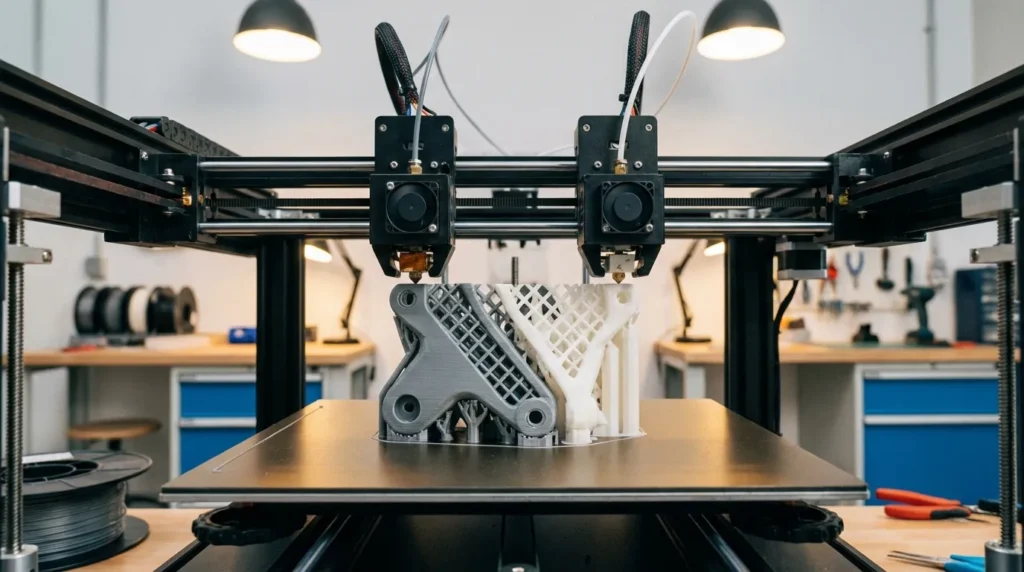
A dual extrusion 3D printer uses two separate extruders and nozzles working together. This means the printer can feed two different filaments during the same job. It’s perfect when you want variety without stopping mid-print. The filaments can be different colors, different materials, or even one that’s a soluble support made to dissolve after the print is done.
IDEX technology in dual extrusion allows printing more complex pieces by using hydrosoluble supports and combining materials without compromising part quality.
In demanding industries, this feature makes a real difference. Picture creating a complex aerospace bracket using strong, high-performance PEEK while a soluble support holds every tricky overhang. When printing finishes, the support dissolves, leaving a smooth part ready to use. You can also mix flexible TPU with rigid nylon to produce shapes that a single-extruder printer would struggle with. Another smart option is printing with conductive filament alongside a solid base, so prototypes can carry electrical current straight from the printer.
It works especially well with Independent Dual Extrusion (IDEX) systems, like RatRig V-Core builds from Raven 3D Tech, where each print head moves separately. That setup lets you make two identical parts or mirrored versions at the same time, cutting production time for small-batch projects.
Benefits of a Dual Extrusion 3D Printer in Industrial Settings
In manufacturing, a dual extrusion 3D printer offers more than just cleaner-looking prints. It’s a practical way to save valuable time when deadlines are tight. The mix of speed and accuracy often means products ship on time instead of rushing through last-minute fixes.
| Benefit | Impact | Example |
|---|---|---|
| Multi-material printing | Combine rigid and flexible in one job | Functional prototypes with TPU hinges |
| Reduced post-processing | Up to 50% faster finishing | Soluble supports for aerospace tooling |
| Improved surface finish | No scarring from supports | Medical device components |
| Color differentiation | Clear part identification | Educational engineering models |
What makes the technology stand out?
- Multi-material capability: Combine tough engineering-grade filaments with dissolvable supports to avoid long cleanup sessions while still creating shapes single-material printers can’t handle.
- Reduced assembly needs: Complex parts can be printed in one pass, removing tricky alignments and lowering small human errors.
- Better surface quality: Dissolvable supports safeguard delicate surfaces, perfect for precision items like surgical guides.
- Clearer prototypes: Using different colors in prototypes or training models helps clients and teams understand layouts right away.
We are at a pivotal moment for additive manufacturing. By empowering users and fostering collaboration, we can shift from focusing solely on innovation to delivering tangible business value.
For industrial engineers, it can feel like shifting from trial runs to dependable production. Cutting build time for complex parts by about 30% while keeping accuracy high makes a big difference.
Common Challenges with a Dual Extrusion 3D Printer and How to Overcome Them
A dual extrusion 3D printer can open up many possibilities, though the first few prints can be tricky to get right.
- Calibration complexity: Nozzle alignment can slowly drift over time.
- Material compatibility: Some filament pairs don’t bond well.
- Maintenance demands: More parts mean more frequent cleaning and adjustments.
- Higher cost: Usually runs about 20–40% more than single-extrusion.
Even a small offset, like 0.2 mm, can wreck a model. Run small test prints after every few jobs to catch misalignment early.
When you’re new, stick with easy combos. PLA with PVA supports? Great beginner choice. PETG with BVOH? Better once you’ve gained practice. Odd mixes can warp or split, so save those for experiments.
Mixing colors can get muddy. A purge tower and quick nozzle wipe help keep them sharp. Auto-offset sensors or self-leveling beds make setup quicker.
More calibration tips are here: Essential Guide to 3D Printer Calibration.
Best Practices for Dual Extrusion 3D Printer Success
If you want prints that look clean and run without trouble, start with choices that matter. Pair materials that work well together. Strong engineering filaments often do best with soluble supports that stick firmly; otherwise, layers may not hold and blobs can appear.
ABS and nylon like a warm, stable setting. Using an enclosure keeps temperature steady, cuts warping, and helps each layer line up nicely. Keep firmware and slicer profiles up to date. Updates often bring better purge tower control, improved presets, and tweaks that make prints come out nicer.
IDEX printers offer perks: duplication mode speeds up identical parts, while mirror mode makes matched designs without reworking CAD files.
Simple upkeep—cleaning extruders, checking gears, and adding lubrication—avoids jams and keeps flow steady. With IDEX plus Klipper, prints can be quicker and sharper. Adjusting tool changes and adding prime pillars or ooze shields keeps surfaces neat when switching materials.
Real-World Applications and Case Studies
In aerospace tooling, one of the best things about a dual extrusion 3D printer is how it cuts out slow, tedious steps after printing. Complex jigs made from tough composite materials can be printed with supports that dissolve away, leaving parts ready to go.
In education, teachers in technical subjects often use it to make lessons easier. Mechanical models printed in different colors let students quickly see how each piece works. STEM programs benefit since color cues help ideas stick faster.
Automotive prototyping shines here. Some parts need rigid frames with flexible sections. A dual extrusion 3D printer can print both at once, ABS frames next to TPU gaskets, creating a working prototype without extra assembly.
| Industry | Application | Benefit |
|---|---|---|
| Aerospace | PEEK + soluble supports for jigs | 50% faster post-processing |
| Automotive | ABS + TPU for prototypes | Integrated flexible components |
| Education | PLA multi-color models | Improved learning clarity |
In medical manufacturing, surgeons can rehearse on anatomical models combining firm, bone-like areas with softer tissue zones, giving realistic practice for complex operations.
Industry Trends and Future Outlook
Advances in material science and faster automation are steering where dual extrusion is going. By 2026, printers should work with composite blends, metal-filled filaments, and other high-performance materials with fewer adjustments.
Automation is coming quickly. Picture a robotic arm removing a finished part and starting the next job right away. In a busy smart factory, that could cut labor costs and boost speed.
Hybrid manufacturing, mixing FDM dual extrusion with CNC finishing, keeps precision high while design freedom stays open, as shown in Exploring Hybrid Manufacturing. AI-powered slicing tools will likely plan tool paths with great accuracy, trim prep time, and spot mistakes before they ruin a print.
Your Path Forward with a Dual Extrusion 3D Printer
A dual extrusion 3D printer has grown from a hobbyist’s weekend project into a serious tool that changes how ideas turn into finished products. When you mix the right materials, use calibration routines you’ve fine‑tuned, and keep your workspace steady, you’ll see complex parts coming off the printer faster without losing accuracy.
For engineers and manufacturers in Australia, using a dual extrusion 3D printer isn’t about chasing flashy extras. It’s about making builds and details possible that couldn’t be done before. Raven 3D Tech provides reliable machines, smart upgrades, and a team with plenty of hands‑on experience. They help you choose a printer that fits your production speed, match it with materials suited to your work, and set up software that works with your goals.
Stick with material combinations you trust, then keep improving calibration until it feels automatic. From there, explore advanced setups—IDEX with Klipper is a popular step up. Keep quality checks steady, even when things get busy. That’s when turnaround times shorten, finishes get better, and your edge grows.
Now could be the right time. A dual extrusion 3D printer can lift your results and fit easily into your process without the usual hassles.
