
Table of Contents
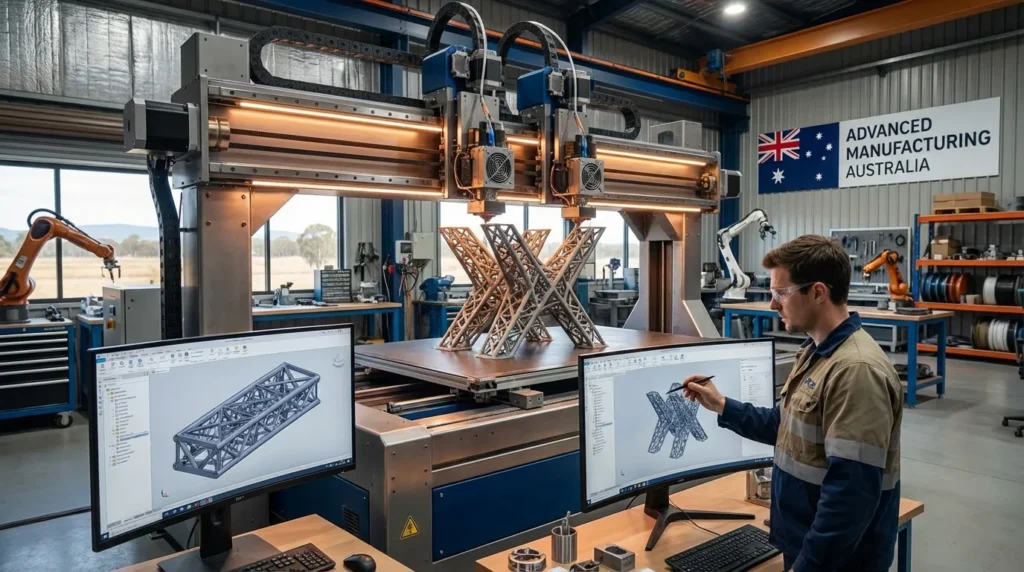
Design for Additive Manufacturing: Essential Skills for Engineers
In the rapidly evolving world of industrial 3D printing, simply knowing how to operate a printer is no longer enough. Engineers and manufacturing professionals in Australia face a new reality. Success with additive manufacturing (AM) hinges on the ability to design parts specifically for AM processes. This approach, known as Design for Additive Manufacturing (DfAM), is transforming workflows, enabling geometries impossible with traditional manufacturing, and driving faster production cycles.
For those working with high-speed, high-precision FDM systems, especially industrial-grade setups like RatRig V-Core or IDEX dual extrusion machines, harnessing DfAM principles directly impacts prototyping speed, tooling efficiency, and production quality. In this article, we explore the essential skills engineers need, industry-specific trends, and actionable strategies to integrate DfAM into advanced manufacturing environments.
As additive manufacturing matures, the emphasis is shifting from simply being able to print parts to designing parts that can only be made through additive processes.
Understanding the Core Principles of Design for Additive Manufacturing
DfAM is more than just tweaking a CAD file for 3D printing. It’s a mindset shift. Traditional design constraints, such as subtractive manufacturing limitations, give way to additive-specific opportunities like complex lattice structures, internal channels, and part consolidation.
Key principles include topology optimization, which uses algorithms to reduce weight while maintaining strength. Generative design leverages AI to explore thousands of design permutations. Engineers must also master support structure minimization to reduce material waste and post-processing time.
According to the Wohlers Report 2025, the global AM industry grew 9.1% to reach USD 21.9 billion in 2025. This growth underscores the importance of advanced design capabilities.
| Principle | Benefit | Example |
|---|---|---|
| Topology Optimization | Weight reduction | Aircraft bracket |
| Lattice Structures | Material efficiency | Medical implants |
| Part Consolidation | Reduced assembly | Automotive manifolds |
Each principle offers tangible benefits, from reducing part weight to eliminating multiple components through consolidation. In practice, applying these principles means engineers can create parts that withstand high mechanical loads with less material. They can also optimize fluid flow through intricate internal channels or design lightweight yet strong prosthetic devices. Balancing geometric complexity with manufacturability is crucial. Overly complex designs can increase print times and post-processing demands. By combining computational design tools with manufacturing insight, engineers can unlock efficiencies across aerospace, medical, and automotive sectors. This also reduces costs and environmental impact.
Mastering Material Science for Design for Additive Manufacturing in FDM
Material selection directly influences a part’s mechanical performance, thermal resistance, and printability. Engineers working with high-precision FDM must understand how polymer characteristics interact with machine parameters.
High-strength polymers like polycarbonate and PEEK demand elevated print temperatures and enclosed build chambers to prevent warping. Flexible filaments require fine-tuned retraction settings to maintain accuracy. Composites, such as carbon fiber-infused nylon, offer strength-to-weight advantages but can be abrasive to nozzles. Therefore, hardened steel tips are often necessary.
Engineers who understand the design freedoms and constraints of additive manufacturing can unlock performance gains that are impossible with traditional methods.
Australia’s growing adoption of advanced materials in aerospace and defense highlights the importance of aligning design choices with material capabilities. Engineers must also integrate sustainability considerations, selecting recyclable or biodegradable options where feasible. Furthermore, mastering thermal properties, layer adhesion, and moisture absorption rates allows for better control over print quality. For example, nylon’s susceptibility to moisture can be mitigated with proper storage and drying, which directly impacts tensile strength. Understanding the wear characteristics of filled polymers helps predict part lifespan. By aligning material science expertise with part design goals, engineers can ensure each print meets dimensional and functional requirements while performing reliably in real-world conditions.
Process Engineering and Calibration for Design for Additive Manufacturing
High-speed, high-precision FDM printing demands meticulous process control. Engineers must be adept at calibrating extrusion flow, bed leveling, and thermal management to ensure consistent quality.
For example, Klipper firmware integration enables faster print speeds without sacrificing accuracy. This is possible thanks to advanced motion planning algorithms. Dual extrusion systems, especially IDEX configurations, require precise nozzle alignment and synchronization to avoid defects.
For step-by-step calibration strategies, refer to the Ultimate Guide to FDM 3D Printer Calibration Techniques. This guide covers extrusion tuning, sensor automation, and error reduction methods.
Process engineering also involves understanding environmental factors. Temperature fluctuations, humidity, and vibration can all compromise results. Incorporating enclosures and temperature control systems ensures consistent layer adhesion and dimensional stability. Engineers should validate machine performance regularly using benchmark test prints and statistical process control (SPC) methods. Fine-tuning acceleration and jerk settings can prevent ringing artifacts. Optimizing cooling fan profiles can improve overhang performance. In industrial contexts, integrating IoT sensors for live monitoring provides actionable data to maintain optimal conditions. By developing a systematic approach to calibration and process monitoring, engineers can achieve predictable outcomes even when scaling production.
Integrating Post-Processing and Quality Assurance in Design for Additive Manufacturing
Post-processing is an often-overlooked skill in AM workflows. Engineers must plan for support removal, surface finishing, and dimensional verification from the outset.
Techniques range from chemical smoothing for ABS parts to CNC machining for tight-tolerance interfaces. Dimensional accuracy verification can involve coordinate measuring machines (CMMs) or optical scanning to confirm specifications.
Quality assurance processes must be embedded into production cycles, especially for tooling or end-use components where compliance with industry standards is critical. Documentation, traceability, and repeatability are essential for scaling production.
Australia’s manufacturing sector is blending AM with traditional processes. For example, hybrid manufacturing setups, as discussed in Exploring Hybrid Manufacturing: Integrating 3D Printing and CNC Systems, allow precise post-processing while retaining additive design advantages. Beyond visual inspection, advanced QA can include non-destructive testing methods. These methods, such as ultrasonic inspection or X-ray CT scanning, detect internal flaws. Implementing statistical quality control ensures parts meet tolerance requirements batch after batch. Engineers can develop standardized finishing protocols to achieve consistent aesthetics. Integrating QA feedback loops into the design phase helps identify recurring issues, reducing rework and improving efficiency.
Leveraging CAD, Simulation, and Automation Tools
CAD proficiency is foundational, but AM-specific software capabilities are critical. Tools like nTopology enable lattice generation, while Fusion 360 offers integrated generative design modules.
Simulation tools allow engineers to predict thermal gradients, warping tendencies, and structural performance before printing. Automation, including AI-driven parameter optimization, accelerates workflows and minimizes trial-and-error.
Engineers must also develop collaboration skills, working with robotics teams to enable multi-axis printing or integrating AI into production planning. Parametric modeling skills allow rapid iteration and customization without starting from scratch. Finite element analysis (FEA) within CAD software can validate load-bearing capacity before printing. Automation platforms can manage printer fleets, scheduling jobs based on material availability and machine status. By combining design intelligence, predictive simulation, and automation, engineers can reduce lead times and improve success rates.
Your Path Forward in Industrial DfAM
Design for Additive Manufacturing is no longer a niche skill. It’s a core competency for engineers aiming to lead in Australia’s advanced manufacturing sector. By mastering material science, process engineering, post-processing, and AM-specific CAD tools, professionals can unlock the full potential of high-speed, high-precision FDM systems.
Industry trends, from continuous printing to sustainable material use, are reshaping production possibilities. The engineers who thrive will be those who integrate these capabilities seamlessly into their workflows.
Whether you’re in aerospace, automotive, or education, investing in DfAM skills positions you at the forefront of manufacturing innovation. Start by refining your design approach, experimenting with advanced materials, and adopting cutting-edge process controls.
For ongoing reliability in your industrial 3D printing operations, explore our Industrial 3D Printing Maintenance Guide for Maximum Reliability. Keep your systems performing at peak capacity.
The path forward is clear. Embrace the design freedoms of additive manufacturing, and you’ll transform your engineering capabilities into a competitive advantage in Australia’s manufacturing landscape. Staying engaged with industry developments, participating in training, and collaborating across disciplines will be key to remaining competitive. By adopting a proactive learning mindset and leveraging emerging tools, engineers can meet current demands and anticipate future opportunities.
