
Table of Contents
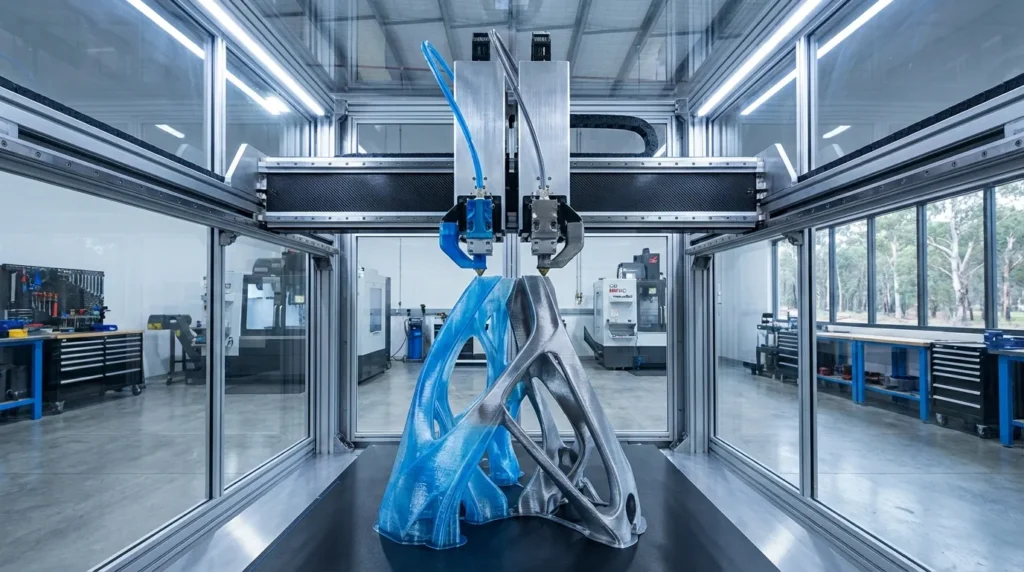
Dual Extrusion 3D Printer Techniques for Multi-Material Printing
In the world of industrial and professional 3D printing, the dual extrusion 3d printer is no longer just a novelty. It is becoming a cornerstone of high-speed, high-precision manufacturing workflows. For Australian engineers, educators, and advanced hobbyists, the ability to integrate multiple materials into a single build is opening doors to more complex designs, faster prototyping, and reduced assembly requirements. Whether you’re producing aerospace tooling, medical devices, or intricate prototypes, mastering advanced dual extrusion 3d printer techniques can dramatically improve both efficiency and quality.
The ability to print with multiple materials in a single build will revolutionize additive manufacturing in 2025.
In this article, we’ll explore the latest developments in dual extrusion 3d printers, practical strategies for multi-material 3D printing, and actionable steps to implement these techniques in Australian manufacturing contexts.
Understanding Dual Extrusion 3D Printer Technology
Dual extrusion 3d printers use two separate extruders, either sharing a single carriage or operating independently, to print with two different filaments during the same job. This setup allows for combinations like rigid engineering plastics with flexible elastomers, or functional thermoplastics with soluble support materials. The benefits go beyond aesthetics; functional properties can be embedded directly into a part, such as impact resistance in targeted zones or chemical resistance in critical surfaces.
Independent Dual Extruder (IDEX) systems, such as those integrated into RatRig V-Core machines, can print mirrored or duplicated parts simultaneously, effectively doubling throughput. In industrial contexts, this is critical for meeting tight deadlines without compromising precision, especially when producing batches of identical components for assembly lines.
Recent advances have reduced nozzle switching times from approximately eight seconds to just two seconds, minimizing downtime and filament waste. AI-driven slicing software is also optimizing toolpaths to reduce purge volumes and improve bonding between dissimilar materials, while predictive algorithms can detect potential adhesion issues before printing begins.
Additionally, manufacturers are now integrating filament monitoring systems that track humidity, diameter consistency, and color accuracy in real time. This ensures that both extruders operate under optimal conditions, which is especially important when combining engineering-grade polymers with specialty filaments.
| Technology | Benefit | Example |
|---|---|---|
| IDEX Dual Extrusion | Parallel part printing | RatRig V-Core |
| Soluble Supports | Complex geometries without manual cleanup | PVA, BVOH |
| Multi-Material Bonding | Improved adhesion between dissimilar polymers | Nylon + TPU |
According to industry reports, dual extrusion 3d printers are gaining traction in aerospace, healthcare, and tooling sectors, where the ability to combine materials streamlines production. With adoption rates projected to grow by over 25% annually, the technology is becoming a standard for advanced manufacturing.
Optimizing Dual Extrusion 3D Printer Workflows for Multi-Material Printing
Implementing multi-material 3D printing isn’t just about hardware; it requires a refined workflow. From filament storage to slicing settings, every step impacts final quality and production efficiency.
First, material compatibility must be assessed. Not all polymers bond well together, and differences in shrinkage or extrusion temperatures can cause warping or delamination. For example, pairing nylon with TPU requires careful temperature control and optimized cooling to ensure proper adhesion, while combining PETG with PVA demands precise moisture control to prevent support degradation during printing.
Second, purge management is critical. Purge towers or wipes are used to clean the nozzle between material changes, but inefficient purging can waste large amounts of filament. AI-driven slicing can minimize purge cycles, reducing waste by up to 30%, and some advanced systems now use “smart purge blocks” that double as functional calibration pieces.
Third, soluble support materials such as PVA or BVOH enable complex designs that would be impossible with single-material setups. Once printed, these supports dissolve in water, eliminating manual post-processing and reducing the risk of damaging delicate parts. This is particularly valuable for intricate internal channels in fluid-handling devices.
Furthermore, workflow optimization includes environmental controls. Maintaining a consistent print chamber temperature prevents warping in multi-material builds, and active humidity regulation in filament storage cabinets extends material shelf life.
In practice, optimizing dual extrusion 3d printer workflows involves iterative testing, calibration, and sometimes hybrid manufacturing approaches. For example, some Australian facilities combine dual extrusion printing with CNC milling to achieve tight tolerances on functional surfaces while leveraging multi-material capabilities for complex geometries. For more on integrating 3D printing with CNC machining, see Exploring Hybrid Manufacturing: Integrating 3D Printing and CNC Systems.
Industrial Applications and Case Studies
Australian manufacturers are leveraging dual extrusion 3d printer technology for applications ranging from aerospace tooling to medical device prototyping. In aerospace, hybrid manufacturing that combines dual extrusion FDM with CNC machining allows production of titanium parts with embedded polymer components for weight reduction, vibration damping, or integrated cable routing channels.
In healthcare, multi-material prints can integrate rigid biocompatible polymers with flexible sections for patient-specific prosthetics. This eliminates the need for multi-stage assembly, reducing turnaround time by days and improving patient comfort through better fit and flexibility.
One notable example involves an industrial tooling company in Melbourne using IDEX systems to print mirrored jigs simultaneously. By producing two identical jigs in one run, they halved production time while maintaining micron-level tolerances, which is critical for precision alignment tools used in automotive manufacturing.
Another case study comes from the marine industry, where dual extrusion is used to create propeller prototypes combining rigid cores with abrasion-resistant outer layers. This allows engineers to test designs in real-world conditions without committing to full metal production runs.
rows={[“Aerospace”,“Hybrid titanium/polymer parts”,“Weight reduction”],[“Healthcare”,“Custom prosthetics”,“Reduced assembly time”],[“Tooling”,“Mirrored jig production”,“50% faster output”]}
caption=“Industrial case studies of dual extrusion in Australia”
/>
These examples illustrate how multi-material 3D printing is reshaping manufacturing by integrating functional and aesthetic properties into single builds. As adoption spreads, more industries are discovering how the technology can reduce supply chain complexity, cut costs, and enable product innovations previously considered impractical.
Technical Challenges and Solutions for Dual Extrusion 3D Printers
Despite its benefits, dual extrusion 3d printers present challenges. Material compatibility remains the most significant issue, particularly when mixing polymers with differing thermal expansion rates. Poor adhesion can lead to delamination or warping, especially in parts with large surface areas where stress concentrates.
Another challenge is print speed. While high-performance dual extrusion heads can reach speeds of 300 mm/s, balancing speed with layer adhesion requires careful tuning of extrusion temperatures, cooling rates, and retraction settings. High-speed printing can introduce stringing or oozing between materials if retraction is not properly configured.
Thermal management is critical, especially for high-performance materials like PEEK or ULTEM. Enclosed print chambers with controlled temperature prevent warping and maintain dimensional accuracy, while active cooling systems can be adjusted per extruder to match material needs. For a detailed breakdown of enclosure setup, see 3D Printer Enclosure Setup for High-Speed FDM Printing.
Maintenance routines must also be adapted. Dual extrusion systems have more moving parts, increasing wear. Regular calibration, nozzle cleaning, and firmware updates, such as integrating Klipper, ensure consistent output. In addition, implementing scheduled lubrication of mechanical components and monitoring stepper motor performance can extend machine lifespan.
Finally, training operators to recognize early signs of material feed issues, such as inconsistent extrusion or color contamination, can prevent costly print failures. A proactive approach to maintenance and monitoring is essential for sustained success in multi-material printing.
Future Trends in Multi-Material Printing
The future of dual extrusion 3d printer technology is being shaped by AI, sustainability, and expanding material options. AI-driven optimization will further reduce waste and improve bonding between materials by dynamically adjusting print parameters mid-build based on sensor feedback. Sustainability efforts will push recyclable and low-carbon filaments to the forefront, especially in regions like Australia that are investing heavily in greener manufacturing initiatives.
Multi-material printing is also expected to play a role in large-format construction printing, where different materials can be used for structural and aesthetic purposes in a single build. Imagine printing an entire building facade with integrated insulation layers and decorative panels, all in one continuous process.
Emerging research is exploring conductive and magnetic filaments for integrated electronics manufacturing. This could allow 3D printers to produce complete functional devices with embedded circuits, sensors, and mechanical components in a single pass.
Industry analysts predict the 3D printing materials market will grow from USD 2.74 billion in 2024 to USD 18.55 billion by 2035, with multi-material capabilities driving much of that growth. As material science advances, expect greater availability of high-performance composites tailored for dual extrusion systems.
Making Advanced Dual Extrusion 3D Printer Techniques Work for You
For Australian engineers, educators, and advanced hobbyists, the adoption of advanced dual extrusion 3d printer techniques offers a competitive edge. By integrating these systems into your workflow, you can reduce assembly steps, expand design possibilities, and accelerate production, ultimately improving both ROI and innovation potential.
Start by selecting an industrial-grade dual extrusion 3d printer that meets your speed, precision, and material compatibility requirements. Consider factors such as build volume, nozzle configuration, and available firmware features. Invest in training for your team to handle material compatibility issues, optimize slicing settings, and troubleshoot common dual extrusion problems.
Implement a robust maintenance schedule to keep your system running at peak performance, including periodic calibration, nozzle inspections, and environmental monitoring for temperature and humidity. Pair this with a documented workflow that standardizes best practices for multi-material projects.
For deeper insights into calibration, visit Ultimate Guide to FDM 3D Printer Calibration Techniques. With the right approach, dual extrusion 3d printers can transform your manufacturing capabilities, delivering complex, high-quality parts faster and more efficiently than ever before.
By staying ahead of trends, leveraging AI-driven optimizations, and mastering these techniques, you’ll position your operation at the forefront of Australia’s advanced manufacturing landscape, ready to meet the challenges of 2025 and beyond.
