
Table of Contents
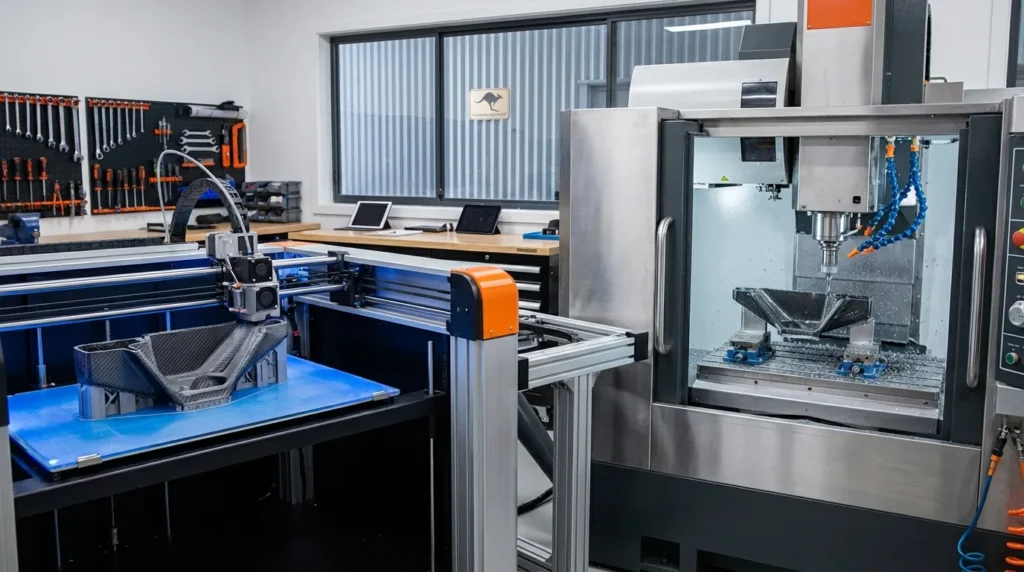
Exploring Hybrid Manufacturing: Integrating 3D Printing and CNC Systems
Hybrid manufacturing is rapidly transforming industrial production. It combines the speed and design freedom of 3D printing with the precision and reliability of CNC machining. For Australian engineers, manufacturers, educators, and advanced hobbyists, this integration is more than a novelty. It is a strategic advantage in meeting high-speed, high-precision demands for prototyping, tooling, and production-grade applications.
The value lies in blending additive and subtractive processes in a single workflow. By doing so, manufacturers reduce lead times and minimize waste. They also achieve tolerances once only possible with dedicated CNC setups. This article explores the practical applications, technical benefits, and future trends of hybrid manufacturing. It focuses on high-performance FDM 3D printing integrated into CNC systems.
Hybrid manufacturing is no longer a niche technology. It’s becoming the default approach for high-value production, where the strengths of additive and subtractive processes combine to deliver unprecedented precision and efficiency.
Understanding the Hybrid Manufacturing Workflow
At its core, hybrid manufacturing merges two distinct processes: additive manufacturing (3D printing) and subtractive manufacturing (CNC machining). Additive manufacturing builds parts layer by layer, enabling complex geometries and lightweight structures. CNC machining removes material to achieve precise dimensions and smooth surface finishes.
In a hybrid workflow, a part might be printed to near-net shape using a high-speed FDM printer. This reduces material waste and speeds up the build. The part is then transferred, sometimes within the same machine, to CNC milling or turning for final finishing. This combination delivers both design freedom and dimensional accuracy. Consequently, intricate internal channels or overhangs can be incorporated without sacrificing fit or finish.
Hybrid systems are valuable in industries like aerospace, automotive, and medical device manufacturing. Tolerances can be as tight as ±0.01 mm. For Australian manufacturers, integrating these systems can help reshore production and reduce reliance on overseas suppliers. Moreover, it enables agile responses to changing market demands.
| Process | Strengths | Limitations |
|---|---|---|
| FDM 3D Printing | Complex shapes, rapid prototyping | Surface finish, tolerances |
| CNC Machining | Precision, material variety | Material waste, tooling time |
| Hybrid | Speed + precision | Higher upfront investment |
By combining these strengths, hybrid manufacturing minimizes the limitations inherent in either process alone. This enables production teams to move from concept to finished product with fewer iterations and reduced overhead.
Technical Advantages for High-Speed FDM and CNC Integration
For professionals seeking high-speed, high-precision results, hybrid manufacturing offers several key advantages:
- Prototyping Efficiency: Rapidly create functional prototypes with near-final tolerances in one workflow. This can reduce development cycles from months to weeks.
- Tooling Production: Produce jigs, fixtures, and molds in engineering-grade thermoplastics. Then finish with CNC for durability and fit. This enables better repeatability in production lines.
- Material Versatility: Handle composites, metals, and high-performance polymers like PEKK and ULTEM. This allows manufacturers to meet diverse requirements without separate workflows.
- Cost Savings: Reduce waste by printing near-net shapes before machining. This can cut material costs by up to 70% and lower energy consumption compared to fully subtractive processes.
The integration of CNC machining and 3D printing allows manufacturers to produce complex parts with tight tolerances directly from digital models. This eliminates multiple steps in the production workflow.
Australian SMEs can benefit from hybrid setups when producing custom tooling for low-volume, high-value runs. High-speed RatRig V-Core systems with IDEX dual extrusion, integrated with CNC workflows, excel here. The ability to print multi-material parts and immediately finish them to spec unlocks efficiencies not possible with standalone systems. Additionally, it enables rapid iteration based on client feedback without costly retooling.
Implementing Hybrid Manufacturing in Industrial Workflows
Transitioning to hybrid manufacturing requires both technical and operational considerations.
- Assess Production Needs: Identify parts that require complex geometries and precise tolerances, such as aerospace brackets or medical tooling.
- Choose Compatible Hardware: Select FDM systems capable of high-speed, high-precision output. Ensure CNC equipment can accommodate printed materials, including composites.
- Integrate Software: Use CAM software that supports hybrid workflows. Verify interoperability between design and manufacturing teams.
- Train Staff: Ensure operators are skilled in both 3D printing and CNC machining. Cross-training improves flexibility and reduces downtime.
- Maintain Equipment: Follow preventive maintenance schedules for both systems to avoid costly failures.
For deeper insights into optimizing FDM output before CNC finishing, see our Ultimate Guide to FDM 3D Printer Calibration Techniques. It covers layer alignment, extrusion control, and thermal management, all crucial for optimal machining results.
Real-World Applications and Case Studies
Hybrid manufacturing is proving its worth in sectors demanding precision and speed:
- Aerospace Tooling: Universities like RMIT collaborate with industry to produce composite tooling using hybrid workflows. This cuts lead times from weeks to days while maintaining aerospace quality standards.
- Automotive Components: Custom fixtures and parts printed in carbon fiber-reinforced nylon, then CNC finished for exact fit, help reduce vehicle assembly times. They also improve ergonomics for workers.
- Medical Devices: Surgical guides printed in biocompatible materials and machined for smoothness ensure patient safety and enhance surgical accuracy.
Australian companies leveraging hybrid setups report gains in turnaround times. For example, a tooling manufacturer reduced production time for complex molds by 60% after implementing hybrid processes. It also improved dimensional consistency across batches.
| Industry | Lead Time Reduction | Cost Savings |
|---|---|---|
| Aerospace | 55% | $18,000 annually |
| Automotive | 60% | $12,500 annually |
| Medical | 48% | $9,700 annually |
These examples highlight the tangible benefits of integrating high-speed FDM printing with CNC machining. They show how hybrid workflows deliver economic and performance advantages in demanding environments.
Advanced Considerations and Future Trends
Looking ahead, hybrid manufacturing is set to become more efficient thanks to AI-driven optimization. Machine learning algorithms fine-tune print parameters and CNC toolpaths to minimize cycle times. They also improve surface quality by adapting to each job’s specific material and geometry.
Large-scale hybrid machines capable of switching between laser metal deposition and milling in a single setup are becoming more accessible. For Australian manufacturers, this means producing large parts locally with minimal supply chain risk. It also allows quick responses to urgent defense or infrastructure projects.
Sustainability is driving adoption. Hybrid workflows generate less scrap material compared to subtractive-only processes. Furthermore, integrating recycled feedstock into the additive stage offers new pathways to circular manufacturing models.
Integrating Hybrid Systems with Multi-Material Printing
Combining hybrid manufacturing with multi-material capabilities, such as IDEX dual extrusion, opens more possibilities. Imagine printing a component with a rigid core and flexible outer layer. Then CNC machine precise interfaces to ensure perfect assembly with mating parts.
This approach is effective in producing parts with embedded seals, conductive tracks, or soft-touch surfaces. These are difficult to achieve with traditional manufacturing alone. It also allows engineers to consolidate multiple components into a single printed-and-machined part. Consequently, assembly steps and potential points of failure are reduced.
For professionals interested in mastering multi-material workflows with Klipper firmware integration, our Mastering Multi-Material 3D Printing with IDEX and Klipper guide offers valuable insights. It covers calibration, extrusion synchronization, and hybrid finishing techniques.
This multi-material hybrid approach enables production of complex assemblies in fewer steps. Ultimately, it increases throughput without sacrificing quality and opens new opportunities for product innovation.
Building Your Success with Hybrid Manufacturing
Hybrid manufacturing is not just about combining machines. It is about redefining workflows to achieve unmatched speed, precision, and flexibility. Whether you are an industrial engineer seeking tighter tolerances, a manufacturer aiming to reduce lead times, or an educator preparing students for future industry demands, integrating high-speed FDM and CNC processes can be transformative.
Start by evaluating your current production bottlenecks. Identify parts that could benefit from additive design freedom and CNC finishing accuracy. Prioritize those projects for hybrid integration. Invest in compatible hardware and software, and train your team to operate seamlessly across both domains.
For Australian manufacturers, embracing hybrid manufacturing can mean faster turnaround, reduced costs, and greater independence from global supply chain disruptions. With advancements in materials, machine capabilities, and AI-driven optimization, the potential is growing. Early adopters are already seeing measurable competitive advantages.
By taking deliberate steps now, you position yourself to lead in a future where hybrid workflows are standard for high-value production. This ensures your business remains agile, innovative, and resilient in an evolving industrial landscape.
