
Table of Contents
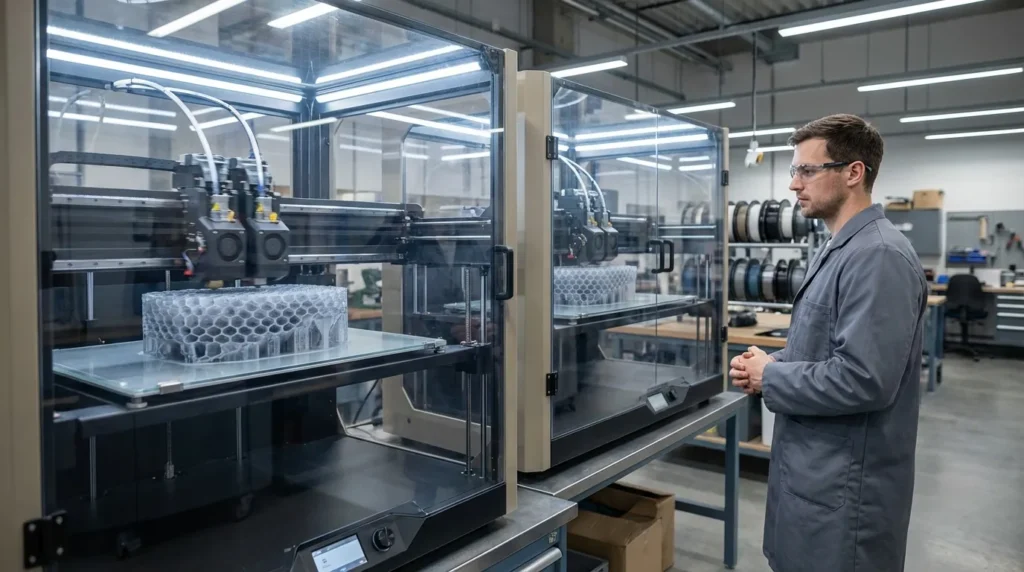
3D Printing Trends 2026: Key Technologies and Insights
3D printing is no longer just a quick way to spin up prototypes. In everyday production, it shows up where work actually happens, and that’s easy to notice if you’re involved in manufacturing. Looking ahead to 3D printing trends 2026 and the years after, the pace of change often feels faster than it used to. Machines keep getting quicker, parts handle load better, and workflows feel more connected and easier to manage (which helps on busy days). Expectations have risen right along with this shift, especially as these tools move from test benches onto the shop floor.
For Australian manufacturers, this change matters in practical ways. Cutting lead times through local production can steady supply chains by avoiding overseas delays (and fewer surprises). With more hands‑on control over quality and design choices, teams can respond quickly when changes are needed, like mid‑project. Industrial FDM 3D printing sits at the centre of this move, especially for tooling, jigs, fixtures, and short‑run end‑use parts (used directly in production), often right when production needs them.
This article looks at the most important 3D printing trends for 2026, focusing on where additive manufacturing is heading and how high‑speed, high‑precision FDM fits into real production work as the industry matures day to day, such as updating a fixture overnight to keep a line moving.
Industrial Additive Manufacturing Moves Into Full Production
What’s catching attention in additive manufacturing isn’t hype anymore. It’s the quiet shift in how the tech is used day to day. Industrial 3D printing is moving past one-off prototypes and into regular production runs, the kind that repeat week after week. Real work, not test pieces. You can often see this in revenue data, which points to steady growth and a clear move toward industrial systems that sit on factory floors instead of demo labs.
| Metric | Value | Year |
|---|---|---|
| Global additive manufacturing revenue | USD 24.2 billion | 2025 |
| Year-on-year market growth | 10.9% | 2025 |
| Industrial printer market size | USD 20.8 billion | 2026 |
That trend changes how companies think. The numbers suggest less hands-on experimenting and more spending on machines they can rely on every day, which probably feels familiar during equipment planning. Priorities shift fast: consistent parts matter, uptime matters, and understanding real part cost becomes important once volumes rise. There’s often little room left for guessing.
Additive manufacturing is no longer advancing on a single, uniform growth curve. What we see in Wohlers Report 2026 is an industry adjusting to tighter capital conditions, more selective investment, and higher expectations for utilisation and return.
For industrial FDM users, expectations rise with this shift. Printers need to act like production assets, not lab tools, a real step forward. That means rigid builds, motion that stays accurate over time, and electronics that handle long runs without drifting. In my view, this is often where industrial platforms start to pull away from typical desktop machines.
High-Speed FDM and 3D Printing Trends 2026 in Production
High-speed 3D printing used to mean taking a quality hit, and most shops just worked around it. That idea is fading. By 2026, fast FDM is expected to feel normal on the factory floor, not like a flashy trade‑show demo. Speed alone isn’t the focus anymore. What matters is how that speed is achieved, since most teams care more about getting the same part every time than chasing top numbers.
The real change is in the hardware and control systems doing the quiet work. Stiffer frames, linear rails, multi‑motor setups, and well‑tuned firmware handle the details that actually matter. The focus has moved to tighter motion control and smarter toolpaths, with less flex overall. This setup often allows higher acceleration while layers stay clean and dimensions stay close to the CAD model instead of drifting during a print. That’s where the shift really shows.
Klipper firmware plays a big part here. By moving calculations off the printer and allowing better motion tuning, it lets engineers run faster without accuracy falling apart. With proper calibration, which many shops still skip, cycle times drop and parts stay consistent from one run to the next. You notice it right away.
In production, speed really means throughput. Printing jigs overnight instead of waiting all weekend changes schedules and deadlines, and it makes print farms more realistic when identical machines run the same tested profiles day after day.
IDEX and Multi-Material Printing Drive Real Efficiency
On busy shop floors, the kind that rarely slow down, IDEX 3D printers stand out because they keep machines working. Dual extrusion here isn’t just about color changes or simple supports anymore. Independent toolheads often let teams print two parts at the same time, or handle true multi‑material jobs without clumsy workarounds. That lack of tradeoffs makes a clear difference, and it helps explain why these systems appear so often in production.
A common setup has one toolhead printing a carbon‑fibre nylon body, while the other handles soluble support or a flexible interface layer, which turns out to be useful more often than people expect. This mix usually cuts post‑processing time, improves surface finish, and makes cleanup easier. In tooling work, that often leads to better fit and longer tool life.
For me, 2026 marks the tipping point: the year AM finally breaks free from its prototyping roots and establishes itself as a practical, scalable production technology across multiple mainstream industries.
The main catch is calibration. Treating IDEX like a standard dual extruder is a common mistake. Toolhead alignment, temperature balance, and material handling all need extra attention, and it’s easy to rush. Miss a step and the results show. When everything is dialed in, though, IDEX systems often reduce waste, increase machine use, and lower cost per part in very practical ways.
Automation, AI, and Closed-Loop Control Take Over Routine Tasks
The biggest shift is how much less hands-on time machines need today. As additive manufacturing scales up, manual setup often turns into a bottleneck, and that slowdown has pushed systems toward automation, likely later than it should have. By 2026, many industrial FDM machines are expected to rely on sensors and software for tasks that once needed an operator watching every step. To me, that change felt unavoidable.
Automatic bed leveling, paired with flow and error monitoring, is quickly becoming standard. AI-based tools can catch extrusion problems early and pause a print before it becomes a mess, saving a lot of frustration. Over time, this data helps predict maintenance needs and keeps machines running smoothly, with much less guesswork.
By 2026, the 3D printing industry will definitely enter a phase of industrial implementation and real scaling.
For manufacturers, the payoff is lower risk. Fewer failed prints usually mean less wasted material and more trust in unattended runs. In Australia, where labor costs are higher, this makes industrial 3D printing a realistic production option, especially for shops running long jobs overnight.
Advanced FDM Materials Expand What Is Possible
What’s changing things isn’t just the hardware. Materials often matter more than machines, and that’s clearly the case here. The next phase of 3D printing is showing up through tougher, more stable filaments instead of flashy new systems. Carbon‑fibre reinforced nylons and other high‑performance blends are now common in FDM, including flame‑retardant options, which is a big deal for factory use.
This shift explains why printed parts are moving into jobs once saved for machined components. On busy shop floors, especially for tooling and fixtures (not just test benches), these materials can handle heat, stay stiff, and resist chemicals. They’re no longer stuck in labs, and that shows in everyday production work.
Another change is traceability. Paperwork matters here. Industrial users usually want consistent, well‑documented material batches so quality systems stay intact and additive manufacturing fits regulated environments.
Sustainability also factors in, though it’s often a trade‑off. Recycled and lower‑impact filaments appear in non‑critical tooling, while performance still drives choices and material efficiency begins to shape planning.
Putting 3D Printing Trends 2026 to Work in Australian Manufacturing
What matters most is when new technology actually reaches the shop floor. Knowing where things are heading only helps once the tools can handle real workloads, not theory (that’s often where plans fall apart). For industrial engineers and educators, practical decisions usually shape the result. One useful option is choosing high‑speed FDM printers based on machine rigidity and motion behavior as a whole system, with solid firmware support included, instead of chasing headline specs alone. That approach often keeps performance steady, especially during long production runs.
Print farms are appearing more often across Australian manufacturing, and there’s a clear reason. Running several identical machines with tested profiles is often easier to manage than relying on one oversized system meant to do everything (and often struggling). In my view, this means fewer surprises. It also helps keep production moving while reducing maintenance strain.
Training still matters, a lot. Clear calibration steps and sensible routines for material handling and upkeep, including storage habits people actually stick to, usually protect accuracy over long print runs and cut down on avoidable rework.
Looking ahead, 3D printing trends 2026 point to maturity. Additive manufacturing is settling into a steady role as a reliable production tool, not hype, with gains that are real and measurable on the factory floor.
Now It Is Your Turn to Build for the Future
What matters most in the future of 3D printing isn’t chasing every new feature that appears. It’s about tools that hold up on the factory floor, not just in demos, where real production runs happen every day. High-speed industrial FDM, IDEX systems, advanced materials, and smart automation all point one direction: reliable output as volumes grow and schedules tighten.
Speed helps, but bigger gains often come from precision and repeatability, like getting the same results from job to job, and from how these machines fit into an existing workflow. One practical approach is to treat additive manufacturing like any other production process, where results are consistent and surprises are fewer.
The next few years reward people who prepare early. For Australian manufacturers and educators, that means choosing systems that keep performing across full production runs.
