
Table of Contents
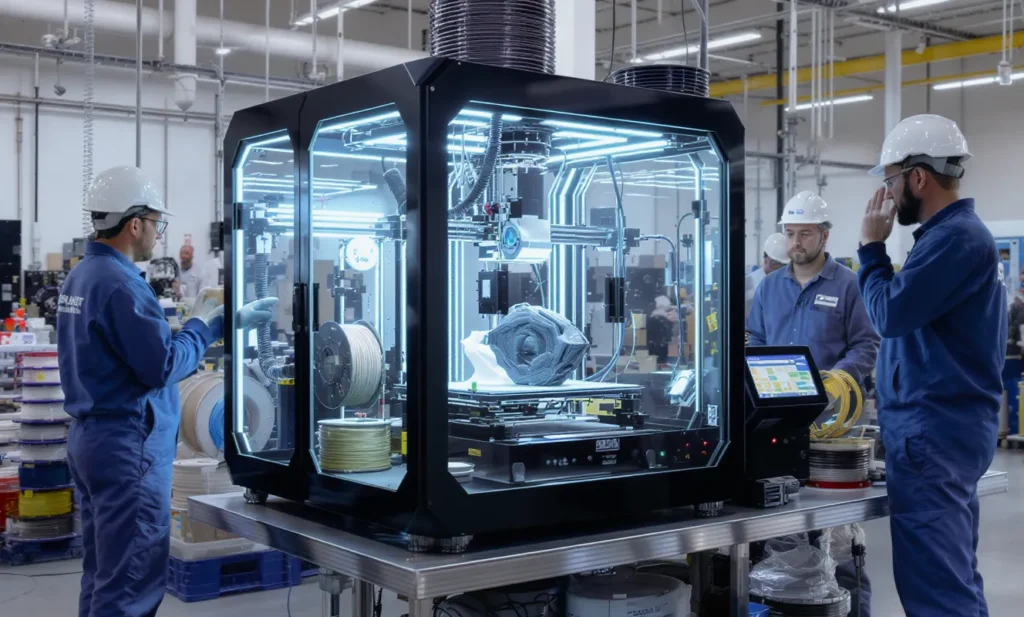
3D Printer Enclosure Setup for High-Speed FDM Printing
In 2025, high-speed FDM 3D printing has evolved beyond hobbyist setups into a core capability for industrial engineers, manufacturing professionals, and advanced technical educators in Australia. Consequently, the demand for precision prototypes, production-grade tooling, and rapid iteration cycles means that print quality and speed are no longer a trade-off — they must coexist. This is where a well-designed, temperature-controlled 3D printer enclosure becomes critical for success.
A properly engineered 3D printer enclosure not only stabilizes print conditions but also allows for continuous operation at higher speeds without sacrificing mechanical integrity. Moreover, for professionals working with advanced materials like PEEK, carbon fiber-reinforced polymers, or composites, an enclosure is no longer optional — it is an operational necessity.
A temperature-controlled enclosure is not just about improving print quality, it’s about enabling the printer to maintain optimal conditions for high-speed operation without sacrificing mechanical integrity.
Why a 3D Printer Enclosure Matters for High-Speed FDM Printing
High-speed printing amplifies mechanical stresses, temperature fluctuations, and environmental variables that can cause defects. Without a 3D printer enclosure, temperature swings can lead to warping, layer separation, or inconsistent extrusion. Therefore, for industrial printers, especially RatRig V-Core systems integrated with Klipper firmware, the enclosure is part of the performance equation.
An enclosure essentially acts as a microclimate for your print, shielding the process from drafts, dust, and ambient temperature changes that can destabilize extrusion. For example, when printing ABS at high speeds, even a minor 5°C temperature drop can cause layer adhesion issues. Furthermore, enclosures with sealed seams and thermally efficient materials ensure that the print environment remains constant, allowing for repeatable results even in varied workshop conditions.
According to Zeal 3D Printing, Australian manufacturers in 2025 are increasingly integrating enclosures with active air filtration and automated thermal regulation to meet safety standards while improving high-speed FDM performance. This trend aligns with workplace safety regulations requiring enclosed systems with HEPA filtration for polymer-based high-speed printing in industrial environments. Additionally, studies show that enclosed, filtered printing environments can reduce airborne ultrafine particle emissions by up to 95%, making them safer for continuous operation.
| Factor | Impact on High-Speed Printing | 2025 Trend |
|---|---|---|
| Thermal Stability | Prevents layer delamination | PID-controlled multi-zone heating |
| Air Quality Control | Ensures safe operation | HEPA + activated carbon filtration |
| Structural Rigidity | Reduces vibration | Composite or steel frame panels |
As shown in the table above, each design consideration directly impacts print speed and quality. For example, multi-zone heating systems allow different areas of the chamber to be maintained at optimal temperatures for specific materials. Moreover, structural rigidity plays a role in maintaining dimensional accuracy, as even minor vibrations can cause visible artifacts at high print speeds.
Designing Your 3D Printer Enclosure for Temperature-Controlled Printing
Temperature-controlled printing is the backbone of high-speed FDM performance. Modern enclosures use PID controllers to maintain precise chamber temperatures, often with multiple sensors to detect and adjust for fluctuations. Specifically, for high-performance materials, chamber temperatures can reach up to 250°C.
Key elements to consider:
- Insulated Panels: Reduce heat loss and stabilize temperature.
- Multi-Zone Heating: Adjust specific zones for different materials.
- Humidity Control: Prevent filament degradation during long prints.
In practice, this means selecting insulation materials with high R-values that can withstand prolonged exposure to elevated temperatures without degrading or off-gassing. Furthermore, multi-zone heating can be particularly beneficial when printing complex assemblies that use multiple material types. Humidity control, often overlooked, is vital in Australia’s varied climates. Therefore, integrated dehumidifiers or sealed filament storage systems can prevent moisture uptake, which otherwise leads to brittle prints and extrusion inconsistencies.
These systems also impact energy efficiency. Additionally, advanced enclosures in 2025 can reduce energy consumption by up to 30% compared to older models while maintaining high-speed print quality. Ultimately, energy-efficient designs lower operational costs and align with sustainability initiatives increasingly adopted by Australian manufacturers.
Step-by-Step Guide to Setting Up Your 3D Printer Enclosure
- Select the Right Frame: For RatRig V-Core or similar systems, choose an enclosure frame that matches the printer footprint and allows for future expansion.
- Install Thermal Insulation: Use high-temperature-resistant insulation to prevent heat loss.
- Integrate Heating Elements: Position heaters strategically to ensure even temperature distribution.
- Add Filtration Systems: Install HEPA and activated carbon filters to meet safety requirements.
- Configure Sensors and Controllers: Connect temperature and humidity sensors to a PID controller for automated regulation.
When selecting a frame, consider materials like anodized aluminum or powder-coated steel for durability. In addition, for insulation, ceramic fiber blankets or polyisocyanurate panels can offer exceptional thermal performance. Heating elements should be paired with circulation fans to eliminate hotspots, while filtration units should be easily accessible for quick filter changes. Calibration of sensors is critical — a misreading of just a few degrees can lead to inconsistent results at high speeds.
For detailed thermal management strategies, see 3D Printer Thermal Management for Industrial 3D Printing.
Case Study: Aerospace Prototyping in a 3D Printer Enclosure
In aerospace applications, hybrid manufacturing setups combine high-speed FDM printing with CNC machining inside temperature-controlled 3D printer enclosures. Consequently, this allows for rapid production of titanium and composite parts with precision tolerances.
| Application | Material | Chamber Temp |
|---|---|---|
| Aerospace tooling | Carbon fiber-reinforced polymer | 90°C |
| Composite prototyping | PEEK | 250°C |
As illustrated, different materials demand vastly different thermal environments. Without precise control, high-speed printing can result in defects that render parts unusable. Moreover, in one documented case, an Australian aerospace supplier reduced their prototyping cycle time by 45% after upgrading to a fully enclosed, actively heated system.
Common 3D Printer Enclosure Mistakes to Avoid
- Underestimating Heat Loss: Poor insulation leads to unstable chamber temperatures.
- Ignoring Filtration Needs: High-speed printing can release harmful particulates.
- Overlooking Maintenance: Filters and heaters require regular upkeep.
Another common pitfall is neglecting cable and component heat resistance. Consequently, internal electronics, wiring, and stepper motors must be rated for elevated temperatures. Operators also sometimes overlook airflow patterns. Therefore, improperly positioned fans can create turbulence that affects print quality. Establishing a maintenance schedule ensures performance over years of service.
For maintenance strategies, refer to Industrial 3D Printer Maintenance for Continuous Operation.
Industry Trends and Future Outlook
The Australian 3D printing market is projected to grow from USD 672.3 million in 2025 to USD 2,773.3 million by 2034, with a 17.05% CAGR. Furthermore, industrial adoption is being driven by aerospace, automotive, and healthcare sectors.
Future enclosure designs will likely integrate:
- AI-driven thermal regulation
- Automated material changeover systems
- Real-time environmental monitoring
We can expect to see 3D printer enclosures with predictive analytics that adjust heating and airflow before conditions drift out of spec. Additionally, integration with MES will allow for full traceability of environmental conditions for each part produced.
Implementation Tools and Resources
Raven 3D Tech offers industrial-grade 3D printer enclosures and integration solutions for high-speed FDM systems. Moreover, combining Klipper firmware with modular enclosure designs allows engineers to fine-tune performance.
Additional tools include infrared thermal cameras for validating enclosure performance, vibration sensors for detecting structural resonance, and cloud-connected controllers for remote monitoring. Furthermore, open-source software communities provide firmware configurations optimized for enclosure use.
For filament-specific strategies, see Complete Guide to 3D Printing Filaments: Selection, Storage, and Handling for Precision Results.
Building Your Success with a 3D Printer Enclosure
Setting up a 3D printer enclosure for high-speed FDM printing in 2025 is about engineering control into every variable. From temperature stability to air quality, each component influences output quality and operational safety.
Success comes from approaching enclosure design as part of a complete production ecosystem. Therefore, aligning it with material handling, printer calibration, and workflow planning is essential. Ultimately, by understanding the technical demands of high-speed printing, leveraging modern enclosure technologies, and integrating best practices, you can transform your FDM system into a reliable, production-grade asset.
The path forward is clear: invest in precision, prioritize safety, and embrace the tools that make high-speed FDM printing not just possible, but profitable. Consequently, you position your business to meet growing market demands with speed, repeatability, and confidence — qualities that define competitive advantage in the decade ahead.
